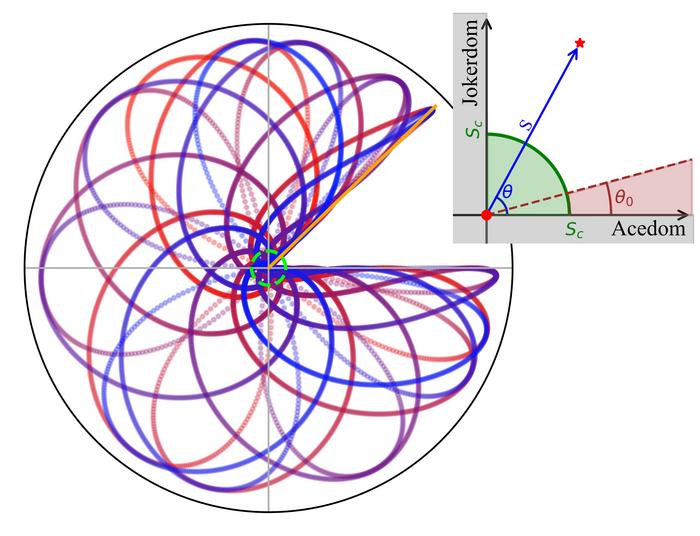

Wild Cards: Bridging Fiction and Physics Through Viral Dynamics
Washington — In a remarkable intersection of literature and science, physicist Ian Tregillis, known for his contributions to the anthology series Wild Cards, has forged a path between the realms of speculative fiction and theoretical physics. His latest endeavor, jointly articulated with celebrated author George R.R. Martin, addresses the scientific underpinnings of the series’ viral infection narratives. This initiative has culminated in a groundbreaking paper published in the esteemed American Journal of Physics, examining the dynamics of a fictional alien virus and its mutations in the human genome.
The Wild Cards series has captivated audiences for decades, weaving intricate storylines where a virulent alien pathogen transforms humans into extraordinary beings known as “Aces” or “Jokers.” The series explores the existential ramifications of this viral infection, among other themes, while engaging readers with a rich tapestry of character-driven narratives. Tregillis’s foray into the physics of this fictional universe came as an extension of a series of blog entries on the Wild Cards website that dissected its scientific implications. What started as casual contemplation soon transformed into a serious inquiry that would lead to rigorous equations and theoretical models.
At the core of Tregillis’s research is a Lagrangian framework that provides a robust methodology to understand the dynamics governing the viral interactions among the infected. The Lagrangian approach, a rich area of theoretical physics, allows researchers to analyze systems’ behavior through energy dynamics rather than forces. This perspective is not only central to classical mechanics but also extends into quantum mechanics and general relativity, making it an exceedingly potent tool when translating the abstract intricacies of fiction into tangible scientific discourse.
In his exploration, Tregillis drew on various mathematical models, initially experimenting with fractal structures and thermodynamic analogies, which echoed the chaotic nature of viral mutations and their unintended consequences on human genetics. His ability to distill complex ideas into a coherent theoretical framework signifies a pioneering effort to marry literary creativity with scientific rigor. The resulting Lagrangian model encapsulates the time-averaged behavior of the viral system, generating statistical distributions of outcomes that align with the narrative arcs present in the Wild Cards universe.
Perhaps one of the most striking aspects of this research is Tregillis’s acknowledgment that while the physical model of the Wild Card virus mirrors real-world concepts in virology and genetics, it is primarily a narrative device. He emphasizes that the essence of storytelling lies in character development and interpersonal dynamics rather than strict adherence to scientific protocol. The fictional virus serves as a catalyst for exploring human nature, ambitions, and the myriad challenges that arise in a world transformed by alien technology.
Co-author George R.R. Martin’s involvement adds an intriguing layer to the research, merging his experience as a renowned author with scientific discovery. By co-authoring this paper, Martin steps into an academic sphere, marking his debut as a contributor to peer-reviewed scientific literature. This venture exemplifies the fluidity between genres and demonstrates how science fiction can inspire meaningful scientific inquiry.
The paper, titled “Ergodic Lagrangian dynamics in a superhero universe,” elucidates not only the mechanics of the fictional virus but also its implications for educational purposes. By framing complex scientific principles within the context of popular narratives, Tregillis and Martin hope to engage a broader audience and stimulate interest in physics as well as storytelling. The ability to transform abstract scientific concepts into relatable content serves to educate without alienating those who might otherwise shy away from physics.
Moreover, this collaboration illustrates the potential for interdisciplinary dialogues to foster new ways of thinking about both literature and science. In an era where science communication is vital for public understanding of crucial issues such as epidemiology and genetic engineering, the synergy between a physicist and a novelist exemplifies a successful model for demystifying science. Their work aims to underscore the importance of scientific literacy in navigating contemporary societal challenges.
As Tregillis and Martin continue to explore the wide-ranging consequences of the Wild Card virus, they inspire future endeavors that seek to merge the art of storytelling with scientific exploration. The chapter they have opened not only promotes a novel understanding of viral dynamics but also encourages a holistic learning approach that nurtures imagination while cultivating intellectual curiosity. In doing so, they exemplify how creative storytelling can illuminate and promote complex scientific ideas to audiences worldwide.
As the article makes its debut in the American Journal of Physics on January 23, 2025, it promises to be a pivotal moment for both authors and for anyone intrigued by the fusion of science and fiction. Readers are invited to examine the playful yet profound intersection of these worlds through the lens of viral dynamics and human potential. Moving forward, the continuing dialogue between these disciplines could yield further insights into both the fictional universes we create and the real-world phenomena we strive to understand.
Subject of Research: The dynamics of viral behavior in the Wild Cards universe through a Lagrangian framework.
Article Title: Ergodic Lagrangian dynamics in a superhero universe
News Publication Date: January 23, 2025
Web References: https://doi.org/10.1119/5.0228859
References: N/A
Image Credits: Ian Tregillis
Keywords: Physics, Virology, Viral Dynamics, Genetics, Science Fiction, Lagrangian Mechanics, Storytelling, Science Communication, Interdisciplinary Research, Education.
Tags: Okay