Credit: Courtesy Rall Walsh
A new, freely available software tool developed by Stanford scientists will enable energy companies and regulatory agencies to calculate the probability of triggering manmade earthquakes from wastewater injection and other activities associated with oil and gas production.
"Faults are everywhere in the Earth's crust, so you can't avoid them. Fortunately, the majority of them are not active and pose no hazard to the public. The trick is to identify which faults are likely to be problematic, and that's what our tool does," said Mark Zoback, professor of geophysics at Stanford's School of Earth, Energy & Environmental Sciences. Zoback developed the approach with his graduate student Rall Walsh.
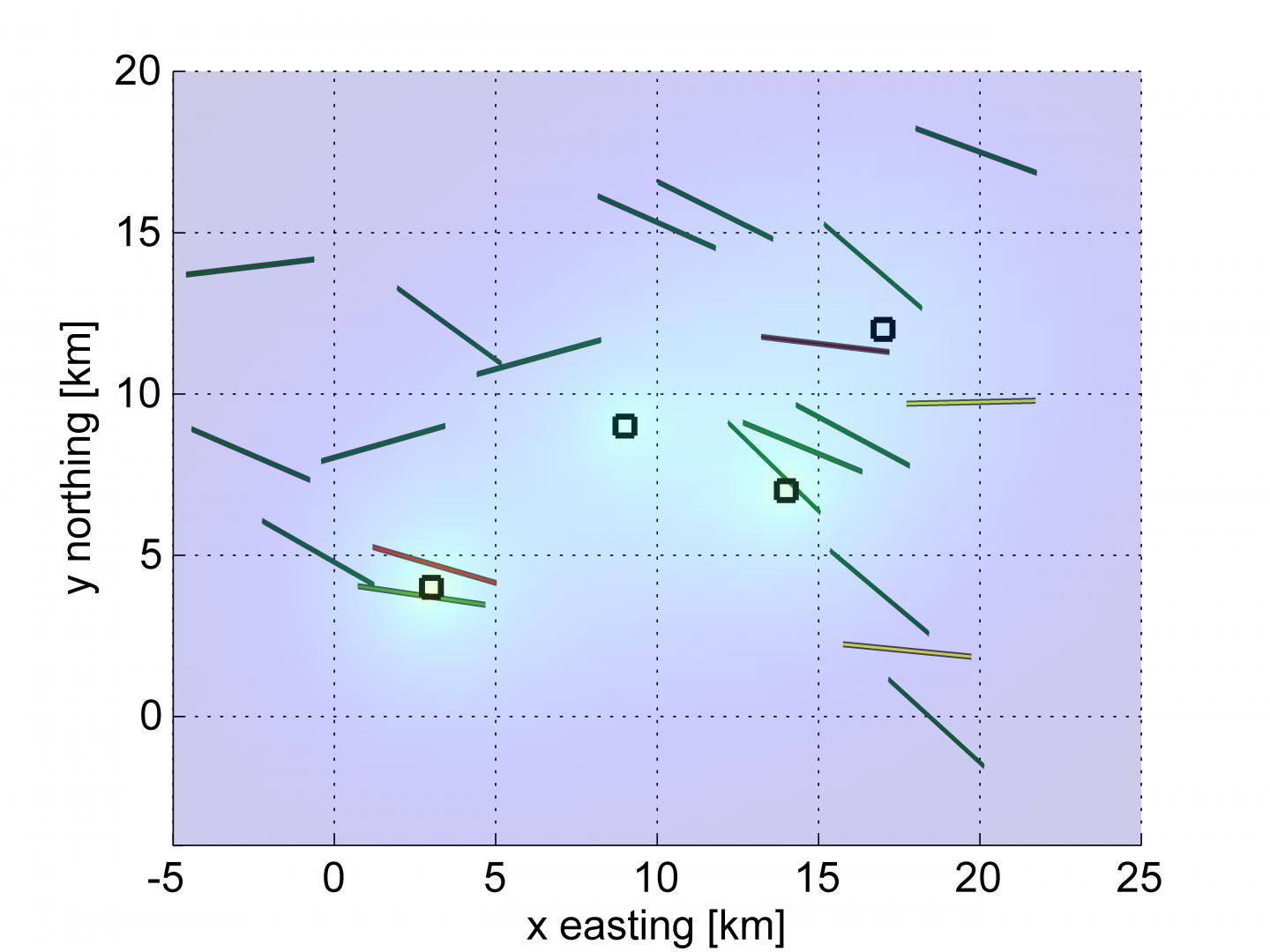
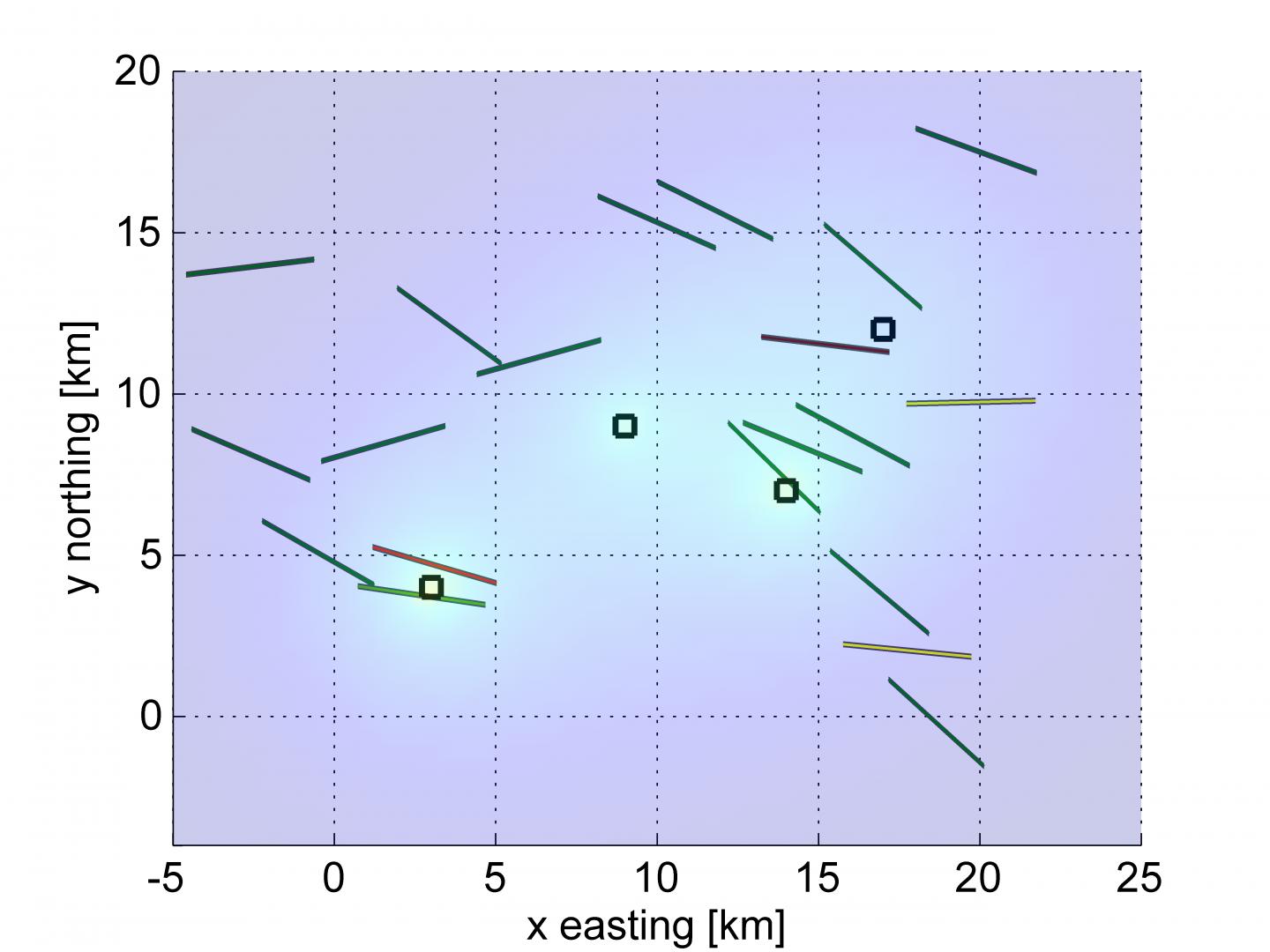
Four wells increase pressure in nearby faults. If a fault is stable, it is green. If a fault is pushed toward slipping, it is colored yellow or red depending on how sensitive it is, how much pressure is put on it, operational uncertainties and the tolerance of the operator.
Oil and gas operations can generate significant quantities of "produced water" – brackish water that needs to be disposed of through deep injection to protect drinking water. Energy companies also dispose of water that flows back after hydraulic fracturing in the same way. This process can increase pore pressure – the pressure of groundwater trapped within the tiny spaces inside rocks in the subsurface – which, in turn, increases the pressure on nearby faults, causing them to slip and release seismic energy in the form of earthquakes.
The Fault Slip Potential (FSP) tool that Walsh and Zoback developed uses three key pieces of information to help determine the probability of a fault being pushed to slip. The first is how much wastewater injection will increase pore pressure at a site. The second is knowledge of the stresses acting in the earth. This information is obtained from monitoring earthquakes or already drilled wells in the area. The final piece of information is knowledge of pre-existing faults in the area. Such information typically comes from data collected by oil and gas companies as they explore for new resources.
Testing the tool
Zoback and Walsh have started testing their FSP tool in Oklahoma, which has experienced a sharp rise in the number of earthquakes since 2009, due largely to wastewater injection operations. Their analysis suggests that some wastewater injection wells in Oklahoma were unwittingly placed near stressed faults already primed to slip.
"Our tool provides a quantitative probabilistic approach for identifying at-risk faults so that they can be avoided," Walsh said. "Our aim is to make using this tool the first thing that's done before an injection well is drilled."
Regulators could also use the tool to identify areas where proposed injection activities could prove problematic so that enhanced monitoring efforts can be implemented.
The FSP software program will be made freely available for download at SCITS.stanford.edu on March 2.
Funding for the development of the software was provided by the Stanford Center for Induced and Triggered Seismicity (SCITS), an industrial affiliates program involving 10 Stanford professors. The Fault Slip Potential software was developed in collaboration with ExxonMobil.
Zoback is also a senior fellow at Stanford's Precourt Institute for Energy, an affiliate of the Stanford Woods Institute for the Environment and the director of the Stanford Natural Gas Initiative.
###
Media Contact
Ker Than
[email protected]
650-723-9820
@stanfordearth
https://earth.stanford.edu/
############
Story Source: Materials provided by Scienmag