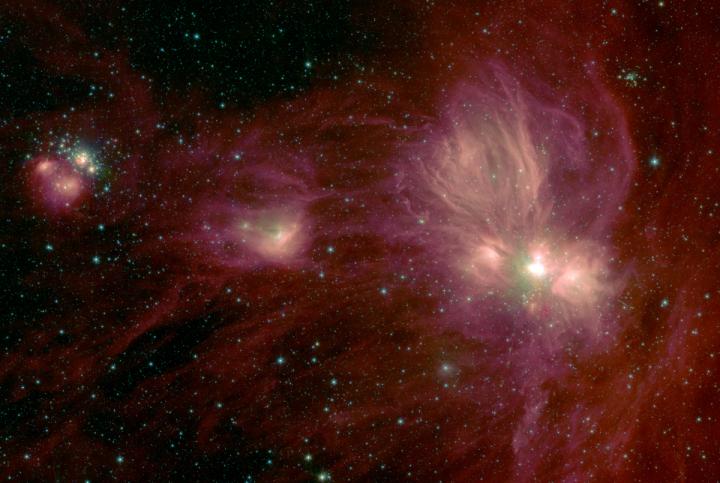
Credit: UMass Amherst/ Robert Gutermuth
AMHERST, Mass. – University of Massachusetts Amherst astrophysicist Stella Offner, who has received a five-year, $429,000 faculty early career development (CAREER) grant from National Science Foundation (NSF), plans to use it not only to study how stars are born, but also to develop interactive online astronomy "tours" to enhance K-12 science education in local schools.
The CAREER grant is NSF's most prestigious award to junior faculty who exemplify the role of teacher-scholars through outstanding research, excellent education and integrating education and research with their institution's mission.
Offner says she hopes to develop a better understanding of two fundamental questions in star formation, that is, how stars obtain their masses and how stars interact with their birth environments. Her team will perform computer simulations of forming star clusters and test different theories for the origin of star masses.
She says, "This is an important astrophysics problem because a star's mass determines how long it will live, whether it could host planets and how it will eventually die."
Offner will use the simulations to produce models to compare directly to telescope observations of star-forming regions in the Milky Way galaxy. "From small stars all the way to huge ones that are a hundred times the mass of our sun, the same physics is at work, but we do not know how it produces such a broad range of different masses," she notes.
"Many astronomers are trying to measure the distribution of stars in distant, old galaxies by looking at their total light, but we can't interpret that until we understand the distribution in the local universe," she adds. Within galaxies, stars are born in cold clouds of gas tens to hundreds of light years across, which collapse to form groups of stars that can have planets.
Factors such as gas density, metal content, outflow feedback and radiation from young stars are believed to play a role in star formation. Offner will perform computer simulations to figure out how a few basic rules of physics interact with these and other variables to form stars of such different sizes and qualities. She works closely with astronomers who observe star-forming regions to design such simulations.
Using new data from this work, Offner plans to have her undergraduate astronomy students create tours about stars and planets using the public software World Wide Telescope (WWT), which makes actual astronomy data available to any user around the globe. "Astronomers rely on public support for our research," she says. "so we feel a strong obligation to share our exciting new discoveries with the public."
The WWT program is easy to use and allows astronomy data to be explored by everyone, the astrophysicist says. In addition to planet and star tours, she will create interactive online astronomy labs for girls in the Eureka! program held on the UMass Amherst campus each summer. "I hope to find local teachers who are interested in using these labs in their classrooms as well," Offner says.
###
Media Contact
Daniel Fitzgibbons
[email protected]
413-545-0444
@umassscience
http://www.umass.edu
############
Story Source: Materials provided by Scienmag