
In a remarkable advancement within the realm of molecular biology, a team of researchers has successfully illustrated the dynamic nature of ribosomal translation within cellular contexts, laying groundwork that promises profound insights into the mechanics of protein synthesis essential for life. This groundbreaking work, spearheaded by Professor ZHANG Xinzheng at the Institute of Biophysics, Chinese Academy of Sciences, has harnessed the cutting-edge technology of cryo-electron microscopy (cryo-EM) alongside their innovative software, GisSPA. The result is a revelation into the intricate, near-atomic resolution details of ribosome behavior during translation in Saccharomyces cerevisiae, commonly known as Brewer’s yeast.
The ribosome acts as a cellular machinery translating genetic information from messenger RNA (mRNA) into functional proteins. This process is paramount to all biological organisms, underpinning cellular function, metabolic regulation, and even the development of various diseases. Understanding ribosomal translation in detail could unlock keys to manipulating these processes for therapeutic ends. Achieving this level of understanding, however, has long posed a significant challenge due to the ribosome’s complex nature and the difficulties inherent in capturing its dynamic conformational states.
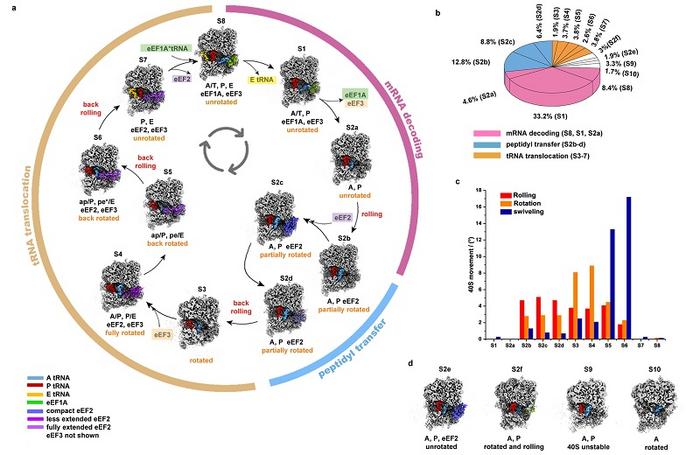
The researchers’ study marks a seminal moment by providing detailed measurements that elucidate the movement of the small subunit (SSU) of the ribosome throughout the translation process. One fascinating observation made was the periodic involvement of three key elongation factors—eEF1A, eEF2, and eEF3—each playing critical roles in the translation cycle, as they bind and subsequently dissociate from the ribosome. Such detailed examination of these molecular interactions reveals not only their timing but also the conformational changes that occur, thereby enriching our understanding of ribosomal mechanics during protein synthesis.
Interestingly, the study was able to capture the compact conformation of eEF2 during the all-important peptidyl transfer reaction. This finding is fundamentally vital as it highlights how eEF2 can stabilize the ribosomal context necessary for optimal function during this key step of translation. Additionally, observations of eEF2 in less extended forms during initial translocation stages provide valuable insights into how its structural adaptations facilitate distinct phases of translation.
The identification of the ribosome in its fully rotated state, bound to the open form of eEF3, further supports the complexity of ribosomal dynamics. The research illustrates that binding events are not merely passive but are accompanied by coordinated movements of ribosomal subunits, including head swiveling and body rotation. This comprehensive view challenges prior understanding and posits that ribosomes are not static entities but instead operate within a dynamic framework that reflects their functional roles.
Furthermore, the work tackles the notion of biological activity being constrained to singular conformations. Instead, it underscores an inherent variability in ribosome structure that corresponds with its functional cycles. Such multilayered dynamics emphasize how translation is not merely a linear process but a concert of conformational states that adapt to facilitate the myriad steps involved in protein synthesis.
The implications of this research extend far beyond the immediate field of structural biology. Insights gained could influence our understanding of translational regulation, cellular stress responses, and even the machinery of viral hijacking of host cell ribosomes. As protein synthesis is intricately linked to many cellular pathways, the revelations of this study may pave new avenues for therapeutic interventions targeting dysfunctional translation, a common theme in many diseases, including cancer and genetic disorders.
Moreover, the application of GisSPA, the proprietary algorithm developed by ZHANG’s team, to analyze cryo-EM data signifies a leap in how researchers can visualize and interpret molecular dynamics. This novel approach allows for capturing transient states that were previously elusive, offering a new lens through which to examine ribosome functionality and its complex choreography during translation cycles.
As scientific communities become increasingly aware of the potential held in studying ribosomal mechanics, this work stands as a beacon of progress, inviting future investigations into the broader implications of these findings. The detailed portrayal of ribosome dynamics provides an exciting future landscape where researchers can explore how modulating these processes could improve health outcomes or provide innovative strategies against various diseases.
The originality of this research not only underscores the intricate nature of ribosomes but also highlights the profound connective tissue between structure and function in biological systems. Future studies will undoubtedly delve deeper into the subtleties of these interactions, focusing on how environmental variables influence ribosomal dynamics and the potential for therapeutic modulation.
In conclusion, this rigorous examination of ribosomal translation establishes a new paradigm in understanding protein synthesis. The meticulous detail captured by the ZHANG group propels our knowledge forward, reinforcing the essential nature of ribosomes in cellular biology. The fusion of cryo-EM with advanced computational analysis offers an inspiring blueprint for similar inquiries into other molecular machines, ushering in a new era of molecular discovery.
Subject of Research: Ribosomal dynamics during translation in Saccharomyces cerevisiae
Article Title: Capturing eukaryotic ribosome dynamics in situ at high resolution
News Publication Date: 9-Jan-2025
Web References: http://dx.doi.org/10.1038/s41594-024-01454-9
References: Nature Structural & Molecular Biology
Image Credits: Image by ZHANG Xinzheng’s group
Keywords: Ribosomal translation, cryo-electron microscopy, protein synthesis, Saccharomyces cerevisiae, ribosome dynamics, elongation factors, peptidyl transfer, eEF2, eEF3, structural biology, molecular mechanisms