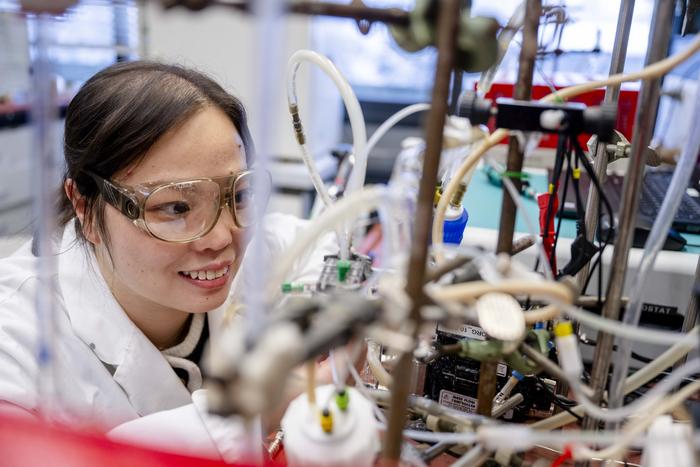
In a groundbreaking advancement within the realms of sustainable chemistry, researchers have made significant strides in the production of methanol from carbon dioxide (CO2) through a hybrid approach merging electrocatalysis and biocatalysis. Made possible by the innovative work of a team led by first authors Panpan Wang and Xin Wang at Ruhr-University Bochum, this research paves the way for more efficient and selective synthesis of methanol, a valuable compound with myriad applications in the chemical industry.
Methanol, a chemical that stands at the intersection of convenience and sustainability, is a substance that has garnered attention due to its potential as an alternative fuel source and as a raw material in synthetic processes. A notable challenge in producing methanol from CO2 arises from the fact that carbon dioxide is the most oxidized form of carbon, necessitating multiple reduction steps to convert it into usable forms. The importance of this research becomes evident in light of global efforts to reduce greenhouse gas emissions and rethink our reliance on fossil fuels.
Electrocatalysis has emerged as a promising technique to initiate the necessary steps for converting CO2 into methanol. However, there are inherent challenges associated with this method. While electrocatalysis can selectively target the initial steps of the reaction, it tends to lead to a branching of reaction pathways, resulting in up to 16 possible products. This lack of specificity poses a significant barrier to the pure production of methanol, which is desired for numerous industrial applications.
Conversely, biocatalysis, which utilizes natural enzymes to facilitate reactions, offers a solution to this specificity problem. These enzymes are adept at catalyzing single reactions, thereby ensuring that only one product is formed. However, biocatalysts come with their own set of challenges. They are often sensitive to environmental conditions, can require cofactors to function, and may pose handling complications, making them less practical for widespread use without further innovations.
In light of these dual challenges, the research team sought to create a hybrid system that leverages the strengths of both electrocatalysis and biocatalysis. This innovative approach entails a two-step process where the initial conversion of CO2 to formate is driven by electrocatalysis. Subsequent steps involve the enzymes formaldehyde dehydrogenase and alcohol dehydrogenase, which convert formate to methanol. However, these enzymes require the cofactor nicotinamide adenine dinucleotide (NAD), which is essential for their activity but is consumed in the catalytic process.
Addressing the need for the regeneration of NAD, the research team integrated a third enzyme into the hybrid system. This strategic addition ensures that the cofactor is recycled, allowing for a sustainable and continuous production of methanol without the loss of crucial reactants. The resulting cascade reaction showcases a simplified multi-step process capable of yielding methanol efficiently, combining the benefits of both catalytic strategies.
The implications of this hybrid method extend beyond just the production of methanol. By demonstrating that such cascades can be effectively employed in a laboratory setting, the research team has opened up new avenues for the development of more complex reactions. The hybrid enzyme-electrocatalyst cascade represents a significant step forward in the pursuit of sustainable manufacturing processes that do not compromise on selectivity or efficiency.
Wolfgang Schuhmann, a key member of the research team, highlights the importance of their findings. He states, “The work proves that such hybrid cascades are in principle feasible and make complex, multi-step reactions selectively possible.” This assertion reinforces the concept that the future of sustainable chemistry may lie in the seamless integration of diverse catalytic mechanisms, maximizing the productive capabilities of each method.
In conclusion, the combination of electrocatalysis and biocatalysis presents an exciting frontier in the quest for alternative methods to produce valuable chemicals from CO2. The ability to transform waste gases into useful products, such as methanol, aligns with global sustainability goals and supports a transition toward a more circular economy. As researchers continue to refine these hybrid systems, we may witness a transformation in how we approach chemical synthesis and waste reduction on a larger scale.
The breakthrough not only contributes to the field of chemistry but also reflects a growing commitment to addressing environmental challenges through innovative scientific research. Future advancements may soon make this hybrid method a cornerstone of sustainable industrial processes aimed at reducing our carbon footprint while generating valuable materials.
Subject of Research: Carbon Dioxide Conversion to Methanol through Hybrid Catalytic Methods
Article Title: Hybrid Enzyme-Electrocatalyst Cascade Modified Gas-Diffusion Electrodes for Methanol Formation from Carbon Dioxide
News Publication Date: 23-Dec-2024
Web References: Not applicable
References: Not applicable
Image Credits: RUB, Marquard
Keywords: electrocatalysis, biocatalysis, methanol, carbon dioxide, hybrid catalysis, sustainability, green chemistry, natural enzymes, catalytic processes, NAD regeneration