Researchers from esteemed institutions including the Max Planck Institute for Physics and Medicine, Institut Jacques Monod, and Niels Bohr Institute have made significant strides in understanding how physical signals within epithelial tissues influence cellular fate during extrusion. This groundbreaking study, published in “Nature Physics,” sheds light on the fundamental role of mechanical intercellular forces in regulating the outcomes of extruded cells, which can either lead to apoptosis or survival. The implications of this research extend far beyond basic biology, paving the way for novel insights into tissue dynamics, cancer progression, and potential therapeutic strategies.
Epithelial tissues, which line surfaces and cavities throughout the body, are in a state of continuous interaction with their external environment. This ongoing communication is crucial for maintaining homeostasis, which involves a delicate balance of cell proliferation and elimination. Intriguingly, the process of cell extrusion plays a vital role in this balance. It serves not only to remove apoptotic cells but also to manage live cell turnover, thereby ensuring that tissue architecture remains intact while allowing for necessary adaptations. The recent study emphasizes that this seemingly simple process is governed by complex mechanical forces that dictate cell behavior at a molecular level.
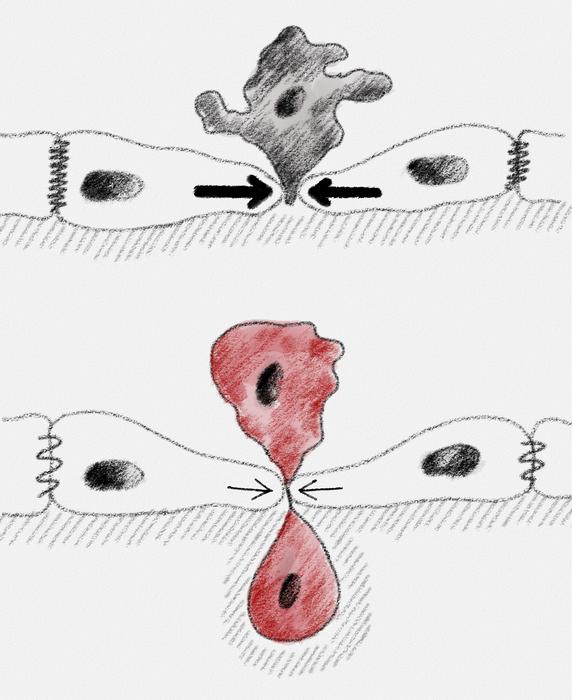
Mechanical forces are not merely passive entities; they play a pivotal role in determining how cells interact with one another. The research team hypothesized that these forces influence the fate of cells during their extrusion from an epithelial layer. The investigation centered on the strength and duration of these mechanical signals, which are transmitted through intercellular junctions known as E-cadherin junctions. The findings reveal that the magnitude of force applied to the cells is directly correlated with their subsequent fate. Specifically, high compressive forces tend to favor the extrusion of apoptotic cells, while lower forces create conditions conducive to the extrusion of live cells, which may be directed either apically or basally depending on the mechanical environment.
The research team employed a multifaceted approach, combining physical modeling of three-dimensional cell structures with experimental techniques involving cells characterized by varying levels of adhesion proteins. This innovative methodology allowed the scientists to observe the dynamics of cell extrusion in a controlled environment, thereby elucidating the underlying mechanisms. Their experiments highlighted that when intercellular force transmission is disrupted or altered due to changes in E-cadherin junctions, the fate of the extruded cells is significantly affected.
In addition to establishing a correlation between mechanical forces and cell fate, the study offered insights into the role of cell communication mechanisms in tissue dynamics. The researchers found that cells that are extruded while alive are more frequently directed toward the basal side of the epithelial layer, a crucial insight that may have implications for understanding cancer metastasis. This preferential directionality adds another layer of complexity to the established narrative surrounding cell extrusion, challenging previous assumptions that viewed this process as uniform and indiscriminate.
The work of this research team not only contributes to our understanding of normal cellular processes but also hints at broader implications for disease states. For instance, the study’s findings could provide a framework for elucidating the mechanisms behind tumor invasion in cancer. By understanding the physical cues that dictate how cells are extruded from tissues, researchers may be able to identify new therapeutic targets to enhance or inhibit cell migration, ultimately influencing cancer progression.
Furthermore, the role of mechanical intercellular forces in governing cellular outcomes during extrusion presents a novel avenue for investigating the development of various diseases where dysregulation of cell turnover is implicated. The interplay between mechanical signals and cellular behavior underscores the importance of maintaining mechanical homeostasis within tissues, a concept that could be pivotal in fields such as regenerative medicine and tissue engineering.
The implications of this research extend to the understanding of adherens junctions, which appear crucial in regulating intercellular forces. These structures not only facilitate cell adhesion but also act as mechanical transmitters that mediate communication between cells. Disruption of these junctions has been implicated in a variety of pathological conditions, including cancer, thus emphasizing the potential impact of the findings in clinical contexts.
Despite the advancement in our understanding of tissue dynamics through this research, further investigations are warranted to fully elucidate the complexity of cellular extrusion processes and the myriad of factors that may influence them. The interplay between mechanical forces, cellular signaling pathways, and genetic expression remains an area ripe for exploration, and future studies may uncover additional regulatory mechanisms that govern the fate of cells during extrusion.
In summary, the findings reported by the collaborative teams from the Max Planck Institute, Institut Jacques Monod, and Niels Bohr Institute contribute to a deeper comprehension of the physical basis underlying critical cellular processes. They establish mechanical intercellular forces as key determinants of cell fate during extrusion, potentially influencing our understanding of developmental processes and cancer biology. This research not only enriches the existing body of knowledge but also opens up new vistas for future studies aimed at harnessing the power of mechanical forces in therapeutic applications.
The results communicated in this study are monumental in their implications and underscore the importance of interdisciplinary research that bridges physical science and biology. By unveiling the hidden forces that shape the living systems around us, researchers are one step closer to deciphering the complex language of life itself—a language spoken through mechanical forces in the intricate dance of cells.
Subject of Research: Cells
Article Title: Dynamic forces shape the survival fate of eliminated cells
News Publication Date: 8-Jan-2025
Web References:
References:
Image Credits: © MPL, Susanne Viezens
Keywords
Cell extrusion, mechanical forces, epithelial tissue, apoptosis, cancer, E-cadherin, intercellular communication, tissue homeostasis, tumor progression, regenerative medicine.