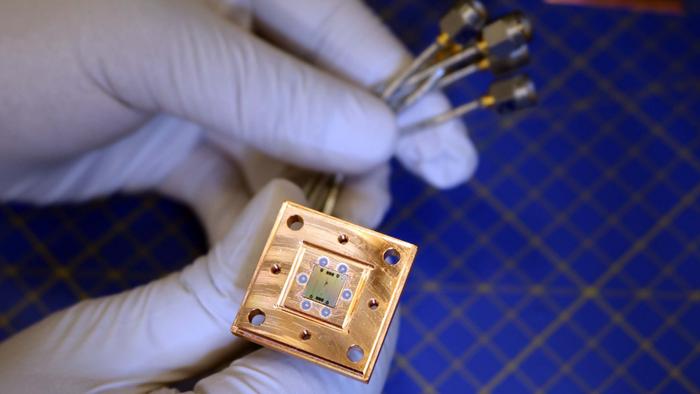
The race to enhance quantum computing technology has taken a significant turn with the development of an innovative quantum refrigerator by researchers at Chalmers University of Technology in Sweden and the University of Maryland, USA. As quantum computers advance, one of the critical limitations remains the necessity for extreme cooling of qubits, the fundamental units of information in quantum systems. This advanced refrigerator promises to address that challenge by autonomously cooling superconducting qubits to unprecedented low temperatures, a crucial step towards realizing the full potential of quantum computation.
Quantum computers differ fundamentally from classical computers due to their use of qubits instead of standard bits. While bits can only exist in one of two states—0 or 1—qubits can simultaneously exist in both states due to the principle of superposition. This unique property allows quantum computers to undertake complex calculations at speeds unattainable by classical systems, making advancements in quantum technology particularly significant for various fields including medicine, cryptography, and artificial intelligence.
However, for qubits to maintain these superposition states without error, they must be safeguarded from environmental interference and well regulated in terms of thermal conditions. The current state-of-the-art cooling systems, known as dilution refrigerators, can only achieve temperatures of approximately 50 millikelvin above absolute zero. Achieving closer proximity to absolute zero is challenging due to the limitations imposed by thermodynamic laws, which state that no physical process can reach absolute zero.
The newly developed quantum refrigerator represents a paradigm shift in cooling techniques, combining innovative superconducting circuits with the ability to operate autonomously without external control. By harnessing ambient heat from the environment, the quantum refrigerator can cool qubits down to an impressive 22 millikelvin. This precision allows qubits to reach their ground state more reliably, thereby increasing the likelihood of successful computations.
Aamir Ali, a research specialist in quantum technology at Chalmers University, emphasizes the significance of achieving a higher probability of the qubit being in its ground state before computation, which is now at 99.97 percent. In contrast, traditional refrigerators could only manage probabilities between 99.8 and 99.92 percent. Though these figures may initially seem marginal, they compound over successive computations, leading to substantial improvements in performance efficiency within quantum systems.
The operational mechanics of this quantum refrigerator rely on the interaction between the target qubit, which requires cooling, and two auxiliary qubits designed for the refrigeration task. The ingenious setup includes a deliberately engineered warm thermal environment acting as a hot thermal bath. This system effectively channels energy from the thermal environment into one of the cooling qubits, subsequently transferring heat from the target qubit to another cold qubit, which is then connected to an even colder environment. This circular process allows for effective and ongoing cooling of the qubit, a significant advancement in quantum thermal management.
Furthermore, the researchers’ unexpected success with this mechanical setup extends beyond a mere proof-of-concept. It marks the pioneering demonstration of an autonomous quantum thermal machine performing a practical and beneficial task. As quantum technology matures, this autonomous operation exemplifies how future quantum systems could be designed for efficiency, reducing the need for complex control mechanisms and additional energy inputs.
The ramifications of this research extend far beyond just the realm of quantum computing. The ability to cool qubits autonomously lays the groundwork for more practical applications of quantum technology across various sectors, from finance to climate modeling, where computational power can spearhead innovation and breakthroughs.
The research team, led by Aamir Ali, Simone Gasparinetti, Claudia Castillo-Moreno, and Paul Jamet Suria, emphasizes the collaborative effort that marked the creation of this technology. Their collective work at the Department of Microtechnology and Nanoscience at Chalmers University of Technology and the University of Maryland underscores the importance of cross-institutional collaboration in advancing technological horizons that could profoundly impact society.
As researchers continue to refine these technologies and improve quantum computing reliability, the path toward an era where quantum computers complement classical ones more fluidly appears closer than ever. The significance of achieving stable and efficient cooling in qubit systems cannot be overstated—it is the lynchpin that could unlock a future dominated by quantum-enhanced technologies across multiple fields.
In conclusion, advancements like the thermally driven quantum refrigerator illustrate the exciting potential of quantum research and innovation. With continued support and development, we stand on the precipice of a new technological era characterized by sophisticated quantum systems that promise to redefine our relationship with computational capabilities.
Subject of Research: Quantum refrigerator for superconducting qubits
Article Title: Thermally driven quantum refrigerator autonomously resets a superconducting qubit
News Publication Date: 9-Jan-2025
Web References: Nature Physics
References: N/A
Image Credits: Chalmers University of Technology | Lovisa Håkansson
Keywords
Quantum computing, superconducting qubits, cooling technology, quantum refrigerator, thermodynamics.