
Deep in the realms of aerospace engineering, a groundbreaking study is taking shape, one that could potentially redefine how we approach the design and deployment of spacecraft. As humanity continues to push the boundaries of space exploration, the optimization of spacecraft structures remains a primary concern. Conventional spacecraft designs often use heavy materials to ensure durability and functionality, but the necessity for efficient fuel use during launch has spurred a search for lighter alternatives.
Researchers at Osaka Metropolitan University are at the forefront of this quest. Under the guidance of Professor Takashi Iwasa, a groundbreaking approach has been developed using advanced photogrammetry techniques to monitor thin membranes applied in spacecraft design. These thin membranes offer the dual advantage of being lightweight and functional, making them an attractive option for aerospace engineers. However, their implementation is not without challenges, primarily due to deformation caused by environmental stressors and structural loads during operation.
This deformation often manifests as wrinkles, which can significantly impede the intended performance of these membranes. As spacecraft ascend beyond Earth’s atmosphere, they encounter unique conditions—ranging from extreme temperature fluctuations to varying levels of pressure. These factors can lead to the undesirable wrinkling of thin membrane materials, raising the urgency for innovative methodologies to accurately gauge and manage such deformations.
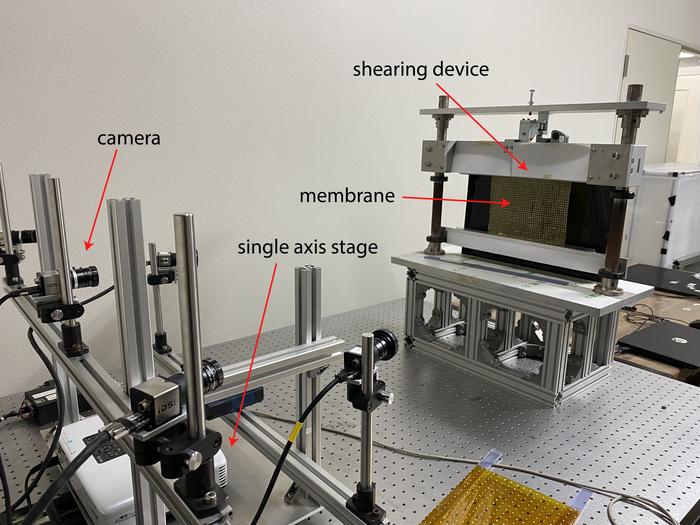
Professor Iwasa and his team approached this challenge through a novel measurement technique that utilizes a single camera setup. Traditionally, photogrammetry has relied on multiple cameras to capture varying perspectives to compute three-dimensional data accurately. Yet, this approach can be cumbersome and impractical, especially within the confined spaces of a spacecraft. By leveraging tension-field theory, the research team’s method allows for the detection of wrinkles in thin membranes more efficiently than before.
The methodology involves capturing images of the thin membrane before and after the application of stress. Key measurement points printed on the membrane serve as reference markers. The shift in the positions of these markers between the two sets of photographs provides crucial data about the frequency and amplitude of the resulting wrinkles. This analytical approach not only streamlines the measurement process but also enhances its accuracy, as each wrinkle’s characteristics can be quantified without the need for extensive equipment.
In their research, Professor Iwasa’s team demonstrated the capability of this technology in real-world applications. They specifically targeted large thin membrane spacecraft that often operate under demanding conditions, thus validating the practical implications of their findings. The ability to monitor structural integrity in environments where space and equipment provisioning is limited makes this research a potential game-changer for future space missions.
Furthermore, the implications of this research extend beyond mere performance enhancement. By ensuring that these thin membrane structures can maintain their integrity under stress, the safety and reliability of spacecraft can be significantly improved. This advancement could not only expedite future missions but also reduce operational costs, thereby enabling more frequent and ambitious endeavors into the cosmos.
As society gravitates towards more sustainable practices, the role of lightweight materials in aerospace engineering becomes increasingly crucial. The development of technologies that minimize material use while maximizing performance aligns with the broader goals of sustainability in engineering. Professor Iwasa’s work embodies this ethos, showcasing how careful innovation can lead to meaningful progress in space technology.
The findings from this study were published in the journal “Measurement,” where they have attracted attention from various sectors within the engineering and aerospace communities. The experimental nature of the research underscores the commitment of academia to addressing practical challenges, reinforcing the value of collaborative efforts between academic institutions and industry practitioners.
Currently, the published work underlines the continuous evolution of measurement technologies, reflecting an ongoing trend where traditional methods are surpassed by innovative approaches that marry simplicity with effectiveness. As the complexities of space exploration demand more nuanced solutions, the introduction of this single-camera technique offers an exciting glimpse into the future of engineering measurements.
In essence, Professor Iwasa’s research is positioned to contribute not just to the understanding of thin membranes but also to the ambitious aspirations humanity holds for space exploration. As researchers refine these methods, they pave the way for yet more efficient spacecraft designs, ultimately enhancing our ability to explore the final frontier. The next step for this research would involve further field tests, refining the techniques based on varying environments and stress factors that membranes may endure in actual missions.
In conclusion, the commitment to advancing measurement technology exemplified by Osaka Metropolitan University is a beacon of innovation, promising to propel the field of aerospace engineering into a new era. As we strive to unravel the mysteries of space, pioneering research like this ensures that we approach the cosmos not only with curiosity but also armed with the tools necessary to thrive in its ever-challenging environment.
Subject of Research: Measurement of wrinkles in thin membranes used in spacecraft
Article Title: Monitoring thin membranes for wrinkles using single-camera photogrammetry
News Publication Date: 2-Nov-2024
Web References: DOI link
References: Measurement Journal, Osaka Metropolitan University
Image Credits: Credit: Osaka Metropolitan University
Keywords
Applied sciences and engineering, Cameras, Plastic deformation, Polymer engineering, Photography, Measure theory, Technology, Engineering, Computer science, Optics, Spacecraft, Mechanical engineering, Research and development, Thin films.