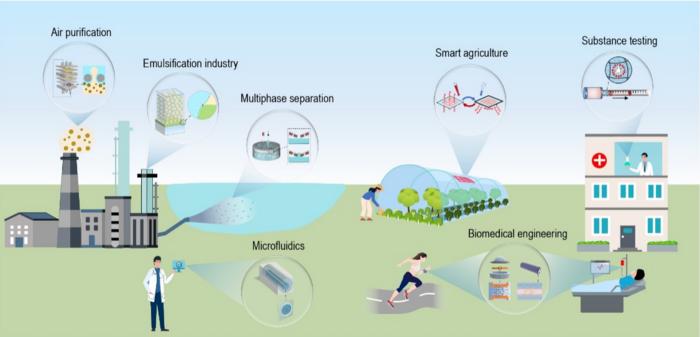
In the field of materials science, innovations in liquid-solid composites are driving transformative changes across various industries. One of the most promising advancements in this arena is the development of liquid-based confined interface materials (LCIMs). These materials present a unique approach to harnessing the fluidic nature of liquids, coupled with the stability and structure provided by solid frameworks. Their fascinating properties open the door to a multitude of applications, from enhancing air purification systems to revolutionizing smart agriculture techniques.
Liquid-based confined interface materials are engineered by integrating confined liquids within solid structures at the mesoscale. This integration is crucial, as it enables the materials to exhibit exceptional characteristics, such as defect-free surfaces that are molecularly smooth. These surfaces not only enhance the aesthetic qualities of the materials but also significantly improve their functionality. The goal is to foster dynamic interfaces that can adapt to various environmental conditions, leading to innovative solutions for real-world challenges.
What sets LCIMs apart is their remarkable anti-fouling capabilities, which prevent unwanted accumulation of contaminants on surfaces. This property is particularly beneficial in industries such as microfluidics and biomedical engineering, where maintaining sterile conditions is paramount. Additionally, LCIMs allow for multiphase flow control, enabling more efficient separation processes. This attribute is critically important in the emulsification industry, where the manipulation of different liquids can lead to the creation of stable emulsions for food, cosmetics, and pharmaceuticals.
The construction of liquid-based confined interface materials is a meticulous process that leverages synergistic interactions between confined liquids and their solid hosts. By responding to various stimuli—such as temperature, light, magnetism, sound, and electric fields—these materials can achieve dynamic responsiveness that traditional materials cannot offer. This dynamic nature allows for innovative designs that can evolve depending on the specific requirements of their applications, making them highly versatile in a rapidly advancing technological landscape.
Researchers have identified four representative behaviors characterizing the motion of confined liquids within these materials: translation, rotation, strain, and mixing. Each behavior plays a vital role in how LCIMs function, influencing their practical applications significantly. For instance, rotation could facilitate improved mixing processes in chemical reactions, while translation may enhance the migration of essential nutrients in smart agriculture. Understanding these interactions is crucial for optimizing the performance of LCIMs across various contexts.
Moreover, advancements in artificial intelligence (AI) are poised to further enhance the capabilities of LCIMs. By integrating AI into the design process, researchers can achieve intelligent interface control, allowing these materials to respond in real time to changing conditions. By harnessing machine learning algorithms, scientists can predict optimal configurations and functionalities for specific applications, paving the way for efficient design and scalable solutions that address the needs of industries on a global scale.
In discussing future directions, the challenge of material stability and durability emerges as a critical concern. Promoting resilience under complex conditions is imperative for the widespread adoption of these materials. Researchers are actively exploring novel designs that enhance the longevity of LCIMs while maintaining their unique properties. This endeavor requires a multidisciplinary approach, combining insights from materials science, engineering, and computational models to create robust solutions that withstand rigorous use.
Furthermore, the potential for LCIMs to contribute significantly to biomedical engineering cannot be overstated. As medical applications demand increasingly sophisticated technologies—for example, drug delivery systems that react intelligently to physiological changes—the adaptability of LCIMs positions them as frontrunners in this domain. Their unique properties could lead to innovative solutions that offer targeted therapy with minimized side effects.
The exploration of LCIMs is more than just an academic inquiry; it is a pathway toward technological evolution. As scientists delve deeper into the mechanics behind these materials, new applications continue to emerge, suggesting that LCIMs could play an integral role in addressing global issues, including environmental challenges, healthcare advancements, and industrial efficiency.
In conclusion, liquid-based confined interface materials represent a pivotal advancement in the materials science landscape, offering a compelling synthesis of fluid dynamics and solid mechanics. Their multifunctional capabilities position them as a critical factor in the development of next-generation technologies across numerous sectors. As researchers continue to push the boundaries of what these materials can achieve, the implications for industry, environment, and society are bound to be significant.
The journey of understanding and optimizing LCIMs is ongoing, and future developments promise to unveil even more exciting potentials. As with any groundbreaking technology, the close collaboration between scientists, industry leaders, and technologists will be essential to unlock the full capabilities of liquid-based confined interface materials, ultimately leading to innovations that could benefit mankind.
Subject of Research: Liquid-Based Confined Interface Materials
Article Title: Applications and Advances in Liquid-Based Confined Interface Materials (LCIMs)
News Publication Date: October 2023
Web References: National Science Review
References: Science China Press Media Contact
Image Credits: ©Science China Press
Keywords
Liquid-solid composites, LCIMs, materials science, air purification, smart agriculture, biomedical engineering, artificial intelligence, sustainability, multiphase separation, emulsification, microfluidics.