Anyone who’s researched ways to lower their environmental impact has likely heard they should eat less meat, particularly beef. Even at scale, cows are an inefficient way to feed people — it takes nearly four tons of water to recoup one ton of beef, and many farming practices emit greenhouse gasses and pollutants.
Anyone who’s researched ways to lower their environmental impact has likely heard they should eat less meat, particularly beef. Even at scale, cows are an inefficient way to feed people — it takes nearly four tons of water to recoup one ton of beef, and many farming practices emit greenhouse gasses and pollutants.
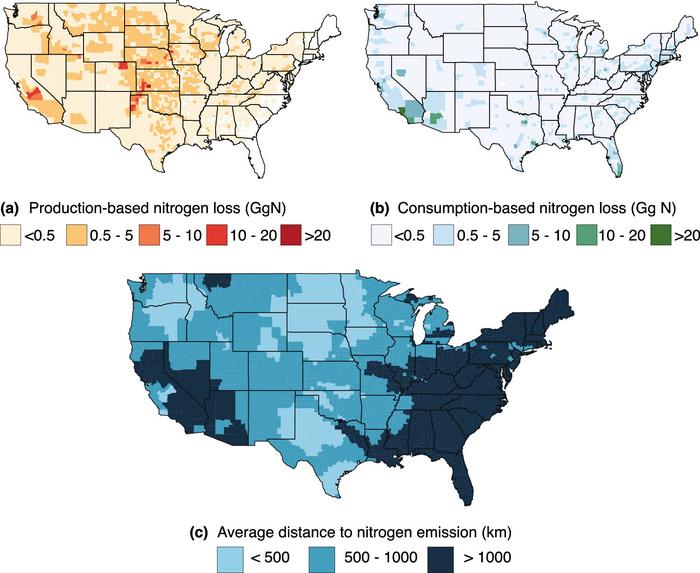
University of Pittsburgh researchers are the first to trace one of those pollutants, nitrogen, along the U.S. beef supply chain at the county level. They found high spatial disconnect between where beef is eaten and where nitrogen’s impacts are felt.
Previous research looked at production-based impacts, said Vikas Khanna, professor of civil and environmental engineering in the Swanson School of Engineering. “They’ve asked, ‘what does it take to produce a certain quantity of beef?’ And they tend to report average environmental impacts,” such as how much water, greenhouse gasses or other pollutants result over the entire process.
In a paper published in the journal Environmental Science and Technology, Khanna and PhD student Anaís Ostroski map the impacts of nitrogen county by county, providing the clearest picture yet of which areas face some of the environmental effects of cattle farming. Khanna and Ostroski are joined by Oleg Prokopyev, a former professor of industrial engineering at Pitt now at the University of Zurich.
“It is essential to measure nitrogen losses and understand where they happen due to the cascading effects on the environment,” said Ostroski, the paper’s lead author. “A single molecule of reactive nitrogen can cause multiple adverse effects until it is converted back to stable atmospheric nitrogen. Food supply chains have grown increasingly complex; we found that when beef is consumed in a given county, it is associated with nitrogen losses in more than 200 counties on average.”
Our atmosphere is 79% nitrogen, but atmospheric nitrogen has strong bonds and doesn’t react with other substances. The nitrogen used for fertilizer, however, is reactive. As it accumulates it can create surface-level ozone, which can lead to respiratory problems. When rain washes nitrogen fertilizers from croplands into waterways, it can spark runaway algae growth, which takes oxygen from the water, suffocating fish and other marine life.
In 2017, beef consumption was responsible for about 1,330 gigagrams of nitrogen released into the environment — that’s enough to fertilize about 19.5 million acres, or 20% of all the corn grown in the United States.
When beef is consumed in a given county, it is associated with nitrogen losses in more than 200 counties on average.
Anaís Ostroski
its effects are not felt equally across the country.
The new research shows people living along the East Coast and in large swaths of California, Nevada and Arizona are more than 600 miles away from the nitrogen that entered the environment in service of their burger.
The pollution happens in a few different ways along the supply chain. Cows are fed food that is grown using nitrogen fertilizers. Much of that is leached away by rainwater, tainting nearby land and water supplies.
Beef cattle are kept in processing facilities where nitrogen is released in wastewater. Here, Khanna sees an opportunity to minimize nitrogen pollution by implementing a circular economy model where valuable nutrients like nitrogen and phosphorus are recovered from the wastewater.
“Recouping nutrients from animal wastewaters would be a win-win solution,” he said. Nitrogen would be kept out of the ecosystem, and farmers could reuse the nitrogen as fertilizer while also reusing the treated water for irrigation.
While it’s important to look at technological solutions to reduce the impact of cattle farming on the environment, Khanna has words of caution about technological exuberance, “Let’s not just look at the trees and miss the forest. It is important to look at potential solutions from a holistic perspective to make sure we are not solving one problem at the expense of others.”
Journal
Environmental Science & Technology
DOI
10.1021/acs.est.4c01651
Method of Research
Data/statistical analysis
Subject of Research
Not applicable
Article Title
Tracing Nitrogen Flows Associated with Beef Supply Chains: A Consumption-Based AssessmentClick to copy article link
Article Publication Date
2-Aug-2024