[Vienna, August 26 2024] – Since the end of the last Ice Age, growth of human population was far from uniform, marked instead by periods of rapid expansion followed by sharp declines. The reasons behind these fluctuations remain only partially understood. Previous research by CSH scientists Peter Turchin, Daniel Kondor, and an international team of collaborators, demonstrated that social conflicts, rather than – or in addition to – environmental factors, could have significantly impacted these patterns. Now, they add another piece to the puzzle.
[Vienna, August 26 2024] – Since the end of the last Ice Age, growth of human population was far from uniform, marked instead by periods of rapid expansion followed by sharp declines. The reasons behind these fluctuations remain only partially understood. Previous research by CSH scientists Peter Turchin, Daniel Kondor, and an international team of collaborators, demonstrated that social conflicts, rather than – or in addition to – environmental factors, could have significantly impacted these patterns. Now, they add another piece to the puzzle.
Wars and conflicts not only cause direct casualties but also create an atmosphere of distress and fear. This fear, by affecting where and how people settle, could have influenced substantially how the population in Europe developed, as shown in a study published in the Journal of the Royal Society Interface.
Flight And Overpopulation
“Globally, scientists have extensively studied and debated the presence and role of conflicts in prehistory. However, estimating their effects, such as those on population numbers is still difficult,” explains Daniel Kondor from CSH. “This is even more complicated by potential indirect effects, like people who, out of fear, leave their homes or avoid certain areas.”
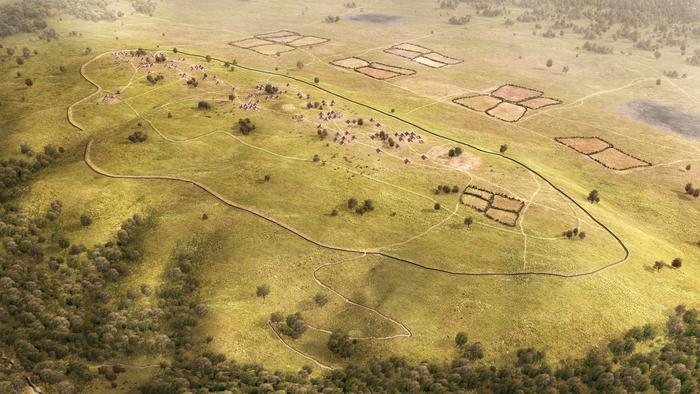
These indirect impacts of conflict could have caused significant, long-term population fluctuations in non-state societies, such as in Neolithic Europe (circa 7,000 BC to 3,000 BC), according to the study’s findings. “Our model shows that fear of conflict led to population declines in potentially dangerous areas. As a result, people concentrated in safer locations, such as hilltops, where overpopulation could lead to higher mortality and lower fertility,” Kondor explains.
Match Archaeological Evidence
The ongoing threat would prevent the settlement of much of the remaining land. Co-author Detlef Gronenborn from the Leibniz Centre for Archaeology (LEIZA) in Mainz, Germany, adds: “The results from the simulation studies nicely match empirical evidence from archaeological field work, like for instance the Late Neolithic site of Kapellenberg near Frankfurt, dating to around 3700 BCE. Like there, we have many instances of a temporal abandonment of open agricultural land, associated with a retreat of groups to well-defendable locations and considerable investments in large-scale defense systems like ramparts, palisades and ditches.”
“This concentration of people in specific, often well-defended locations could have led to increasing wealth disparities and political structures that justified these differences,” adds Peter Turchin from CSH. “In that way, indirect effects of conflict might have also played a crucial role in the emergence of larger political units and the rise of early states.”
Complexity Science Meets Archaeology
To simulate population dynamics in Neolithic Europe, the researchers developed a computational model. To test the model, they utilized a database of archaeological sites, analyzing the number of radiocarbon age-measurements from various locations and time periods, under the assumption that this reflects the scale of human activities, and thus, ultimately, population numbers. “This allows us to examine the typical amplitudes and timescales of population growth and decline across Europe,” Kondor explains. “Our goal was for our simulation to reflect these patterns.”
In the future, the model could help interpret archaeological evidence, such as signs of overpopulation or land use patterns, which in turn can provide necessary context and data for further refinements to modeling. This is a typical example of interdisciplinary collaboration that CSH aims to foster. “Using complexity science methods, we develop mathematical models to analyze the rise and fall of complex societies and identify common factors,” Turchin explains. This involves collecting vast amounts of historical data, managed in specialized databases like the Seshat Global History Databank. “For the most complete picture possible, direct collaboration with archaeologists is immensely important. This study is a great example of the potential that such interdisciplinary collaboration can have,” Kondor emphasizes.
About CSH
The Complexity Science Hub (CSH) is Europe’s research center for the study of complex systems. We derive meaning from data from a range of disciplines – economics, medicine, ecology, and the social sciences – as a basis for actionable solutions for a better world. Established in 2015, we have grown to over 70 researchers, driven by the increasing demand to gain a genuine understanding of the networks that underlie society, from healthcare to supply chains. Through our complexity science approaches linking physics, mathematics, and computational modeling with data and network science, we develop the capacity to address today’s and tomorrow’s challenges.
Journal
Journal of The Royal Society Interface
DOI
10.1098/rsif.2024.0210
Method of Research
Computational simulation/modeling
Subject of Research
People
Article Title
Landscape of Fear: Indirect effects of conflict can account for large-scale population declines in non-state societies
Article Publication Date
28-Aug-2024
COI Statement
The researchers declare no conflict of interest.