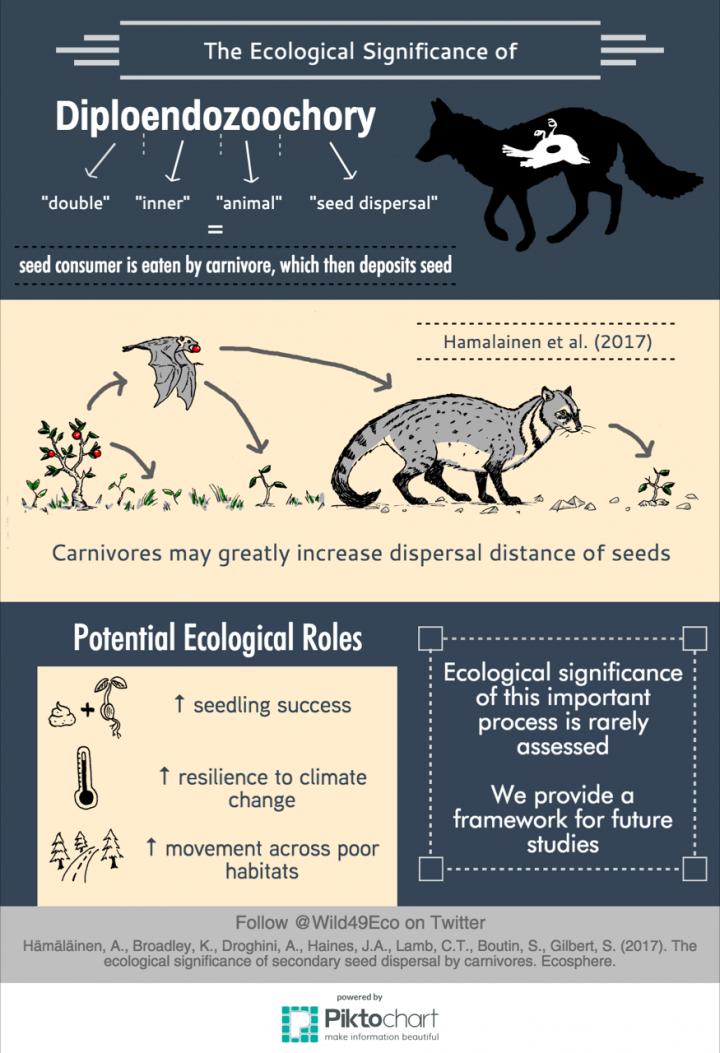
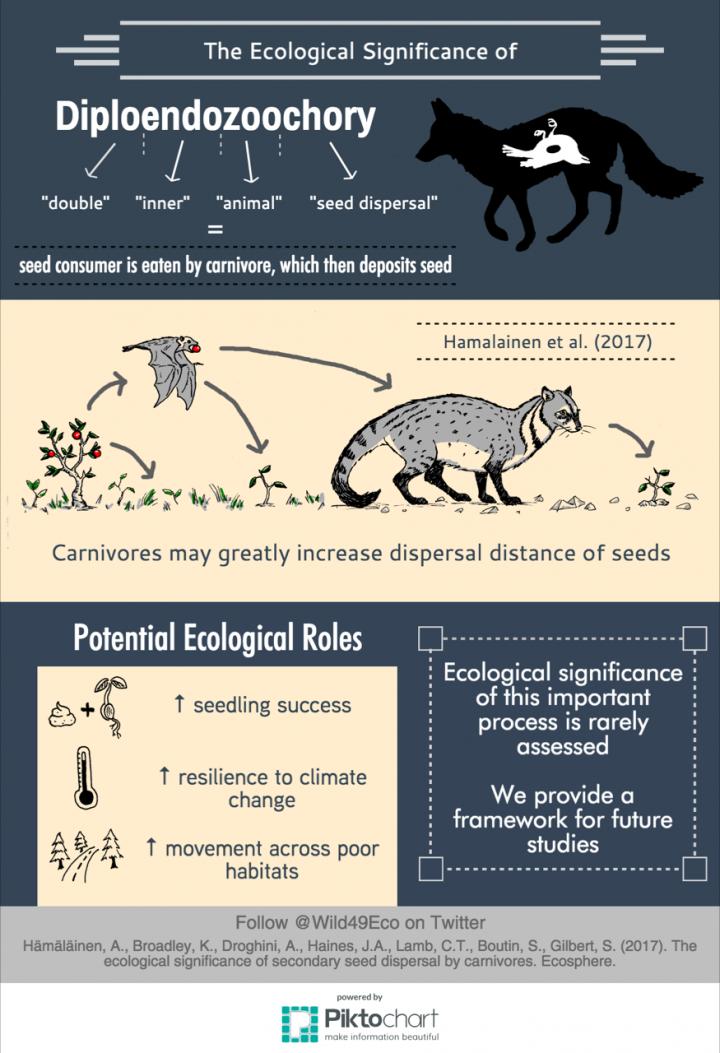
Credit: Kate Broadley and Clayton Lamb
EDMONTON (Under embargo until Thursday, February 23, 2017 at 10 a.m. MST)–In the middle of Alberta's boreal forest, a bird eats a wild chokecherry. During his scavenging, the bird is caught and eaten by a fox. The cherry seed, now inside the belly of the bird within the belly of fox, is transported far away from the tree it came from. Eventually, the seed is deposited on the ground. After being broken down in the belly of not one but two animals, the seed is ready to germinate and become a cherry tree itself. The circle of life at work.
Diploendozoochory, or the process of a seed being transported in the gut of multiple animals, occurs with many species of plants in habitats around the world. First described by Charles Darwin in 1859, this type of seed dispersal has only been studied a handful of times. And in a world affected by climate change and increasing rates of human development, understanding this process is becoming increasingly important.
A new study by researchers at the University of Alberta's Department of Biological Sciences is the first to comprehensively examine existing literature to identify broader patterns and suggest ways in which the phenomenon is important for plant populations and seed evolution.
Anni Hämäläinen, lead investigator and postdoctoral fellow, explains that predator-assisted seed dispersal is important to colonize and recolonize plant life in the wild.
"Thick-shelled seeds may benefit from the wear and tear of passing through the guts of two animals, making them better able to germinate than if they had passed through the gut of the prey alone," explains Hämäläinen. "It's even possible that some plants have evolved specifically to take advantage of these predator-specific behaviours."
Diploendozoochory also has broader environmental implications.
Often larger than prey animals, predators cover larger distances with ease. As humans continue to develop and alter wilderness, such as by cutting down forests or building roads, predators may be the only animals large enough to navigate across these areas and enable plants to recolonize them.
"Climate change will alter where some plants can find suitable places to grow," explains Hämäläinen. "Seed-carrying predators may have a role in helping plants cover a larger area and hence move with the changing climate."
These different factors are like pieces in a puzzle, explains Hämäläinen: to fully understand the big picture of how they affect plant populations, scientists need to know how all of the pieces fit together.
"Our work has highlighted how interesting and important diploendozoochory is, and we hope that it will help and encourage others to fill some of these gaps in our understanding," says Hämäläinen.
###
The paper "The ecological significance of secondary seed dispersal by carnivores" is published in Ecosphere. This research was conducted by Anni Hämäläinen, Kate Broadley, Amanda Droghini, Jessica Haines, Clayton Lamb, and Sophie Gilbert, under the supervision of Stan Boutin, professor in the Department of Biological Sciences and Alberta Biodiversity Conservation Chair.
Media Contact
Katie Willis
[email protected]
780-248-1215
@ualberta
http://www.ualberta.ca
############
Story Source: Materials provided by Scienmag