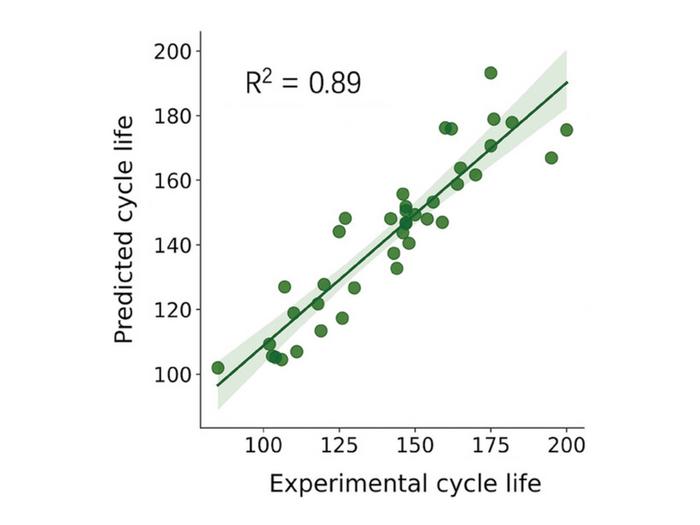
1. NIMS and SoftBank Corp. have jointly developed a model capable of predicting the cycle lives of high-energy-density lithium-metal batteries by applying machine learning methods to battery performance data. The model proved able to accurately estimate batteries’ longevity by analyzing their charge, discharge and voltage relaxation process data without relying on any assumption about specific battery degradation mechanisms. The technique is expected to be useful in improving the safety and reliability of devices powered by lithium-metal batteries.
1. NIMS and SoftBank Corp. have jointly developed a model capable of predicting the cycle lives of high-energy-density lithium-metal batteries by applying machine learning methods to battery performance data. The model proved able to accurately estimate batteries’ longevity by analyzing their charge, discharge and voltage relaxation process data without relying on any assumption about specific battery degradation mechanisms. The technique is expected to be useful in improving the safety and reliability of devices powered by lithium-metal batteries.
2. Lithium-metal batteries have the potential to achieve energy densities per unit mass higher than those of the lithium-ion batteries currently in use. For this reason, expectations are high for their use in a wide range of technologies, including drones, electric vehicles and household electricity storage systems. In 2018, NIMS and SoftBank established the NIMS-SoftBank Advanced Technologies Development Center. Together they have since carried out research on high-energy-density rechargeable batteries for use in various systems, such as mobile phone base stations, the Internet of Things (IoT) and high altitude platform stations (HAPS). A lithium-metal battery with an energy density higher than 300 Wh/kg and a life of more than 200 charge/discharge cycles has previously been reported. Putting high-performance lithium-metal batteries like this into practical use while ensuring their safety will require the development of techniques capable of accurately estimating the cycle lives of these batteries. However, degradation mechanisms are more complex in lithium-metal batteries than in conventional lithium-ion batteries and are not yet fully understood, making the development of models capable of predicting the cycle lives of lithium-metal batteries a great challenge.
3. This research team fabricated a large number of high-energy-density lithium-metal battery cells—each composed of a lithium-metal anode and a nickel-rich cathode—using advanced battery fabrication techniques the team had previously developed. The team then evaluated the charge/discharge performance of these cells. Finally, the team constructed a model able to predict the cycle lives of lithium-metal batteries by applying machine learning methods to the charge/discharge data. The model proved able to make accurate predictions by analyzing charge, discharge and voltage relaxation process data without relying on any assumption about specific battery degradation mechanisms.
4. The team intends to further improve the cycle life prediction accuracy of the model and expedite efforts to put high-energy-density lithium-metal batteries into practical use by leveraging the model in the development of new lithium-metal anode materials.
***
5. This project was carried out by a research team led by Qianli Si (Junior Researcher, NIMS), Shoichi Matsuda (Team Leader, NIMS) and Yoshitaka Tateyama (Group Leader, NIMS) as part of R&D activities at the NIMS-SoftBank Advanced Technologies Development Center.
6. This research was published in Advanced Science, an open access journal, on June 27, 2024, Japan Time.
Journal
Advanced Science
DOI
10.1002/advs.202402608
Method of Research
Experimental study
Subject of Research
Not applicable
Article Title
Data-Driven Cycle Life Prediction of Lithium Metal-Based Rechargeable Battery Based on Discharge/Charge Capacity and Relaxation Features
Article Publication Date
27-Jun-2024