• HOME
  • NEWS
  • EXPLORE
    • CAREER
      • Companies
      • Jobs
    • EVENTS
    • iGEM
      • News
      • Team
    • PHOTOS
    • VIDEO
    • WIKI
  • BLOG
  • COMMUNITY
    • FACEBOOK
    • INSTAGRAM
    • TWITTER
Wednesday, August 20, 2025
BIOENGINEER.ORG
No Result
View All Result
  • Login
  • HOME
  • NEWS
  • EXPLORE
    • CAREER
      • Companies
      • Jobs
        • Lecturer
        • PhD Studentship
        • Postdoc
        • Research Assistant
    • EVENTS
    • iGEM
      • News
      • Team
    • PHOTOS
    • VIDEO
    • WIKI
  • BLOG
  • COMMUNITY
    • FACEBOOK
    • INSTAGRAM
    • TWITTER
  • HOME
  • NEWS
  • EXPLORE
    • CAREER
      • Companies
      • Jobs
        • Lecturer
        • PhD Studentship
        • Postdoc
        • Research Assistant
    • EVENTS
    • iGEM
      • News
      • Team
    • PHOTOS
    • VIDEO
    • WIKI
  • BLOG
  • COMMUNITY
    • FACEBOOK
    • INSTAGRAM
    • TWITTER
No Result
View All Result
Bioengineer.org
No Result
View All Result
Home NEWS Science News Biology

Going slow is better for fast cycling

by
August 19, 2024
in Biology
Reading Time: 2 mins read
0
Share on FacebookShare on TwitterShare on LinkedinShare on RedditShare on Telegram

Embryonic stem (ES) cells are pluripotent stem cells that can produce all cell types of an organism. ES cells proliferate rapidly and have been thought to experience high levels of intrinsic replication stress. However, a recent report published in EMBO Reports by Kurashima et al. challenges this assumption by providing a detailed molecular investigation of replication dynamics in these cells.

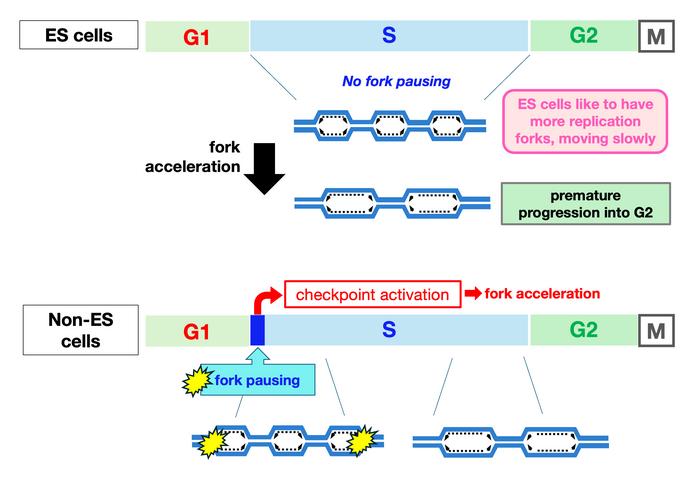
Comparison of DNA Replication Mechanism in ES and non-ES cells

Credit: T. Tsubouchi

Embryonic stem (ES) cells are pluripotent stem cells that can produce all cell types of an organism. ES cells proliferate rapidly and have been thought to experience high levels of intrinsic replication stress. However, a recent report published in EMBO Reports by Kurashima et al. challenges this assumption by providing a detailed molecular investigation of replication dynamics in these cells.

Led by Dr. Tomomi Tsubouchi at the National Institute for Basic Biology (NIBB) in Japan, the research team explored replication fork dynamics – such as replication fork speed, pausing frequency, and origin firing density – across different substages of the S phase. Their findings reveal previously overlooked aspects of replication not only in ES cells but also in other non-pluripotent cells.

Dr. Kiminori Kurashima, the first author in the study, explains, “By fractionating cells in substages of the S phase and performing DNA fiber assays on these sorted populations, we discovered that mammalian pluripotent stem cells maintain a slow fork speed and high active origin density throughout the S phase, with minimal fork pausing”. This contrasts with their finding that in non-pluripotent cells, which exhibit slower fork speeds at the beginning of the S phase but accelerate thereafter. Non-pluripotent cells also experience fork pausing specifically in the early S phase, likely activating checkpoint mechanisms to facilitate fork acceleration and reduce pausing.

The research also shows that upon differentiation, mouse ES cells adopt replication characteristics similar to those of non-pluripotent cells. Furthermore, some features of DNA replication observed in mouse ES cells are shared with human iPS cells, suggesting that the slow replication fork with high origin density may be a hallmark of pluripotency. Surprisingly, forcing an acceleration of replication forks led to miscoordination between genome replication completion and cell cycle progression.

Dr. Tsubouchi concludes, “We propose that slow replication forks are not the manifestation of replication impediments but rather an integral feature of DNA replication in ES cells. Our study underscores the dynamic regulation of DNA replication and highlights how different cell types employ distinct mechanisms.”


Journal

EMBO Reports

DOI

10.1038/s44319-024-00207-5

Method of Research

Experimental study

Subject of Research

Cells

Article Title

Embryonic stem cells maintain high origin activity and slow forks to coordinate replication with cell cycle progression

Article Publication Date

25-Jul-2024
Share12Tweet8Share2ShareShareShare2

Related Posts

blank

Soybean Phytocytokine-Receptor Module Boosts Disease Resistance

August 20, 2025
Breakthrough Study Reveals New Methods to Protect Nerve Cells from ALS

Breakthrough Study Reveals New Methods to Protect Nerve Cells from ALS

August 19, 2025

Does Your Brain React to What You Do or How You Do It?

August 19, 2025

Aramchol Enhances Regorafenib Efficacy in Treating Gastrointestinal Tumors

August 19, 2025

POPULAR NEWS

  • blank

    Molecules in Focus: Capturing the Timeless Dance of Particles

    141 shares
    Share 56 Tweet 35
  • Neuropsychiatric Risks Linked to COVID-19 Revealed

    80 shares
    Share 32 Tweet 20
  • Modified DASH Diet Reduces Blood Sugar Levels in Adults with Type 2 Diabetes, Clinical Trial Finds

    60 shares
    Share 24 Tweet 15
  • Predicting Colorectal Cancer Using Lifestyle Factors

    47 shares
    Share 19 Tweet 12

About

We bring you the latest biotechnology news from best research centers and universities around the world. Check our website.

Follow us

Recent News

Soybean Phytocytokine-Receptor Module Boosts Disease Resistance

New Potent Tubulin Inhibitor Discovered for Cancer

Enhancing Ionic Conductivity in Garnet Electrolytes with Sr-Ta

  • Contact Us

Bioengineer.org © Copyright 2023 All Rights Reserved.

Welcome Back!

Login to your account below

Forgotten Password?

Retrieve your password

Please enter your username or email address to reset your password.

Log In
No Result
View All Result
  • Homepages
    • Home Page 1
    • Home Page 2
  • News
  • National
  • Business
  • Health
  • Lifestyle
  • Science

Bioengineer.org © Copyright 2023 All Rights Reserved.