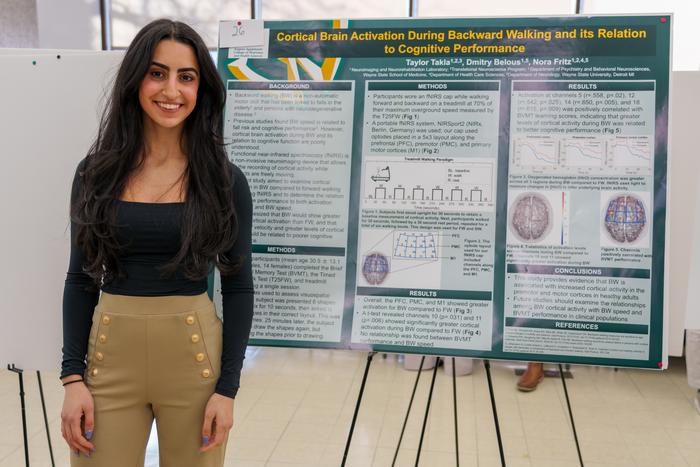
DETROIT — Taylor Takla, a Ph.D. candidate in the translational neuroscience program in Wayne State University’s School of Medicine, recently received a two-year, $96,812 F31 grant from the Eunice Kennedy Shriver National Institute of Child Health and Human Development of the National Institutes of Health to study fear of falling in those with multiple sclerosis (MS).
DETROIT — Taylor Takla, a Ph.D. candidate in the translational neuroscience program in Wayne State University’s School of Medicine, recently received a two-year, $96,812 F31 grant from the Eunice Kennedy Shriver National Institute of Child Health and Human Development of the National Institutes of Health to study fear of falling in those with multiple sclerosis (MS).
The grant, “Investigating Fear of Falling in Multiple Sclerosis: An Interplay of Neural, Motor, Cognitive, and Psychological Factors,” aims to address a major public health concern in persons with MS that results in increased falls, decreased physical activity and loss of independence.
“Fear of falling is a major issue for people with MS, leading to serious negative health and quality of life outcomes,” said Takla. “It’s both a risk factor and a consequence of experiencing a fall. This creates a vicious cycle where individuals become less confident in their balance, reduce their participation in activities, get physically weaker and experience subsequent increased fall risk and greater fear of falling. This cycle results in social isolation, psychological distress and reduced overall well-being.”
The long-term goal of the study is to break that cycle, ultimately reducing falls and increasing physical activity in the MS community. Takla aims to examine the neural, motor, cognitive and psychological factors underlying fear of falling to achieve this goal. She hopes that by understanding these factors, she and other researchers will see which contribute to fear of falling the most and — by targeting such factors through rehabilitation strategies — improve outcomes and quality of life for patients.
“We want to take a comprehensive approach,” said Takla. “We study the neural components with an MRI by taking images of the brain and looking at brain activity. We are looking at three specific brain areas, the cerebellum, the hippocampus and amygdala, which are involved in motor, cognitive and psychological functioning. We also are conducting a battery of motor, cognitive and psychological tests to look at behavioral components like balance and walking abilities, executive functioning, and anxiety. Through the combination of advanced MRI techniques and a comprehensive evaluation of behavioral functioning, we hope to gain a more complete understanding of fear of falling and its downstream consequences than by using any single measure alone.”
“F31 grants from the National Institutes of Health are awarded to promising predoctoral students to conduct research training with the help of outstanding research mentors,” said Ezemenari M. Obasi, Ph.D., vice president for research & innovation at Wayne State University. “Under the guidance of her mentor, Nora Fritz, Ph.D., associate professor of physical therapy in the Eugene Applebaum College of Pharmacy and Health Sciences, Taylor will have the opportunity to conduct research that has the potential to help many within our community and beyond.”
The grant number for this National Institutes of Health award is F31HD116491.
# # #
About Wayne State University
Wayne State University is one of the nation’s pre-eminent public research universities in an urban setting. Through its multidisciplinary approach to research and education, and its ongoing collaboration with government, industry and other institutions, the university seeks to enhance economic growth and improve the quality of life in the city of Detroit, state of Michigan and throughout the world. For more information about research at Wayne State University, visit research.wayne.edu.
Wayne State University’s research efforts are dedicated to a prosperity agenda that betters the lives of our students, supports our faculty in pushing the boundaries of knowledge and innovation further, and strengthens the bonds that interconnect Wayne State and our community. To learn more about Wayne State University’s prosperity agenda, visit president.wayne.edu/prosperity-agenda.