• HOME
  • NEWS
  • EXPLORE
    • CAREER
      • Companies
      • Jobs
    • EVENTS
    • iGEM
      • News
      • Team
    • PHOTOS
    • VIDEO
    • WIKI
  • BLOG
  • COMMUNITY
    • FACEBOOK
    • INSTAGRAM
    • TWITTER
Saturday, February 7, 2026
BIOENGINEER.ORG
No Result
View All Result
  • Login
  • HOME
  • NEWS
  • EXPLORE
    • CAREER
      • Companies
      • Jobs
        • Lecturer
        • PhD Studentship
        • Postdoc
        • Research Assistant
    • EVENTS
    • iGEM
      • News
      • Team
    • PHOTOS
    • VIDEO
    • WIKI
  • BLOG
  • COMMUNITY
    • FACEBOOK
    • INSTAGRAM
    • TWITTER
  • HOME
  • NEWS
  • EXPLORE
    • CAREER
      • Companies
      • Jobs
        • Lecturer
        • PhD Studentship
        • Postdoc
        • Research Assistant
    • EVENTS
    • iGEM
      • News
      • Team
    • PHOTOS
    • VIDEO
    • WIKI
  • BLOG
  • COMMUNITY
    • FACEBOOK
    • INSTAGRAM
    • TWITTER
No Result
View All Result
Bioengineer.org
No Result
View All Result
Home NEWS Science News

Reconfigurable single-shot incoherent optical signal processing system for chirped microwave signal

Bioengineer by Bioengineer
February 23, 2017
in Science News
Reading Time: 2 mins read
0
Share on FacebookShare on TwitterShare on LinkedinShare on RedditShare on Telegram
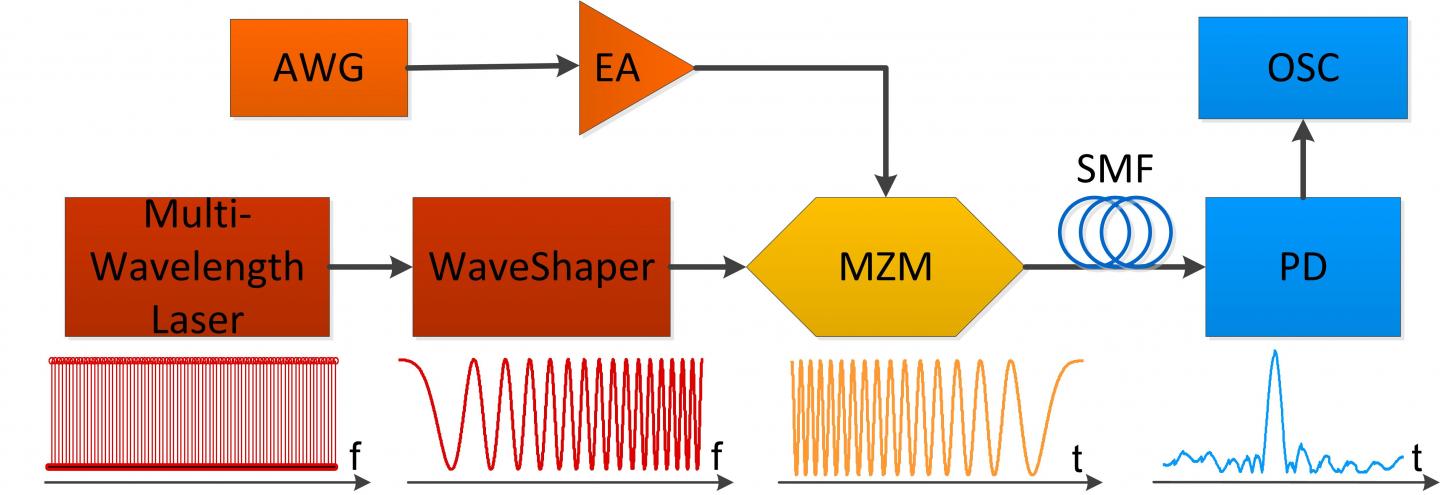
IMAGE

Credit: ©Science China Press

Incoherent photonic generation and processing of microwave signals avoid cumbersome and costly pulsed lasers by using an incoherent broadband light source. This methodology has attracted great interest for a wide range of important applications, such as implementation of microwave photonics filter, arbitrary waveform generation and Fourier transformation. The main limitation of a conventional incoherent photonic signal processing technique is the extremely low signal-to-noise ratio (SNR) of the output signal. The low SNR is a result of the spontaneous emission of a purely incoherent light source such as amplified spontaneous emission (ASE). Therefore, signal manipulation and measurement cannot be achieved in a single shot using a conventional incoherent-light microwave signal processing system. Thousands of times average is typically required to mitigate the white noise that is intrinsically present at the output of an incoherent microwave signal processing system, restricting application of the system to processing periodically repeating signals.

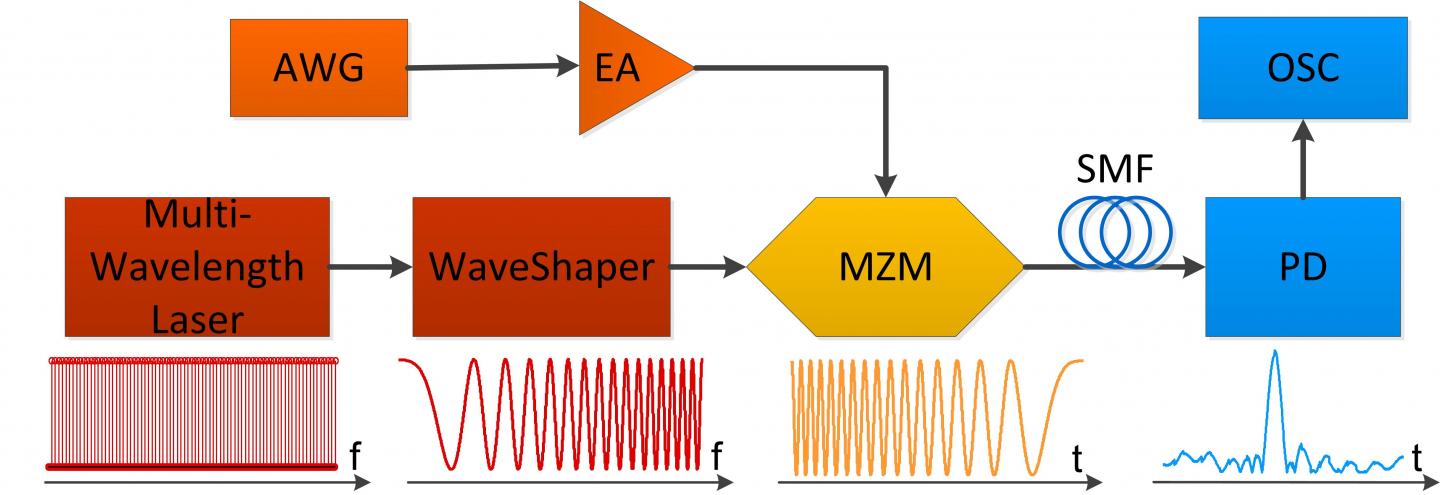
Recently, Prof. Ming Li and his research team in Institute of Semiconductor, Chinese Academy of Sciences and Institut National de la Recherche Scientifique-Énergie, Matériaux et Télécommunications (Canada) report a reconfigurable and single-shot incoherent optical signal processing system for chirped microwave signal compression. In the proposed scheme, they use a multi-wavelength laser (MWL) as the incoherent light source, rather than a continuous spectrum. Due to the use of the MWL, the SNR of the output signal gets improved significantly such that operation in a single-shot is possible. Moreover, the design enables realization of a fiber-based microwave dispersive line with an extremely large chromatic dispersion (i.e., a few ns2, equivalent to several thousand kilometers of conventional single-mode fiber). Such an accomplishment is achieved using a design called time-spectrum convolution (TSC) system. The effective dispersion of microwave signal through this TSC system is orders of magnitude higher than the actual physical optical dispersion used in the system. Furthermore, the induced dispersion on the microwave signal is tunable by adjusting the programmable optical filter or by changing the optical dispersive medium, such that the proposed scheme is fully reconfigurable. Different chirped microwave signals with GHz-bandwidth are successfully compressed and the robustness of the proposed system when input RF signals are largely distorted is also discussed.

###

Reference

Ming Li , Shuqian Sun, Antonio Malacarne, Sophie LaRochelle, Jianping Yao, Ninghua Zhu, Jose Azana. Reconfigurable single-shot incoherent optical signal processing system for chirped microwave signal compression. Science Bulletin, 2017, 62(4):242-248

http://www.sciencedirect.com/science/article/pii/S2095927317300397

Science China Press
http://www.scichina.com/

Media Contact

Ming Li
[email protected]

http://zh.scichina.com/english/

############

Story Source: Materials provided by Scienmag

Share12Tweet8Share2ShareShareShare2

Related Posts

Inflammasome Protein ASC Drives Pancreatic Cancer Metabolism

February 7, 2026

Phage-Antibiotic Combo Beats Resistant Peritoneal Infection

February 7, 2026

Boosting Remote Healthcare: Stepped-Wedge Trial Insights

February 7, 2026

Barriers and Boosters of Seniors’ Physical Activity in Karachi

February 7, 2026
Please login to join discussion

POPULAR NEWS

  • Robotic Ureteral Reconstruction: A Novel Approach

    Robotic Ureteral Reconstruction: A Novel Approach

    82 shares
    Share 33 Tweet 21
  • Digital Privacy: Health Data Control in Incarceration

    63 shares
    Share 25 Tweet 16
  • Study Reveals Lipid Accumulation in ME/CFS Cells

    57 shares
    Share 23 Tweet 14
  • Breakthrough in RNA Research Accelerates Medical Innovations Timeline

    53 shares
    Share 21 Tweet 13

About

We bring you the latest biotechnology news from best research centers and universities around the world. Check our website.

Follow us

Recent News

Inflammasome Protein ASC Drives Pancreatic Cancer Metabolism

Phage-Antibiotic Combo Beats Resistant Peritoneal Infection

Boosting Remote Healthcare: Stepped-Wedge Trial Insights

Subscribe to Blog via Email

Enter your email address to subscribe to this blog and receive notifications of new posts by email.

Join 73 other subscribers
  • Contact Us

Bioengineer.org © Copyright 2023 All Rights Reserved.

Welcome Back!

Login to your account below

Forgotten Password?

Retrieve your password

Please enter your username or email address to reset your password.

Log In
No Result
View All Result
  • Homepages
    • Home Page 1
    • Home Page 2
  • News
  • National
  • Business
  • Health
  • Lifestyle
  • Science

Bioengineer.org © Copyright 2023 All Rights Reserved.