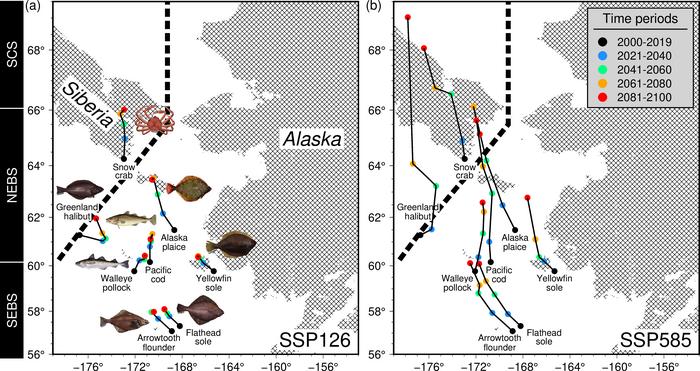
Commercially important marine fish and invertebrate species will likely shift northwards under a warmer climate.
Credit: Irene D. Alabia, et al. PLOS ONE. June 06, 2024
Commercially important marine fish and invertebrate species will likely shift northwards under a warmer climate.
Marine fisheries are an essential source of protein for a large part of the world’s population, as well as supporting around 390 million livelihoods and an industry worth approximately US$ 141 billion, according to the UN FAO. Yet, climate change presents a major threat to the world’s fisheries, particularly in the Pacific Arctic. The eastern Bering Sea and Chukchi Sea—which contain eight of the most productive fisheries in the world—are already experiencing significant climatic shifts that have contributed to the surprise collapse of two important species, snow crab and Pacific cod.
To better understand the potential impact of climate change on fisheries in the region, a research team from Hokkaido University, The University of Tokyo, and the National Institute of Polar Research used bioeconomic modeling to study how the abundance and distribution of eight commercially important marine fish and invertebrate species might change under a range of climate scenarios from 2021-2100. The study was published in the journal PLOS ONE.
“The movement of fish stocks or populations out of their traditional fishing grounds can be challenging for resource managers and stakeholders, exacerbating the risks of overexploitation and the race to fish,” says Irene D. Alabia, a climate change researcher at the Arctic Research Center at Hokkaido University in Japan.
The researchers’ model includes biological parameters, such as population growth rate and fishing mortality rate, and economic parameters, such as the costs and income associated with each species’ fishery. The team modeled four climate-based socioeconomic pathway scenarios: sustainable development, middle of the road, regional rivalry and fossil-fuelled development.
The analysis suggested that under low to moderate levels of climate change, well-managed marine ecosystems may experience only limited economic impacts between now and 2040. However, more extreme warming, including the loss of sea ice, would have more severe impacts.
All the climate scenarios pointed to a shift northward for all of the species studied due to the loss of sea ice habitat and warmer water temperatures in the eastern Bering Sea. The most significant shift in abundance was predicted for Greenland halibut, with the fishery’s center of gravity forecast to move by more than 80 kilometers per decade under the highest impact climate scenario. In contrast, the walleye pollock fishery was projected to shift around 30 kilometers per decade.
Even in the most extreme climate scenario, the news wasn’t all bad. The abundance of Pacific cod was forecast to increase, but the high-value snow crab was forecast to decrease.
“The magnitude of abundance changes varied across species, identifying potential winners and losers under climate change and hinting at the potential restructuring of future marine communities in the Pacific Arctic region,” Alabia said.
The researchers stressed the importance of climate-smart solutions to protect and preserve marine fisheries in order to support food security and ensure a sustainable fishery sector under climate change.
Journal
PLoS ONE
DOI
10.1371/journal.pone.0304718
Method of Research
Computational simulation/modeling
Subject of Research
Not applicable
Article Title
Future redistribution of fishery resources suggests biological and economic trade-offs according to the severity of the emission scenario
Article Publication Date
6-Jun-2024