• HOME
  • NEWS
  • EXPLORE
    • CAREER
      • Companies
      • Jobs
    • EVENTS
    • iGEM
      • News
      • Team
    • PHOTOS
    • VIDEO
    • WIKI
  • BLOG
  • COMMUNITY
    • FACEBOOK
    • INSTAGRAM
    • TWITTER
Saturday, February 7, 2026
BIOENGINEER.ORG
No Result
View All Result
  • Login
  • HOME
  • NEWS
  • EXPLORE
    • CAREER
      • Companies
      • Jobs
        • Lecturer
        • PhD Studentship
        • Postdoc
        • Research Assistant
    • EVENTS
    • iGEM
      • News
      • Team
    • PHOTOS
    • VIDEO
    • WIKI
  • BLOG
  • COMMUNITY
    • FACEBOOK
    • INSTAGRAM
    • TWITTER
  • HOME
  • NEWS
  • EXPLORE
    • CAREER
      • Companies
      • Jobs
        • Lecturer
        • PhD Studentship
        • Postdoc
        • Research Assistant
    • EVENTS
    • iGEM
      • News
      • Team
    • PHOTOS
    • VIDEO
    • WIKI
  • BLOG
  • COMMUNITY
    • FACEBOOK
    • INSTAGRAM
    • TWITTER
No Result
View All Result
Bioengineer.org
No Result
View All Result
Home NEWS Science News Chemistry

High-energy collision study reveals new insights into quark-gluon plasma

by
July 23, 2024
in Chemistry
Reading Time: 3 mins read
0
Schematic representation of the medium temperature dependence of jet transport coefficient in high-energy nucleus-nucleus collisions
Share on FacebookShare on TwitterShare on LinkedinShare on RedditShare on Telegram

In high-energy physics, researchers have unveiled how high-energy partons lose energy in nucleus-nucleus collisions, an essential process in studying quark-gluon plasma (QGP). This finding could enhance our knowledge of the early universe moments after the Big Bang.
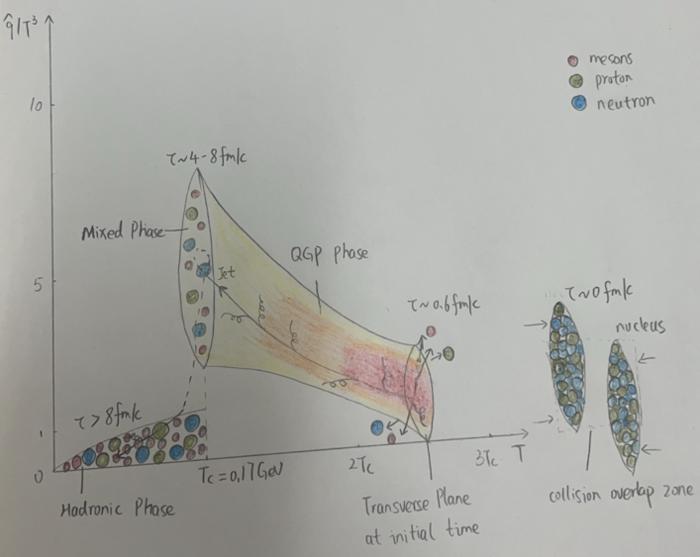
Schematic representation of the medium temperature dependence of jet transport coefficient in high-energy nucleus-nucleus collisions

Credit: Han-Zhong Zhang

In high-energy physics, researchers have unveiled how high-energy partons lose energy in nucleus-nucleus collisions, an essential process in studying quark-gluon plasma (QGP). This finding could enhance our knowledge of the early universe moments after the Big Bang.

Temperature Dependence in Jet Energy Loss

The study reveals that the jet transport coefficient over temperature cubed, a critical factor in parton energy loss in QGP, decreases with increasing medium temperature. This discovery, supported by a significant enhancement of the elliptic flow parameter (v2(pT)) for large transverse momentum (pT​) hadrons, provides a more in-depth understanding of jet quenching in high-energy collisions.

Unveiling the Quark-Gluon Plasma

High-energy collisions create a hot, dense state of matter known as the QGP. As partons pass through this medium, they lose energy. This process, known as jet quenching, leads to the suppression of high pT​ hadrons, measured by the nuclear modification factor (RAA(pT)), and the azimuthal anisotropy, measured by the v2(pT).

Detailed Analytical Approach

The team used a next-to-leading-order perturbative QCD parton model to analyze data from the Relativistic Heavy-Ion Collider (RHIC) and the Large Hadron Collider (LHC). By fitting their models to the experimental data, they found that the jet transport coefficient’s scaled value (q^/T3) decreases with temperature. This novel approach provides a more accurate description of how jets lose energy in these extreme conditions.

The Impact

“This discovery helps us understand the behavior of partons in the quark-gluon plasma more accurately,” says Prof. Han-Zhong Zhang, the corresponding author. “It shows that partons lose more energy near the critical temperature, which could explain the enhanced azimuthal anisotropy observed in high-energy collisions.”

The findings suggest that as partons travel through the QGP, they lose more energy near the transition from QGP to hadron phase, strengthening the azimuthal anisotropy by approximately 10% at RHIC and LHC.

Next Steps

“In the future, we hope to refine our model and enrich the information on qˆ, allowing us to better describe RAA(pT) and v2(pT) simultaneously for both RHIC and LHC energies,” Prof. Zhang mentions their plans.

This study advances high-energy nuclear physics, providing deeper insights into jet energy loss in high-energy collisions. These findings could enhance our understanding of the quark-gluon plasma and pave the way for future research into the fundamental properties of matter under extreme conditions.

This research is a collaborative effort between South China Normal University and Central China Normal University.   


Journal

Nuclear Science and Techniques

DOI

10.1007/s41365-024-01492-4

Method of Research

Computational simulation/modeling

Subject of Research

Not applicable

Article Title

The medium-temperature dependence of jet transport coefficient in high-energy nucleus–nucleus collisions

Article Publication Date

16-Jul-2024

Share12Tweet8Share2ShareShareShare2

Related Posts

blank

Breakthrough in Environmental Cleanup: Scientists Develop Solar-Activated Biochar for Faster Remediation

February 7, 2026
blank

Cutting Costs: Making Hydrogen Fuel Cells More Affordable

February 6, 2026

Scientists Develop Hand-Held “Levitating” Time Crystals

February 6, 2026

Observing a Key Green-Energy Catalyst Dissolve Atom by Atom

February 6, 2026

POPULAR NEWS

  • Robotic Ureteral Reconstruction: A Novel Approach

    Robotic Ureteral Reconstruction: A Novel Approach

    82 shares
    Share 33 Tweet 21
  • Digital Privacy: Health Data Control in Incarceration

    63 shares
    Share 25 Tweet 16
  • Study Reveals Lipid Accumulation in ME/CFS Cells

    57 shares
    Share 23 Tweet 14
  • Breakthrough in RNA Research Accelerates Medical Innovations Timeline

    53 shares
    Share 21 Tweet 13

About

We bring you the latest biotechnology news from best research centers and universities around the world. Check our website.

Follow us

Recent News

Decoding Prostate Cancer Origins via snFLARE-seq, mxFRIZNGRND

Digital Health Perspectives from Baltic Sea Experts

Florida Cane Toad: Complex Spread and Selective Evolution

Subscribe to Blog via Email

Enter your email address to subscribe to this blog and receive notifications of new posts by email.

Join 73 other subscribers
  • Contact Us

Bioengineer.org © Copyright 2023 All Rights Reserved.

Welcome Back!

Login to your account below

Forgotten Password?

Retrieve your password

Please enter your username or email address to reset your password.

Log In
No Result
View All Result
  • Homepages
    • Home Page 1
    • Home Page 2
  • News
  • National
  • Business
  • Health
  • Lifestyle
  • Science

Bioengineer.org © Copyright 2023 All Rights Reserved.