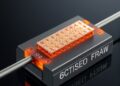
An Innovate UK project worth £1.1M has been awarded to the Lancaster University spinout firm Quinas, the global semiconductor company IQE and Lancaster and Cardiff Universities.

Credit: Lancaster University
An Innovate UK project worth £1.1M has been awarded to the Lancaster University spinout firm Quinas, the global semiconductor company IQE and Lancaster and Cardiff Universities.
Quinas will coordinate the ambitious project which is the first step towards volume production of the universal computer memory ULTRARAM™ invented by Lancaster University Physics Professor Manus Hayne.
ULTRARAM has extraordinary properties, combining the non-volatility of a data storage memory, like flash, with the speed, energy-efficiency, and endurance of a working memory, like DRAM.
Most of the funding for the one-year project will be spent at IQE which will scale up the manufacture of compound semiconductor layers from Lancaster University to an industrial process at the Cardiff based firm. This will involve IQE developing advanced capability for growth of the compound semiconductors gallium antimonide and aluminium antimonide for the first time. The project follows significant investment to boost the UK semiconductor industry and the establishment of the world’s first compound semiconductor cluster in South Wales.
Professor Hayne, who is the Lancaster team lead, co-founder and Chief Scientific Officer at Quinas said: “We are delighted that Innovate UK is supporting this ambitious project, and that IQE has committed to developing the first part of ULTRARAM mass production.”
It is estimated that the global memory chip market will be worth about US$320 billion by 2030 but the UK currently has no stake in it.
Professor Hayne said: “ULTRARAM represents a tremendous economic opportunity for the UK, and the efficiencies it could bring to computing at all scales has the potential for huge energy savings and carbon emission reduction.”
Jessica Wenmouth Lancaster University’s Head of Research Commercialisation said: “I am delighted to support our spinout Quinas on its journey to scale this Lancaster-led innovation to an industrial process suitable for a semiconductor foundry ‘fab,’ thereby generating impact from research through commercialisation.
“This project not only aligns with Lancaster University’s strategy to foster impactful research and innovation but also demonstrates the effective utilisation of strategic grant funding alongside private equity investment. Such collaborations are crucial for bringing new products to market and driving significant investment into the UK for emerging technologies, enhancing our national and global standing in cutting-edge fields.”
The goal of the one-year project to industrialise the process involves scaling up ULTRARAM wafer diameters from 3” at Lancaster to 6” at IQE. This will be achieved by using the mainstream production technique of metal-organic vapour phase epitaxy (MOVPE), also called metal-organic chemical vapour deposition (MOCVD), rather than molecular beam epitaxy (MBE), which is typically used at universities.
Professor Hayne said: “Lancaster will do some initial MBE epitaxy as a control/template for the industrial growth. Our key role will be to characterise the antimonide material grown at IQE, and once sufficient quality is confirmed we will fabricate and test ULTRARAM memory on small areas of the wafers from IQE.
“In parallel with this, Lancaster will continue to work on ULTRARAM scaling, by reducing the size of individual devices (‘Moore’s law’) and making larger and larger arrays. Once devices are small enough and arrays are large enough, the following stage will be to demonstrate fabrication on a complete 8” wafer, and then to translate the process to an industrial one, suitable for a semiconductor foundry ‘fab’.”
ULTRARAM exploits quantum resonant tunnelling to achieve its extraordinary properties and is implemented in compound semiconductors that are used in photonic devices such as LEDs, laser diodes and infrared detectors, but not in digital electronics, which is the preserve of silicon.
DOI
10.1002/aelm.202101103
Method of Research
Experimental study
Subject of Research
Not applicable