• HOME
  • NEWS
  • EXPLORE
    • CAREER
      • Companies
      • Jobs
    • EVENTS
    • iGEM
      • News
      • Team
    • PHOTOS
    • VIDEO
    • WIKI
  • BLOG
  • COMMUNITY
    • FACEBOOK
    • INSTAGRAM
    • TWITTER
Monday, October 5, 2026
BIOENGINEER.ORG
No Result
View All Result
  • Login
  • HOME
  • NEWS
  • EXPLORE
    • CAREER
      • Companies
      • Jobs
        • Lecturer
        • PhD Studentship
        • Postdoc
        • Research Assistant
    • EVENTS
    • iGEM
      • News
      • Team
    • PHOTOS
    • VIDEO
    • WIKI
  • BLOG
  • COMMUNITY
    • FACEBOOK
    • INSTAGRAM
    • TWITTER
No Result
View All Result
Bioengineer.org
No Result
View All Result
Home NEWS Science News

Russian and Indian scientists collaborate on development of a new type accumulator

Bioengineer by Bioengineer
February 22, 2017
in Science News
Reading Time: 2 mins read
0
Share on FacebookShare on TwitterShare on LinkedinShare on RedditShare on Telegram
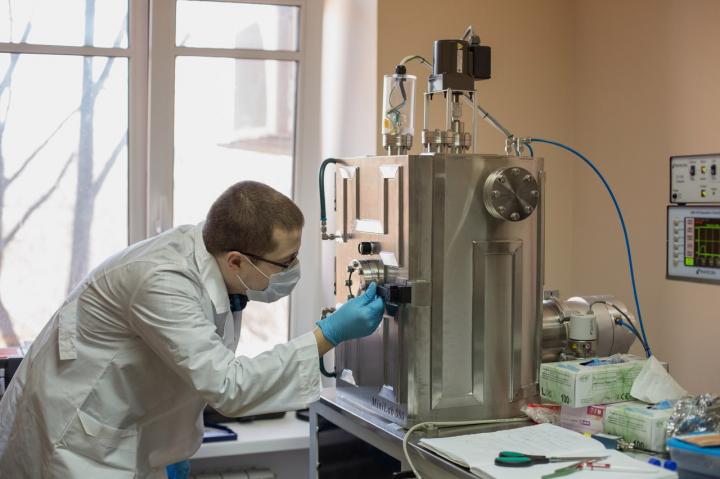
IMAGE

Credit: Peter the Great Saint-Petersburg Polytechnic University

In mid-February 2017 researchers of Peter the Great St. Petersburg Polytechnic University (SPbPU) and the University of Madras obtained support of the Russian Foundation for Basic Research for implementation of the project to create new materials for accumulators of capacitor type. The project should be completed within three years.

Storage of electrical energy in the accumulators of capacitor type is one of the most promising approaches when rapid, in particular pulsed, charge output is required. Such devices should maintain their functionality in conditions of significant temperature increase, combined with the high currents. The aim of the project is to develop approaches for creation of new dielectric materials to increase the efficiency of accumulators of capacitor type in a wide temperature range.

The research focuses on new materials based on antiferroelectrics, having significantly different working mechanism from the widely used analogue.

The principal novelty of the approach offered by scientists is a joint study of the antiferroelectric materials properties both in the form of single crystals, which allows to apply most informative experimental techniques, and in the form of ceramics, that has direct practical significance.

"The opportunity to study monocrystalline antiferroelectrics appeared only in the last few years with the development of methods of this type of crystal growth. Joint influence of pressure and temperature will be studied by X-ray scattering using resistively heated diamond anvil cells. Previously, such approach has never been applied. X-ray scattering techniques are planned to be applied using both laboratory diffractometers, and experimental facilities of synchrotron sources ESRF (France) and CAT (India)", said Dr. Alexey Filimonov, Head of Physical Electronics department of the Institute of Physics, Nanotechnology and Telecommunications, SPbPU.

###

Media Contact

Raisa Bestugina
[email protected]
7-812-591-6675
@pgpuspb

http://english.spbstu.ru/

############

Story Source: Materials provided by Scienmag
Share12Tweet8Share2ShareShareShare2

Related Posts

Blood Clones That Masquerade as Cancer: New Framework Draws Hard Lines in Precision Oncology

Blood Clones That Masquerade as Cancer: New Framework Draws Hard Lines in Precision Oncology

October 5, 2026
A Hidden DNA Insertion Paints Quinoa Leaves in Red and Green

A Hidden DNA Insertion Paints Quinoa Leaves in Red and Green

October 5, 2026

Biochar Research Booms as Scientists Map the Race to Rescue the World’s Dying Soils

October 5, 2026

Better forecasts alone cannot save Africa’s poorest herders from drought

October 5, 2026
Please login to join discussion

POPULAR NEWS

  • Alloys That Shrink Their Own Grains: New PIX Mechanism Refines Metals With Heat Alone

    Alloys That Shrink Their Own Grains: New PIX Mechanism Refines Metals With Heat Alone

    29 shares
    Share 12 Tweet 7
  • Endurance Exercise Reshapes the Liver in Males and Females Through Distinct Molecular Routes

    29 shares
    Share 12 Tweet 7
  • Single Transcription Factor PU.1 Rapidly Converts Fibroblasts into Macrophage-Lineage Cells

    29 shares
    Share 12 Tweet 7
  • New Scale Measures How Ready Nurse Educators Really Are for the AI Era

    29 shares
    Share 12 Tweet 7

About

We bring you the latest biotechnology news from best research centers and universities around the world. Check our website.

Follow us

Recent News

Alloys That Shrink Their Own Grains: New PIX Mechanism Refines Metals With Heat Alone

Endurance Exercise Reshapes the Liver in Males and Females Through Distinct Molecular Routes

Single Transcription Factor PU.1 Rapidly Converts Fibroblasts into Macrophage-Lineage Cells

Subscribe to Blog via Email

Success! An email was just sent to confirm your subscription. Please find the email now and click 'Confirm' to start subscribing.

Join 85 other subscribers
  • Contact Us

Bioengineer.org © Copyright 2023 All Rights Reserved.

Welcome Back!

Login to your account below

Forgotten Password?

Retrieve your password

Please enter your username or email address to reset your password.

Log In
No Result
View All Result
  • Homepages
    • Home Page 1
    • Home Page 2
  • News
  • National
  • Business
  • Health
  • Lifestyle
  • Science

Bioengineer.org © Copyright 2023 All Rights Reserved.