Spontaneous parametric down-conversion (SPDC), as a source of entangled photons, is of great interest for quantum physics and quantum technology, but so far it could be only implemented in solids. Researchers at the Max Planck Institute for the Science of Light (MPL) and Jozef Stefan Institute in Ljubljana, Slovenia, have demonstrated, for the first time, SPDC in a liquid crystal. The results, recently published in Nature, open a path to a new generation of quantum sources: efficient and electric-field tunable.
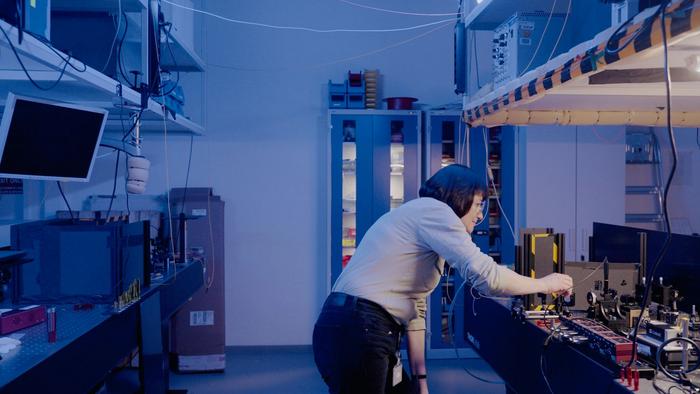
Credit: © Tanya Chekhova
Spontaneous parametric down-conversion (SPDC), as a source of entangled photons, is of great interest for quantum physics and quantum technology, but so far it could be only implemented in solids. Researchers at the Max Planck Institute for the Science of Light (MPL) and Jozef Stefan Institute in Ljubljana, Slovenia, have demonstrated, for the first time, SPDC in a liquid crystal. The results, recently published in Nature, open a path to a new generation of quantum sources: efficient and electric-field tunable.
The splitting of a single photon in two is one of the most useful tools in quantum photonics. It can create entangled photon pairs, single photons, squeezed light, and even more complicated states of light which are essential for optical quantum technologies. This process is known as spontaneous parametric down-conversion (SPDC).
SPDC is deeply linked to central symmetry. This is the symmetry with respect to a point – for instance, a square is centrally symmetric but a triangle is not. In its very essence – a splitting of one photon in two – SPDC breaks the central symmetry. Therefore, it is only possible in crystals whose elementary cell is centrally asymmetric. SPDC cannot happen in ordinary liquids or gases, because these materials are isotropic.
Recently, however, researchers have discovered liquid crystals that have a different structure, the so-called ferroelectric nematic liquid crystals. Despite being fluidic, these materials feature strong central symmetry breaking. Their molecules are elongated, asymmetric and, most importantly, they can be re-oriented by external electric field. Re-orientation of molecules changes the polarization of the generated photon pairs, as well as the generation rate. Given a proper packaging, a sample of such material can be a very useful device because it produces photon pairs efficiently, can be easily tuned with electric field, and can be integrated into more complex devices.
Using the samples prepared in Jozef Stefan Institute (Ljubljana, Slovenia) from a ferroelectric nematic liquid crystal synthesized by Merck Electronics KGaA, researchers at the Max-Planck Institute for the Science of Light have implemented SPDC, for the first time, in a liquid crystal. The efficiency of entangled photons generation is as high as in the best nonlinear crystals, such as lithium niobate, of similar thickness. By applying an electric field of just a few Volts, they were able to switch the generation of photon pairs on and off, as well as to change the polarization properties of these pairs. This discovery starts a new generation of quantum light sources: flexible, tunable, and efficient.
Journal
Nature
DOI
10.1038/s41586-024-07543-5
Method of Research
Experimental study
Subject of Research
Not applicable
Article Title
Tunable entangled photon-pair generation in a liquid crystal
Article Publication Date
12-Jun-2024