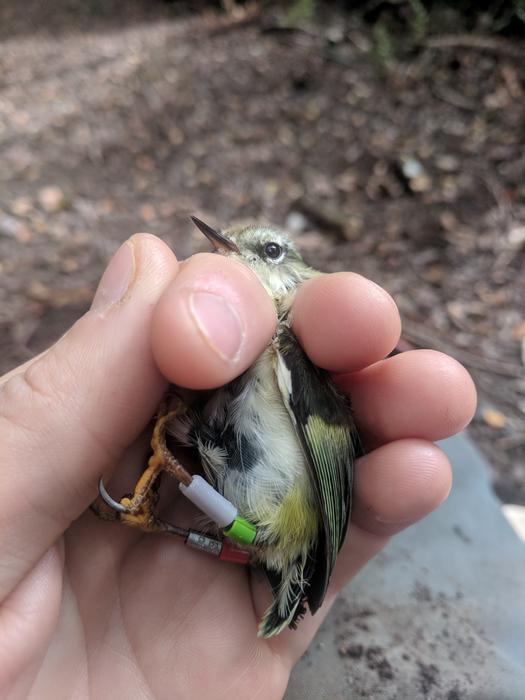
Credit: Photo by Ines G. Moran
|
Parrots, songbirds, and hummingbirds can learn to make new sounds. No-one knew, but New Zealand’s smallest bird, the rifleman or titipounamu, may have a rudimentary version of the same talent. |
|
University of Auckland research into the bird is part of a rethinking of how and when vocal learning evolved in birds. Scientists traditionally assumed birds were split into two groups – those which can learn sounds (parrots, songbirds, and hummingbirds) and those which can’t – but the study published in the scientific journal Communications Biology adds to evidence challenging that assumption. Vocal signatures of distantly related titipounamu had strong similarities if they lived near each other, the Waipapa Taumata Rau, University of Auckland research showed. Close relatives living far apart didn’t sound similar. That suggests the birds’ sounds may not be innate and may be learned from each other, according to Dr Kristal Cain, the senior author of the study, and Dr Ines G. Moran, the lead author. Weighing the same as five or six paper clips, titipounamu live in high-altitude mature native forest, feed on insects and make high-pitched sounds inaudible to some people. The bird is one of the country’s two surviving native wren species and a sort of evolutionary missing link between two of the most impressive learners, songbirds and parrots. Relics of Gondwana, the wrens likely existed in Aotearoa since before the islands broke away from the super continent, roughly 80 million years ago. “If New Zealand wrens are vocal learners, then it is likely that the common ancestor of parrots and songbirds was also capable of rudimentary learning,” says Cain. “This ability in birds could have evolved millions of years earlier than we previously thought.” Vocal learning in songbirds evolved 30-50 million years ago, scientists have estimated. But the songbirds and parrots diverged long before that – closer to 80 million years ago. Vocal convergence The scientists went to all sorts of lengths to gather evidence of vocal copying, such as “vocal convergence,” where animals’ calls become acoustically similar. First, they closely monitored the nests of titipounamu at Boundary Stream Mainland Island in the Hawke’s Bay, identifying and banding individuals and then recording more than 6,800 of the feeding calls routinely made by adult birds (parents and the parents’ helpers) bringing food to the young nestlings over three summers. While the differences in the birds’ calls can’t be detected by most people, detailed analysis of spectrograms – “voiceprints” – revealed unique individual vocal signatures. The researchers then acquired genetic information on the population at large. Finally, they used advanced genetic methods to estimate how much and which aspects of the vocal signature came from genetics as opposed to the social environment. For some parameters, social environment was more important than genetics; there were similarities with a known vocal learner, the zebra finch. The evidence from the scientists’ study isn’t conclusive but it’s strongly suggestive of “rudimentary vocal learning abilities.” “A growing body of evidence suggests we may need to stop classifying birds as either vocal learners or vocal non-learners,” says Cain. “The ability may be much more widespread and likely exists along a spectrum.” Humans, whales, bats Most animals communicate with unlearned, innate vocalisations, while vocal learners include humans, whales and dolphins, elephants and bats. “The vocal behaviour that we were unravelling in this study is very similar to what is known as vocal accommodation in human linguistics,” says Moran. “It’s similar to our ability to adjust our ways of speaking in different social, dialectic, or hierarchical settings – modulating our voices to better fit in certain social groups.” The scientists thanked the mana whenua of the Maungaharuru region, the University’s engineering team, the Department of Conservation, AgResearch, and the Centre for eResearch. A Royal Society Te Apārangi Marsden Fund grant supported the research and funding also came from the University of Auckland Doctoral Scholarship and Press Account, Birds New Zealand Research Funds, and the Centre for Biodiversity and Biosecurity. Learn more about the use of animals in research and teaching at the University of Auckland. Media contact |
Journal
Communications Biology
DOI
10.1038/s42003-024-06253-y
Method of Research
Observational study
Subject of Research
Animals
Article Title
Vocal convergence and social proximity shape the calls of the most basal Passeriformes, New Zealand Wrens
Article Publication Date
15-May-2024
COI Statement
No conflicts of interest