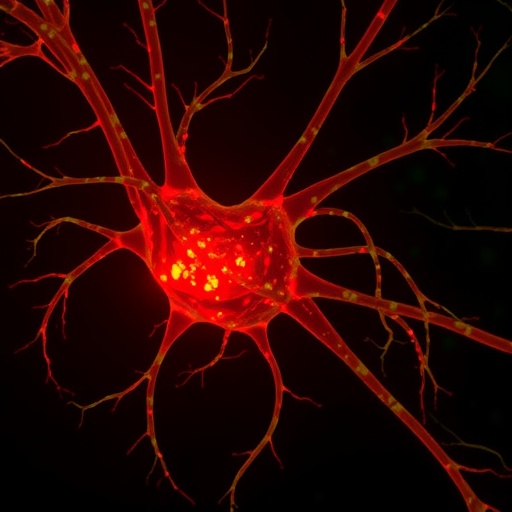
An international team led by researchers at the University of Toronto has found a new RNA virus that they believe is hitching a ride with a common human parasite.

Credit: University of Toronto
An international team led by researchers at the University of Toronto has found a new RNA virus that they believe is hitching a ride with a common human parasite.
The virus, called Apocryptovirus odysseus, along with 18 others that are closely related to it, was discovered through a computational screen of human neuron data – an effort aimed at elucidating the connection between RNA viruses and neuroinflammatory disease. The virus is associated with severe inflammation in humans infected with the parasite Toxoplasma gondii, leading the team to hypothesize that it exacerbates toxoplasmosis disease.
“We discovered A. odysseus in human neurons using the open-science Serratus platform to search through more than 150,000 RNA viruses” said Purav Gupta, first author on the study, recent high school graduate and current undergraduate student at U of T’s Donnelly Centre for Cellular and Biomolecular Research. “Serratus identifies RNA viruses from public data by flagging an enzyme called RNA-dependent RNA polymerase, which facilitates replication of viral RNA. This enzyme allows the virus to reproduce itself and for the infection to spread.”
The study was published recently in the journal Virus Evolution.
The parasite T. gondii is far-reaching, infecting an estimated one-third of the global population. It can live in any non-blood cell type, including neurons, forming cysts inside cells. The parasite is transmitted to nearby cells when the infected cell ruptures.
T. gondii infections often go unnoticed because they only lead to symptoms in rare cases. Regardless, toxoplasmosis merits investigation considering how widespread it is and the potential effects it may have on pregnant women and those who are immunocompromised, Gupta said.
“We believe the virus and parasite work hand-in-hand to cause disease in the human host, where the virus hides inside the parasite, like a soldier in a trojan horse, to gain entry to the human brain,” said Gupta. “Our research marks the first time that scientists have connected toxoplasmosis to a virus.”
The newly discovered A. odysseus is found in two hypervirulent strains of the T. gondii parasite, referred to as RUB and COUGAR.
RUB has been documented in French Guinea to cause severe fever and organ failure, while COUGAR has been shown in British Columbia to be connected to ocular toxoplasmosis – the leading cause of infectious blindness. Researchers found the strains in different geographical locations at different times, demonstrating their potentially wide-ranging impacts.
Symptoms of toxoplasmosis can be aggravated by a hyperactivated human immune response. The virus-carrying parasite triggers this type of response when the immune system senses the foreign RNA of the virus.
“The group of 19 RNA viruses we found are strong biomarkers for parasitic infection,” said Artem Babaian, principal investigator on the study and assistant professor of molecular genetics at the Donnelly Centre and the Temerty Faculty of Medicine. “It’s obvious now that the A. odysseus virus could be a valuable marker of disease-causing infections, like severe toxoplasmosis, in humans or other animals. The next step is to test if this raises the possibility that treating a parasite’s viruses could be an effective means of treating symptoms that arise from parasitic infections.”
Zoonotic viruses that infect other living things in our environment in order to reach us are expected to cause the majority of emerging infectious diseases in humans, Babaian noted. “This study underscores the importance of looking beyond the viruses that infect humans directly into the extended virome,” he said.
This research was supported by the Canadian Institutes of Health Research.
Journal
Virus Evolution
DOI
10.1093/ve/veae040
Article Title
A parasite odyssey: An RNA virus concealed in Toxoplasma gondii
Article Publication Date
11-May-2024