• HOME
  • NEWS
  • EXPLORE
    • CAREER
      • Companies
      • Jobs
    • EVENTS
    • iGEM
      • News
      • Team
    • PHOTOS
    • VIDEO
    • WIKI
  • BLOG
  • COMMUNITY
    • FACEBOOK
    • INSTAGRAM
    • TWITTER
Thursday, September 3, 2026
BIOENGINEER.ORG
No Result
View All Result
  • Login
  • HOME
  • NEWS
  • EXPLORE
    • CAREER
      • Companies
      • Jobs
        • Lecturer
        • PhD Studentship
        • Postdoc
        • Research Assistant
    • EVENTS
    • iGEM
      • News
      • Team
    • PHOTOS
    • VIDEO
    • WIKI
  • BLOG
  • COMMUNITY
    • FACEBOOK
    • INSTAGRAM
    • TWITTER
  • HOME
  • NEWS
  • EXPLORE
    • CAREER
      • Companies
      • Jobs
        • Lecturer
        • PhD Studentship
        • Postdoc
        • Research Assistant
    • EVENTS
    • iGEM
      • News
      • Team
    • PHOTOS
    • VIDEO
    • WIKI
  • BLOG
  • COMMUNITY
    • FACEBOOK
    • INSTAGRAM
    • TWITTER
No Result
View All Result
Bioengineer.org
No Result
View All Result
Home NEWS Science News

New approach for the capture of tumor-derived exosomes from a prostate cancer cell line

Bioengineer by Bioengineer
February 21, 2017
in Science News
Reading Time: 2 mins read
0
Share on FacebookShare on TwitterShare on LinkedinShare on RedditShare on Telegram
IMAGE

Credit: Springer Science+Business Media New York 2017

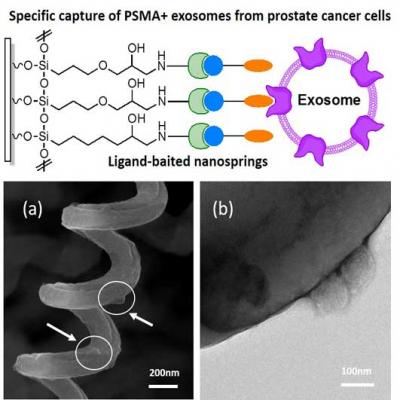
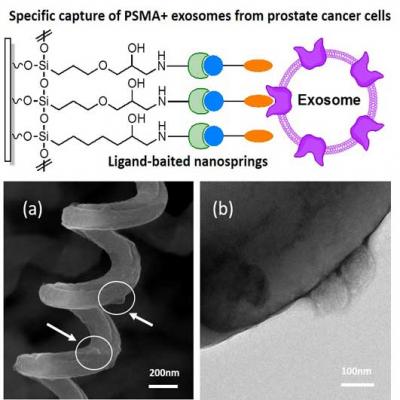
In a new paper in Springer's Journal of Materials Science, researchers at Washington State University report a new approach for the effective capture of tumor-derived exosomes from a prostate cancer cell line. Exosomes are small secreted vesicles that play a key role in intercellular communication and cancer progression.

Developing effective and high-throughput selective capture technology for exosomes bearing the prostate-specific membrane antigen (PSMA) biomarker is critical for early diagnostic and prognostic evaluation of prostate cancer and treatment planning. It is known that the prostate tumor enzyme-biomarker PSMA is highly enriched in exosomes secreted by PSMA+ prostate cancer cells. A novel biofunctionalized silica nanostructure was designed to selectivity capture tumor-derived exosomes through the interaction of a known PSMA ligand with the PSMA on the exosomes.

This work enables a non-invasive approach for diagnosis and prognosis of prostate cancer. It overcomes many of the limitations of alternative approaches that are often ineffective in isolating tumor-derived exosomes from those derived from normal tissue because of the low recovery yields and the time required for the process.

The concept was demonstrated using a single cancer type (i.e., prostate cancer), but based on the data presented in this study, the authors expect that a broad panel of biomarker ligands can be baited on the silica nanostructures to selectively capture biomarker-positive exosomes from an array of cell types. Further advantages of the approach used in this study are the ability to isolate a specific subpopulation of exosomes relying on the expression of a specific surface marker as well as improved exosome recovery rate. In the future, the authors envision a microfluidic flow device that will allow for increased exosome capture efficiency and clinical applications.

###

Reference: Parissa Ziaei, Jonathan J. Geruntho, Oscar Marin-Flores, Clifford E. Berkman, M. Grant Norton. (2017). Silica Nanostructured Platform for Affinity Capture of Tumor-Derived Exosomes, Journal of Materials Science. DOI 10.1007/s10853-017-0905-0

Media Contact

Joan Robinson
[email protected]
49-622-148-78130
@SpringerNature

http://www.springer.com

############

Story Source: Materials provided by Scienmag

Share12Tweet8Share2ShareShareShare2

Related Posts

Dried blood spots reliably quantify HBV DNA and detect HBeAg

Dried blood spots reliably quantify HBV DNA and detect HBeAg

September 3, 2026
GABAergic signaling shapes immune responses in Trichinella-infected dendritic cells

GABAergic signaling shapes immune responses in Trichinella-infected dendritic cells

September 3, 2026

Sugarcane Waste Transformed Into Biodegradable Films to Rival Plastic Packaging

September 3, 2026

Panda-livestock interface reveals divergent virus-sharing patterns

September 3, 2026
Please login to join discussion

POPULAR NEWS

  • Dried blood spots reliably quantify HBV DNA and detect HBeAg

    29 shares
    Share 12 Tweet 7
  • GABAergic signaling shapes immune responses in Trichinella-infected dendritic cells

    29 shares
    Share 12 Tweet 7
  • Sugarcane Waste Transformed Into Biodegradable Films to Rival Plastic Packaging

    29 shares
    Share 12 Tweet 7
  • Panda-livestock interface reveals divergent virus-sharing patterns

    29 shares
    Share 12 Tweet 7

About

We bring you the latest biotechnology news from best research centers and universities around the world. Check our website.

Follow us

Recent News

Dried blood spots reliably quantify HBV DNA and detect HBeAg

GABAergic signaling shapes immune responses in Trichinella-infected dendritic cells

Sugarcane Waste Transformed Into Biodegradable Films to Rival Plastic Packaging

Subscribe to Blog via Email

Enter your email address to subscribe to this blog and receive notifications of new posts by email.

Join 85 other subscribers
  • Contact Us

Bioengineer.org © Copyright 2023 All Rights Reserved.

Welcome Back!

Login to your account below

Forgotten Password?

Retrieve your password

Please enter your username or email address to reset your password.

Log In
No Result
View All Result
  • Homepages
    • Home Page 1
    • Home Page 2
  • News
  • National
  • Business
  • Health
  • Lifestyle
  • Science

Bioengineer.org © Copyright 2023 All Rights Reserved.