Sweat contains biomarkers that can monitor various health conditions, from diabetes to genetic disorders. Sweat sampling, unlike blood collection, is preferred by users due to its painless nature. However, to obtain sufficient nutrients or hormones from sweat for testing, intense physical activity was previously required to induce sweat. This method posed challenges for individuals with limited mobility.
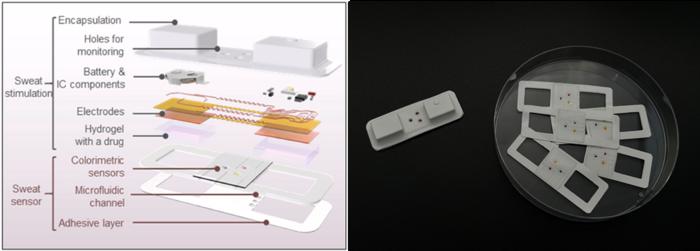
Credit: Korea Institute of Science and Technology
Sweat contains biomarkers that can monitor various health conditions, from diabetes to genetic disorders. Sweat sampling, unlike blood collection, is preferred by users due to its painless nature. However, to obtain sufficient nutrients or hormones from sweat for testing, intense physical activity was previously required to induce sweat. This method posed challenges for individuals with limited mobility.
Dr. Kim Joohee from the Bionics Research Center at the Korea Institute of Science and Technology (KIST, Director Oh Sangrok) and Professor John A. Rogers from Northwestern University jointly announced the development of a convenient sweat monitoring device that does not require physical activity but delivers drug stimulation through the skin. Unlike previous methods that induced sweat through exercise, this device delivers drugs that stimulate sweat glands through the skin.
The research team developed a flexible device capable of delivering drugs to sweat glands by applying a current to a hydrogel containing drugs. This device, which is small and soft, can be easily attached to the skin. Sweat induced by the drug is collected in microfluidic channels within the device and analyzed for biomarkers using biosensors. This enables the analysis of biomarkers in sweat, reducing the need for cumbersome hospital visits for testing and lowering the risk of biomarker contamination during testing, thereby increasing accuracy.
The device developed by the research team was attached to infants with cystic fibrosis, and the chloride concentration, a biomarker in sweat, was confirmed. The results were consistent with those obtained from traditional analysis methods using sweat collected in hospitals, with an accuracy of over 98%. Additionally, the stability of the device on the skin was ensured by confirming skin temperature and pH values. Since cystic fibrosis mainly manifests during infancy, continuous monitoring of disease progression and physical condition is necessary. With this device, monitoring can be easily done at home, reducing the psychological and physical stress on pediatric patients and their caregivers.
This newly developed device contributes to the expansion of non-invasive disease monitoring technology based on sweat in healthy adults as well. Furthermore, the technology of delivering drugs through the skin can be utilized not only to induce sweat but also to increase the delivery rate of drugs in localized areas such as skin conditions or wounds, thereby accelerating recovery.
Dr. Kim Joohee stated, “Through two years of collaborative research with Northwestern University, we have not only addressed the limitations of existing methods for inducing sweat but also achieved success in clinical research, bringing us one step closer to commercialization.” Professor John A. Rogers added, “We plan to conduct large-scale clinical studies and commercialization, including adults, in the future.”
###
KIST was established in 1966 as the first government-funded research institute in Korea. KIST now strives to solve national and social challenges and secure growth engines through leading and innovative research. For more information, please visit KIST’s website at https://eng.kist.re.kr/
This research was conducted through KIST’s major projects and the Outstanding Young Researcher Program (RS-2023-00211342) supported by the Ministry of Science and ICT (Minister Lee Jong-ho). The research findings were recently published online in the latest issue of the international journal “Biosensors & Bioelectronics” (IF 12.6).
Journal
Biosensors and Bioelectronics
DOI
10.1016/j.bios.2024.116166
Article Title
A skin-interfaced, miniaturized platform for triggered induction, capture and colorimetric multicomponent analysis of microliter volumes of sweat
Article Publication Date
29-Feb-2024