• HOME
  • NEWS
  • EXPLORE
    • CAREER
      • Companies
      • Jobs
    • EVENTS
    • iGEM
      • News
      • Team
    • PHOTOS
    • VIDEO
    • WIKI
  • BLOG
  • COMMUNITY
    • FACEBOOK
    • INSTAGRAM
    • TWITTER
Saturday, February 7, 2026
BIOENGINEER.ORG
No Result
View All Result
  • Login
  • HOME
  • NEWS
  • EXPLORE
    • CAREER
      • Companies
      • Jobs
        • Lecturer
        • PhD Studentship
        • Postdoc
        • Research Assistant
    • EVENTS
    • iGEM
      • News
      • Team
    • PHOTOS
    • VIDEO
    • WIKI
  • BLOG
  • COMMUNITY
    • FACEBOOK
    • INSTAGRAM
    • TWITTER
  • HOME
  • NEWS
  • EXPLORE
    • CAREER
      • Companies
      • Jobs
        • Lecturer
        • PhD Studentship
        • Postdoc
        • Research Assistant
    • EVENTS
    • iGEM
      • News
      • Team
    • PHOTOS
    • VIDEO
    • WIKI
  • BLOG
  • COMMUNITY
    • FACEBOOK
    • INSTAGRAM
    • TWITTER
No Result
View All Result
Bioengineer.org
No Result
View All Result
Home NEWS Science News Health

Academician Chen Wei’s team reveals a new mechanism of hyaluronic acid with a specific molecular weight (300-400 kDa) improving host inflammation

Bioengineer by Bioengineer
May 24, 2024
in Health
Reading Time: 2 mins read
0
The mechanism of hyaluronic acid alleviating host inflammation
Share on FacebookShare on TwitterShare on LinkedinShare on RedditShare on Telegram

Previous studies on the function of glycosaminoglycans have primarily focused on improving host physiological indices. However, little attention has been paid to the material basis and mechanism of their mediated improvement of host health by gut microbiota. In this study, the research team focused on investigating the effect of hyaluronic acid with various molecular weights. Utilizing a combination of multi-model and multi-omics technologies, the researchers established that hyaluronic acid with a specific molecular weight (300-400 kDa) can significantly mitigate inflammatory responses in mice. This effect is dependent on gut Bacteroides thetaiotaomicron and Bacteroides caccae, along with their crucial metabolite-myristic acid.
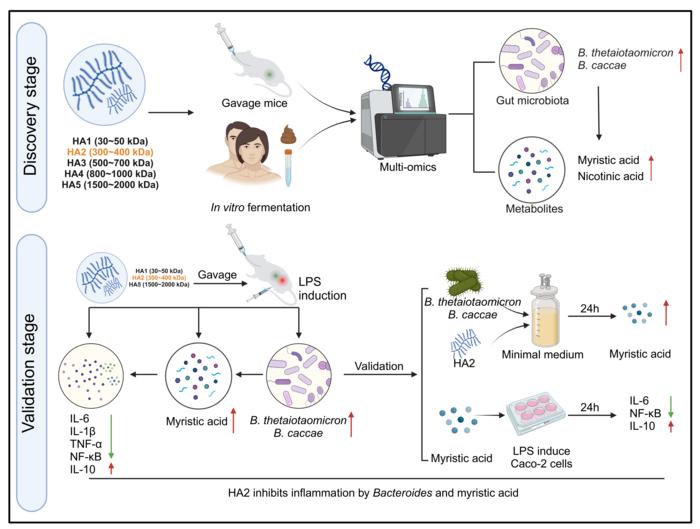
The mechanism of hyaluronic acid alleviating host inflammation

Credit: ©Science China Press

Previous studies on the function of glycosaminoglycans have primarily focused on improving host physiological indices. However, little attention has been paid to the material basis and mechanism of their mediated improvement of host health by gut microbiota. In this study, the research team focused on investigating the effect of hyaluronic acid with various molecular weights. Utilizing a combination of multi-model and multi-omics technologies, the researchers established that hyaluronic acid with a specific molecular weight (300-400 kDa) can significantly mitigate inflammatory responses in mice. This effect is dependent on gut Bacteroides thetaiotaomicron and Bacteroides caccae, along with their crucial metabolite-myristic acid.

Furthermore, the authors validated that Bacteroides thetaiotaomicron and Bacteroides caccae can degrade hyaluronic acid in vitro, producing the beneficial metabolite myristic acid. This finding is based on the extensive repository of over 25,000 human gut microbiota strains established by the Center for Food Biotechnology at Jiangnan University’s School of Food Science and Technology. Simultaneously, they demonstrated that Bacteroides thetaiotaomicron and Bacteroides caccae exhibit high intra-species consistency, indicating the existence of specific genetic clusters among these hyaluronic acid-responsive strains.

Additionally, the research team found that hyaluronic acid stimulates Bacteroides to produce myristic acid, which in turn inhibits the NF-κB signaling pathway, thereby reducing cellular inflammation. This study identified the optimal molecular weight range of hyaluronic acid to improve host inflammation, elucidated the material basis and molecular mechanisms of gut effect strains, provided biomarkers for dietary polysaccharide strategies to alleviate host inflammation, and offered new strategies and insights for the efficient screening of microbiota-directed foods.

See the article:

Hyaluronic acid modulates gut microbiota and metabolites relieving inflammation: a molecular weight-dependent study


Journal

Science Bulletin

DOI

10.1016/j.scib.2024.04.010

Share12Tweet8Share2ShareShareShare2

Related Posts

Evaluating Pediatric Emergency Care Quality in Ethiopia

February 7, 2026

TPMT Expression Predictions Linked to Azathioprine Side Effects

February 7, 2026

Improving Dementia Care with Enhanced Activity Kits

February 7, 2026

Decoding Prostate Cancer Origins via snFLARE-seq, mxFRIZNGRND

February 7, 2026

POPULAR NEWS

  • Robotic Ureteral Reconstruction: A Novel Approach

    Robotic Ureteral Reconstruction: A Novel Approach

    82 shares
    Share 33 Tweet 21
  • Digital Privacy: Health Data Control in Incarceration

    63 shares
    Share 25 Tweet 16
  • Study Reveals Lipid Accumulation in ME/CFS Cells

    57 shares
    Share 23 Tweet 14
  • Breakthrough in RNA Research Accelerates Medical Innovations Timeline

    53 shares
    Share 21 Tweet 13

About

We bring you the latest biotechnology news from best research centers and universities around the world. Check our website.

Follow us

Recent News

Evaluating Pediatric Emergency Care Quality in Ethiopia

TPMT Expression Predictions Linked to Azathioprine Side Effects

Improving Dementia Care with Enhanced Activity Kits

Subscribe to Blog via Email

Success! An email was just sent to confirm your subscription. Please find the email now and click 'Confirm' to start subscribing.

Join 73 other subscribers
  • Contact Us

Bioengineer.org © Copyright 2023 All Rights Reserved.

Welcome Back!

Login to your account below

Forgotten Password?

Retrieve your password

Please enter your username or email address to reset your password.

Log In
No Result
View All Result
  • Homepages
    • Home Page 1
    • Home Page 2
  • News
  • National
  • Business
  • Health
  • Lifestyle
  • Science

Bioengineer.org © Copyright 2023 All Rights Reserved.