• HOME
  • NEWS
  • EXPLORE
    • CAREER
      • Companies
      • Jobs
    • EVENTS
    • iGEM
      • News
      • Team
    • PHOTOS
    • VIDEO
    • WIKI
  • BLOG
  • COMMUNITY
    • FACEBOOK
    • INSTAGRAM
    • TWITTER
Saturday, February 7, 2026
BIOENGINEER.ORG
No Result
View All Result
  • Login
  • HOME
  • NEWS
  • EXPLORE
    • CAREER
      • Companies
      • Jobs
        • Lecturer
        • PhD Studentship
        • Postdoc
        • Research Assistant
    • EVENTS
    • iGEM
      • News
      • Team
    • PHOTOS
    • VIDEO
    • WIKI
  • BLOG
  • COMMUNITY
    • FACEBOOK
    • INSTAGRAM
    • TWITTER
  • HOME
  • NEWS
  • EXPLORE
    • CAREER
      • Companies
      • Jobs
        • Lecturer
        • PhD Studentship
        • Postdoc
        • Research Assistant
    • EVENTS
    • iGEM
      • News
      • Team
    • PHOTOS
    • VIDEO
    • WIKI
  • BLOG
  • COMMUNITY
    • FACEBOOK
    • INSTAGRAM
    • TWITTER
No Result
View All Result
Bioengineer.org
No Result
View All Result
Home NEWS Science News Health

Innovative imaging technique may revolutionize ureteral thermal injury detection

Bioengineer by Bioengineer
May 21, 2024
in Health
Reading Time: 3 mins read
0
Ureteral electrothermal injury, characterized by damaged collagen bundles, with swelling and fragmentation of smooth muscle fibers, is visible via histology ex vivo (left panel, 20× magnification).
Share on FacebookShare on TwitterShare on LinkedinShare on RedditShare on Telegram

In a groundbreaking study, scientists have explored a novel approach to detect electrothermal ureteral injuries, a common complication during pelvic surgery. The ureters, delicate tubes that transport urine from the kidneys to the bladder, are particularly vulnerable due to their proximity to other anatomical structures. Unfortunately, current detection methods often fall short in promptly identifying subtle thermal injuries, which can take days or even weeks to manifest.
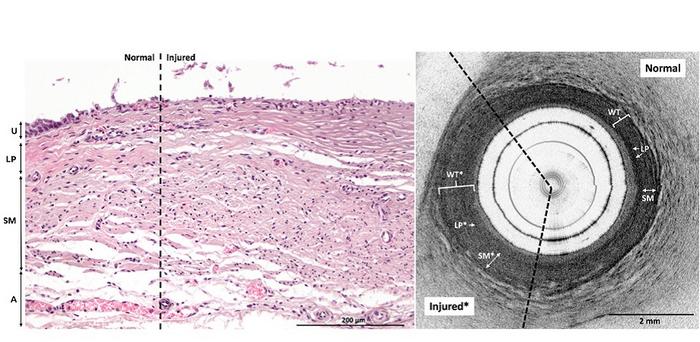
Ureteral electrothermal injury, characterized by damaged collagen bundles, with swelling and fragmentation of smooth muscle fibers, is visible via histology ex vivo (left panel, 20× magnification).

Credit: Long et al., doi 10.1117/1.BIOS.1.1.015001.

In a groundbreaking study, scientists have explored a novel approach to detect electrothermal ureteral injuries, a common complication during pelvic surgery. The ureters, delicate tubes that transport urine from the kidneys to the bladder, are particularly vulnerable due to their proximity to other anatomical structures. Unfortunately, current detection methods often fall short in promptly identifying subtle thermal injuries, which can take days or even weeks to manifest.

Enter optical coherence tomography (OCT) endoscopy—a minimally invasive imaging technique that may revolutionize ureteral injury detection. In research reported in Biophotonics Discovery (BIOS), an interdisciplinary team led by researchers from the University of Arizona’s Department of Biomedical Engineering externally applied electrothermal energy to explanted pig ureters, simulating a spectrum of injury severity. Immediately afterward, they performed OCT endoscopy and compared the resulting images to histology as the gold standard for interpretation.

The findings were remarkable. Lesion size on OCT images correlated with the treatment power used, providing a quantitative measure of injury severity. Moreover, qualitative markers of injury were detectable in nearly all cases, except for one lesion treated at low power. Physicians, trained to identify these features based on established criteria, achieved an impressive average sensitivity of 82 percent and specificity of 96 percent in lesion detection.

Despite the study’s small sample size and its ex vivo nature (meaning the experiments were conducted outside a living organism), the results suggest that OCT endoscopy holds great promise. By enabling timely and accurate identification of electrothermal ureteral injury, this innovative technique could significantly improve patient outcomes and reduce postoperative complications. Surgeons may soon have a powerful tool at their disposal—one that enhances safety and precision during pelvic surgeries.

BIOS Editor-in-Chief Darren Roblyer of Boston University remarks, “This study provides an important step towards protecting patients from ureteral injuries during pelvic surgery. OCT is label-free, safe for the patient, and can be integrated into a remarkably small-diameter endoscope, provide a potentially excellent means for detecting and ultimately preventing these unfortunate injuries.”

The study’s authors recommend further clinical validation to confirm their promising results. 

For details, see the original Gold Open Access article by D. J. Long et al., “Optical coherence tomography for the detection of electrothermal ureteral injury in an ex-vivo porcine model,” Biophoton. Discovery 1(1) 015001 (2024), doi 10.1117/1.BIOS.1.1.015001.

The article is published in the inaugural issue of Biophotonics Discovery.


DOI

10.1117/1.BIOS.1.1.015001

Article Title

Optical coherence tomography for the detection of electrothermal ureteral injury in an ex-vivo porcine model

Article Publication Date

20-May-2024

Share12Tweet8Share2ShareShareShare2

Related Posts

Oxygen-Enhanced Dual-Section Microneedle Patch Improves Drug Delivery and Boosts Photodynamic and Anti-Inflammatory Treatment for Psoriasis

February 7, 2026

Scientists Identify SARS-CoV-2 PLpro and RIPK1 Inhibitors Showing Potent Synergistic Antiviral Effects in Mouse COVID-19 Model

February 7, 2026

Neg-Entropy: The Key Therapeutic Target for Chronic Diseases

February 7, 2026

Multidisciplinary Evidence-Based Guidelines for Therapeutic Drug Monitoring of Biologics in Inflammatory Bowel Disease

February 7, 2026

POPULAR NEWS

  • Robotic Ureteral Reconstruction: A Novel Approach

    Robotic Ureteral Reconstruction: A Novel Approach

    82 shares
    Share 33 Tweet 21
  • Digital Privacy: Health Data Control in Incarceration

    63 shares
    Share 25 Tweet 16
  • Study Reveals Lipid Accumulation in ME/CFS Cells

    57 shares
    Share 23 Tweet 14
  • Breakthrough in RNA Research Accelerates Medical Innovations Timeline

    53 shares
    Share 21 Tweet 13

About

We bring you the latest biotechnology news from best research centers and universities around the world. Check our website.

Follow us

Recent News

Oxygen-Enhanced Dual-Section Microneedle Patch Improves Drug Delivery and Boosts Photodynamic and Anti-Inflammatory Treatment for Psoriasis

Scientists Identify SARS-CoV-2 PLpro and RIPK1 Inhibitors Showing Potent Synergistic Antiviral Effects in Mouse COVID-19 Model

Neg-Entropy: The Key Therapeutic Target for Chronic Diseases

Subscribe to Blog via Email

Enter your email address to subscribe to this blog and receive notifications of new posts by email.

Join 73 other subscribers
  • Contact Us

Bioengineer.org © Copyright 2023 All Rights Reserved.

Welcome Back!

Login to your account below

Forgotten Password?

Retrieve your password

Please enter your username or email address to reset your password.

Log In
No Result
View All Result
  • Homepages
    • Home Page 1
    • Home Page 2
  • News
  • National
  • Business
  • Health
  • Lifestyle
  • Science

Bioengineer.org © Copyright 2023 All Rights Reserved.