The BESIII experiment at the Beijing Electron Positron Collider II (BEPCII) has recently marked a significant achievement. It has made the first measurements of the quantum numbers of the X(2370) particle, along with measurements of its mass, production, and decay properties. These results are consistent with the features of a glueball, which has long been the subject of an intensive experimental search. The study was published in Physical Review Letters on May 2 as an Editor’s Suggestion.
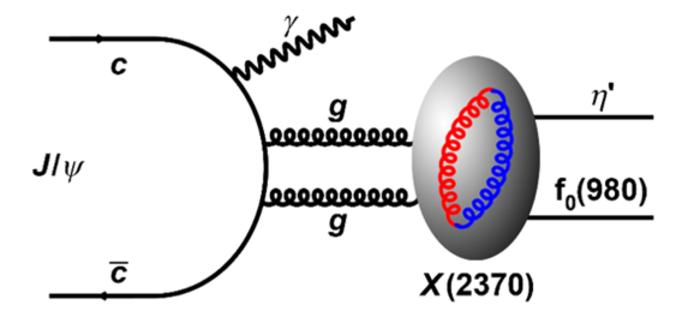
Credit: Image by Institute of High Energy Physics
The BESIII experiment at the Beijing Electron Positron Collider II (BEPCII) has recently marked a significant achievement. It has made the first measurements of the quantum numbers of the X(2370) particle, along with measurements of its mass, production, and decay properties. These results are consistent with the features of a glueball, which has long been the subject of an intensive experimental search. The study was published in Physical Review Letters on May 2 as an Editor’s Suggestion.
In the Standard Model (SM) of particle physics, the strong nuclear force is described by Quantum Chromodynamics (QCD). Gluons are the fundamental particles mediating the strong interactions, just as photons mediate electromagnetic interactions. Within this framework, gluons can attract each other to form new bound states called glueballs. The existence of glueballs is an important prediction of the SM, and they are the only particles in nature composed of force mediators only. The existence of these bound states is a crucial and fundamental test of the SM, but no candidates have yet been unambiguously identified.
Decays of the J/ψ particle produce a gluon-rich environment and are an ideal place to search for glueballs. The very large and clean samples of J/ψ decays collected by the BESIII experiment are therefore extremely interesting. Glueball searches have been one of the most important physical goals of BEPC and BEPCII for decades.
The X(2370) particle was first discovered by the BESIII experiment in 2011. This was the first observation of a particle whose mass, production, and decay properties are consistent with the pseudoscalar glueball (a glueball with quantum numbers of zero spin and negative parity) predicted by SM theory. To confirm the pseudoscalar glueball state experimentally, the most crucial step is to determine whether the spin parity quantum numbers of the X(2370) are indeed zero spin and negative parity.
The BESIII detector at BEPCII has successfully collected about 10 billion J/ψ decays in recent years, more than 100 times more than in previous experiments. With these large samples, a detailed study of one of the X(2370) decay modes in an environment almost entirely free of background contamination was performed.
Due to the excellent design of the BESIII detector, which provides high-precision detection of charged particles and photons, the signal-to-noise ratio has been greatly improved.
Through a complex quantum state interference analysis, the Collaboration performed the first measurement of the spin-parity quantum numbers of the X(2370), as well as the measurement of its mass and yield. The experimental results are consistent with the features of the lightest pseudoscalar glueball predicted by the SM, which provides strong experimental evidence supporting the existence of glueballs.
Journal
Physical Review Letters
DOI
10.1103/PhysRevLett.132.181901
Article Title
Determination of Spin-Parity Quantum Numbers of X(2370) as 0−+ from J/ψ→γK0SK0Sη′
Article Publication Date
2-May-2024