ATLANTA – Chemical Insights Research Institute (CIRI) of UL Research Institutes applies cutting edge technologies to evaluate the toxicity of burn-impacted land areas affected by the August 2023 Lahaina wildfires. Created with CIRI research partners from Duke University and the East-West Center (EWC) in Hawai’i, the study known as Lahaina Environmental Assessment Project (LEAP), will collect and analyze residual dust, soil and ash samples from properties affected by the fires. These residues, including fine dust, can infiltrate schools, homes and office buildings and can also be recirculated into the air. Exposure may contribute to acute and chronic health concerns from inhalation of the dust or ingestion from frequent hand to mouth transfer. Residues may also contaminate the local ecosystem and wash into waterways.
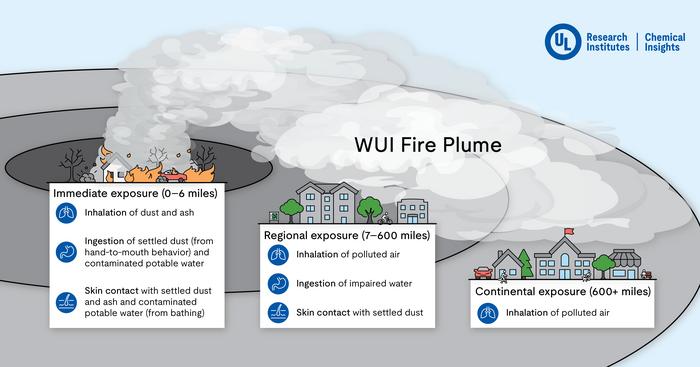
Credit: Chemical Insights Research Institute of UL Research Institutes
ATLANTA – Chemical Insights Research Institute (CIRI) of UL Research Institutes applies cutting edge technologies to evaluate the toxicity of burn-impacted land areas affected by the August 2023 Lahaina wildfires. Created with CIRI research partners from Duke University and the East-West Center (EWC) in Hawai’i, the study known as Lahaina Environmental Assessment Project (LEAP), will collect and analyze residual dust, soil and ash samples from properties affected by the fires. These residues, including fine dust, can infiltrate schools, homes and office buildings and can also be recirculated into the air. Exposure may contribute to acute and chronic health concerns from inhalation of the dust or ingestion from frequent hand to mouth transfer. Residues may also contaminate the local ecosystem and wash into waterways.
CIRI is applying a combination of real-time and laboratory analytical chemistry techniques with high-resolution environmental sampling maps to determine the spatial relationships among the locations, types, and levels of volatile organic compounds (VOCs) and metals associated with fire residues. Samples from over 60 properties in the fire-affected areas are being collected for study. Information gained will contribute to scientific knowledge on health risks of toxic residues left in the aftermath of wildland urban interface (WUI) specific fires. Currently, there is little data on this topic, yet WUI fires are exponentially growing, adversely affecting local communities and extended regions.
“An understanding of these risks is critical to mitigating people exposure and developing community clean up and land reuse strategies,” said Dr. Marilyn Black, VP and Senior Technical Advisor for CIRI, who also co-authored the National Academy’s report titled, The Chemistry of Fires at the Wildland-Urban Interface. “CIRI’s scientific advances with the assistance of its research partners at Duke and EWC will help unravel the complexities of WUI fires, the fate of resulting contamination, and steps for protecting public health.”
“With more than 4,500 households displaced by the fires, the likely contamination of the soil, water, and air is also an important factor in the rebuilding process from a public health perspective,” according to Dr. Sumeet Saksena, Senior Fellow at the East-West Center. “We are working to identify sources on the properties that may have led to unique contamination when they burned, such as vehicles, solar panels, and home appliances.”
Analysis of the samples will be done in CIRI’s Center for Advanced Measurements in Marietta, Georgia. CIRI will use its newly developed environmental Dust VOC (DVOC)™ methodology to analyze a wide range of VOCs in one sample with detection in the parts-per-trillion level. Preliminary evaluations of Maui burn residue using CIRI’s methodology have identified over 500 different VOCs that can be assessed for health concerns. Preliminary analyses of the residue samples also found the presence of metals of concern including arsenic, lead, chromium and lithium.
CIRI’s research plan can be reviewed here.
About Chemical Insights Research Institute:
Chemical Insights Research Institute (CIRI) of UL Research Institutes is a nonprofit organization dedicated to scientific research, publication, education, and communication on environmental exposures resulting from technologies and practices, their impact on human health, and processes for reducing health risks. CIRI provides actionable data and resources to help manufacturers, educators, healthcare providers, and consumers make informed environmental health decisions and risk reduction strategies for the protection of human health.
About UL Research Institutes
UL Research Institutes is a nonprofit research organization dedicated to advancing public safety through scientific discovery. Since 1894, our research has advanced our mission toward a safer, more secure, and sustainable future. Focused on global risks from fire mitigation and air quality to safe energy storage and digital privacy, we conduct rigorous independent research, analyze safety data and partner with experts to uncover and act on existing and emerging risks to human safety.
About East-West Center
The East-West Center was established by the United States Congress in 1960 as a national educational institution to foster better relations and understanding among the peoples of the United States, Asia, and the Pacific islands through programs of cooperative study, training, and research.
About Duke University Exposure Biology and Chemistry (EBC) Lab
The Exposure Biology and Chemistry Laboratory at Duke University is located at the Nicholas School of the Environment Levine Science Research Center (LSRC) building and hosts 1,100 sq ft of wet laboratory space for the analysis of environmental and biological samples. EBC Lab, directed by Prof. Jim Zhang who is a collaborator on the LEAP study, develops novel biomarkers of environmental exposures and supports research that assesses pathophysiological changes caused by environmental exposures. Laboratory site: http://sites.globalhealth.duke.edu/ebclab.
Media Contacts:
Bert Kelly
Chemical Insights Research Institute
Derek Ferrar
East-West Center