• HOME
  • NEWS
  • EXPLORE
    • CAREER
      • Companies
      • Jobs
    • EVENTS
    • iGEM
      • News
      • Team
    • PHOTOS
    • VIDEO
    • WIKI
  • BLOG
  • COMMUNITY
    • FACEBOOK
    • INSTAGRAM
    • TWITTER
Wednesday, April 1, 2026
BIOENGINEER.ORG
No Result
View All Result
  • Login
  • HOME
  • NEWS
  • EXPLORE
    • CAREER
      • Companies
      • Jobs
        • Lecturer
        • PhD Studentship
        • Postdoc
        • Research Assistant
    • EVENTS
    • iGEM
      • News
      • Team
    • PHOTOS
    • VIDEO
    • WIKI
  • BLOG
  • COMMUNITY
    • FACEBOOK
    • INSTAGRAM
    • TWITTER
  • HOME
  • NEWS
  • EXPLORE
    • CAREER
      • Companies
      • Jobs
        • Lecturer
        • PhD Studentship
        • Postdoc
        • Research Assistant
    • EVENTS
    • iGEM
      • News
      • Team
    • PHOTOS
    • VIDEO
    • WIKI
  • BLOG
  • COMMUNITY
    • FACEBOOK
    • INSTAGRAM
    • TWITTER
No Result
View All Result
Bioengineer.org
No Result
View All Result
Home NEWS Science News Chemistry

A second chance for new antibiotic agent

Bioengineer by Bioengineer
May 16, 2024
in Chemistry
Reading Time: 2 mins read
0
Bacterial culture
Share on FacebookShare on TwitterShare on LinkedinShare on RedditShare on Telegram

Significant attempts 20 years ago
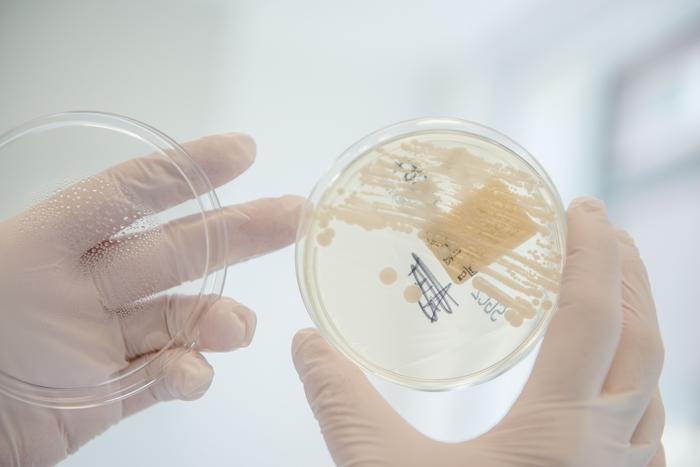
Bacterial culture

Credit: © RUB, Marquard

Significant attempts 20 years ago

The study focused on the protein peptide deformylase (PDF). Involved in protein maturation processes in cells, PDF is essential for the survival of bacteria. However, it’s found in both bacteria and human cells. “Some 20 years ago, significant attempts were made to combat PDF with antibiotic agents,” Raphael Stoll points out. “Yet, the original drug candidate, i.e. actinonin, had to be discarded for several reasons. One of the problems faced was the newly discovered human PDF, which was potentially associated with side effects. Still, further research was carried out to generate modified active compounds,” Hendrik Kirschner adds. As part of his doctoral thesis, he examined PDF in detail in the current study and analysed it from the perspective of structural biology using biomolecular nuclear magnetic resonance (NMR) spectroscopy and X-ray crystallography. These techniques enabled him to obtain a 3D structure resolved at the smallest detail. “This is the result of many years of collaborating with our colleague Professor Eckhard Hofmann,” Raphael Stoll says.

Active molecule is adapted and made more selective

“We can use these techniques to visualize surfaces and binding pockets of biomolecules and show that the binding of molecule to this protein is not static, but dynamic,” Hendrik Kirschner explains. The researchers noticed that there are two different binding orientations in the protein for a modified drug molecule: In addition to the orientation that is also present in human PDF, there’s another one that should, in principle, exclusively occur in bacterial PDF. “This prompts us to modify the drug molecule so that it favours the second binding orientation,” Raphael Stoll says. As a result, the antibiotic molecule could be rendered more selective. “It could provide this drug candidate with a second chance,” Hendrik Kirschner concludes.


Journal

Journal of Medicinal Chemistry

DOI

10.1021/acs.jmedchem.3c02382

Method of Research

Experimental study

Subject of Research

Cells

Article Title

Toward More Selective Antibiotic Inhibitors: A Structural View of the Complexed Binding Pocket of E. coli Peptide Deformylase

Article Publication Date

4-Apr-2024

Share12Tweet8Share2ShareShareShare2

Related Posts

Creating Desktop Particle Accelerators to Open New Frontiers in Scientific Research

Creating Desktop Particle Accelerators to Open New Frontiers in Scientific Research

April 1, 2026
Photochargeable Semiconductor Powers Efficient Amine Coupling

Photochargeable Semiconductor Powers Efficient Amine Coupling

April 1, 2026

From Cells to Smart Gels: Advancing Frontiers in Motion Science

March 31, 2026

Tides Amplify Biochar’s Carbon Capture Efficiency in Coastal Wetlands

March 31, 2026

POPULAR NEWS

  • blank

    Revolutionary AI Model Enhances Precision in Detecting Food Contamination

    96 shares
    Share 38 Tweet 24
  • Imagine a Social Media Feed That Challenges Your Views Instead of Reinforcing Them

    1006 shares
    Share 398 Tweet 249
  • Promising Outcomes from First Clinical Trials of Gene Regulation in Epilepsy

    51 shares
    Share 20 Tweet 13
  • Popular Anti-Aging Compound Linked to Damage in Corpus Callosum, Study Finds

    43 shares
    Share 17 Tweet 11

About

We bring you the latest biotechnology news from best research centers and universities around the world. Check our website.

Follow us

Recent News

Tracking Research on Adult Outcomes After Complex Perinatal History

Unveiling the Biological Pathways Linking Pesticides to Cancer Risk: New Study Sheds Light on Environmental Health Impacts

Inequities in Family Engagement Within the NICU

Subscribe to Blog via Email

Success! An email was just sent to confirm your subscription. Please find the email now and click 'Confirm' to start subscribing.

Join 78 other subscribers
  • Contact Us

Bioengineer.org © Copyright 2023 All Rights Reserved.

Welcome Back!

Login to your account below

Forgotten Password?

Retrieve your password

Please enter your username or email address to reset your password.

Log In
No Result
View All Result
  • Homepages
    • Home Page 1
    • Home Page 2
  • News
  • National
  • Business
  • Health
  • Lifestyle
  • Science

Bioengineer.org © Copyright 2023 All Rights Reserved.