‘Dust clouds’ at the bottom of the deep sea, that will be created by deep-sea mining activities, descend at a short distance for the biggest part. That is shown by PhD research of NIOZ marine geologist Sabine Haalboom, on the bottom of the Pacific Ocean. Yet, a small portion of the stirred-up bottom material remains visible in the water at long distances. “These waters are normally crystal clear, so deep-sea mining could indeed have a major impact on deep-sea life,” Haalboom states in her dissertation that she defends at Utrecht University on May 31st.
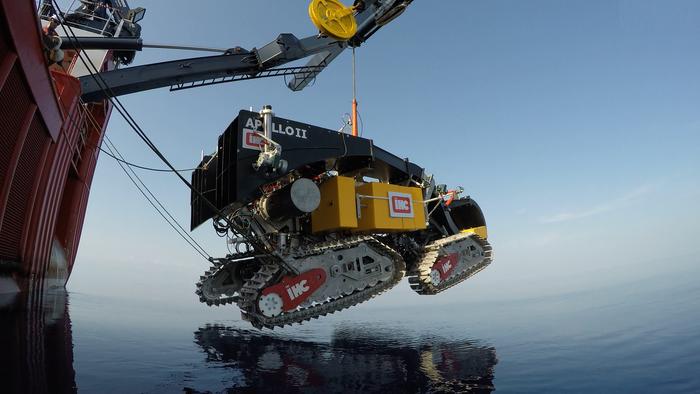
Credit: Photo courtesy: Alberto Serrano.
‘Dust clouds’ at the bottom of the deep sea, that will be created by deep-sea mining activities, descend at a short distance for the biggest part. That is shown by PhD research of NIOZ marine geologist Sabine Haalboom, on the bottom of the Pacific Ocean. Yet, a small portion of the stirred-up bottom material remains visible in the water at long distances. “These waters are normally crystal clear, so deep-sea mining could indeed have a major impact on deep-sea life,” Haalboom states in her dissertation that she defends at Utrecht University on May 31st.
Unidentified Living Organisms between manganese nodules
Currently, the international community is still discussing the possibilities and conditions for mining valuable metals from the bottom of the deep sea. This so-called deep-sea mining may take place at depths where very little is known about underwater life. Among other things, the silt at the bottom of the deep sea, which will be stirred up when extracting manganese nodules, for example, is a major concern. Since life in the deep sea is largely unknown, clouding the water will definitely create completely unknown effects.
Variety of instruments
For her research, Haalboom conducted experiments with different instruments to measure the amount and also the size of suspended particles in the water. At the bottom of the Clarion Clipperton Zone, a vast area in the depths of the Pacific Ocean, Haalboom performed measurements with those instruments before and after a grid with 500 kilograms of steel chains had been dragged across the bottom.
Still murky for a long time
“The first thing that strikes you when you take measurements in that area, is how unimaginably clear the water naturally is,” Haalboom says. “After we dragged the chains back and forth over a 500-meter stretch, the vast majority of the stirred-up material settled within just a few hundred meters. Yet, we also saw that a small portion of the stirred-up bottom material was still visible up to hundreds of meters from the test site and meters above the bottom. The water was a lot murkier than normal at long distances from the test site.”
In a follow-up study, in which PhD candidate Haalboom was not involved, the ‘dust clouds’ were visible even up to five kilometers away from the test site.
Scarce food in clear water
International companies that are competing for concessions to extract the scarce metals from the deep-sea floor, are seizing on the results of these initial trials as an indication of the low impact of deep-sea mining on bottom life. Yet, that is not justifiable, says the co-promoter of Haalboom’s research, NIOZ oceanographer Henko de Stigter. “Sure, based on this PhD research and also based on follow-up research, we know that the vast majority of the dust settles quickly. But when you take in consideration how clear these waters normally are, and that deep-sea life depends on the very scarce food in the water, that last little bit could have a big impact.”
Too early to decide
Both Haalboom and De Stigter urge more research before firm statements can be made about the impact of deep-sea mining. “It is really too soon to say at this point how harmful or how harmless that last bit of dust is that can be spread over such great distances”, De Stigter emphasizes.
DOI
10.33540/2217
Method of Research
News article
Subject of Research
Not applicable