Everyone experiences aging in their own way, and factors such as genetics, lifestyle and environment play a role in this process. Some individuals reach the age of 90 or even 100 in good health, without medications or brain disease. But how do these individuals maintain their health as they age?
Credit: Netherlands Institute for Neuroscience
Everyone experiences aging in their own way, and factors such as genetics, lifestyle and environment play a role in this process. Some individuals reach the age of 90 or even 100 in good health, without medications or brain disease. But how do these individuals maintain their health as they age?
Luuk de Vries from Joost Verhaagen’s group, and his colleagues Dick Swaab and Inge Huitinga, looked at brains from the Netherlands Brain Bank. The Netherlands Brain Bank stores brain tissue from more than 5,000 deceased brain donors with a wide range of different brain diseases. What makes the Netherlands Brain Bank so unique is that, in addition to the stored tissue with very precise neuropathological diagnoses, they also keep the documented medical history and detailed disease course with the symptoms of each donor.
Resilient group
The team found a subgroup of people who had Alzheimer’s disease processes in their brains, but did not show any clinical symptoms while alive. A so-called ‘resilient’ group. But how is it possible that they did not experience any symptoms while others did?
Luuk de Vries: ‘what is happening in these people at a molecular and cellular level was not clear yet. We therefore searched for donors with brain tissue abnormalities who did not show cognitive decline in the Brain Bank. Of all the donors we found 12, so it is quite rare. We think that genetics and lifestyle play an important role in resilience, but the exact mechanism is still unknown.’
Keep challenging yourself
‘Exercise or being cognitively active and having a lot of social contacts can help in delaying the onset of Alzheimer’s disease. It has recently also been found that those who receive a lot of cognitive stimuli, like through a complex job, can build up more Alzheimer’s pathology before developing symptoms. If we can find the molecular basis for resilience, then we have new starting points for the development of medication, which could activate processes related to resilience in Alzheimer’s patients.’
Alzheimer’s versus resilient group
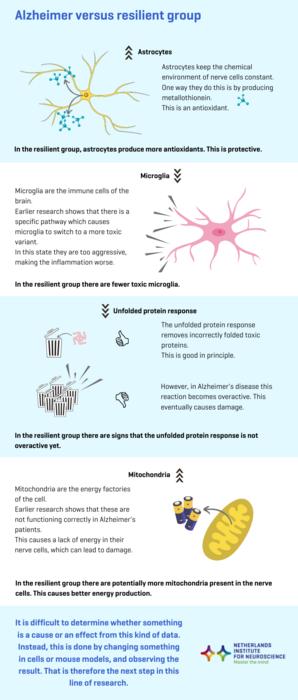
‘When we looked at gene expression, we saw that a number of processes were altered in the resilient group. First of all, the astrocytes appeared to produce more of the antioxidant metallothionein. Astrocytes are like garbage collectors and provide a protective role for the brain. Astrocytes often also ask for help from microglia, but because they can be quite aggressive, they sometimes worsen inflammation. In the resilient group a microglia pathway that’s often linked to Alzheimer’s disease appeared to be less active. In addition, we saw that the so-called “unfolded protein response”, a reaction in brain cells that automatically removes a misfolded toxic protein, was affected in Alzheimer’s patients, but was relatively normal in resilient individuals. Finally, we found indicators that there may also be more mitochondria in the brain cells resilient individuals, which ensures better energy production.’
But what do these differences in processes mean? And is there cause or effect? ‘It remains difficult to determine from human data which process initiates the disease process. You can only demonstrate this by changing something in cells or animal models and seeing what happens next. That is the first thing we have to do now.’
Source: Acta Neuropathol Commun
Journal
Acta Neuropathologica Communications
DOI
10.1186/s40478-024-01760-9
Article Title
Gene-expression profiling of individuals resilient to Alzheimer’s disease reveals higher expression of genes related to metallothionein and mitochondrial processes and no changes in the unfolded protein response