SAN ANTONIO — May 14, 2024 —Southwest Research Institute is investigating an unusual event in the Earth’s magnetotail, the elongated portion of the planet’s magnetosphere trailing away from the Sun. Using data from NASA’s Magnetospheric Multiscale (MMS) mission, SwRI scientists are examining the nature of substorms, fleeting disturbances in the magnetotail that release energy and often cause aurorae.
Since their launch in 2015, the MMS spacecraft have been surveying the magnetopause, the boundary between the magnetosphere and surrounding plasma, for signs of magnetic reconnection, which occurs when magnetic field lines converge, break apart and reconnect, explosively converting magnetic energy into heat and kinetic energy. In 2017, MMS observed signs of magnetic reconnection in the magnetotail but not the normal signs of a substorm that accompany reconnection, such as strong electrical currents and perturbations in the magnetic field.
“We want to see how the local physics observed by MMS affects the entire global magnetosphere,” said SwRI’s Dr. Andy Marshall, a postdoctoral researcher. “By comparing that event to more typical substorms, we are striving to improve our understanding of what causes a substorm and the relationship between substorms and reconnection.”
During the one-year project, SwRI will compare in situ MMS measurements of reconnection affecting local fields and particles to global magnetosphere reconstructions created by the Community Coordinated Modeling Center at NASA’s Goddard Space Flight Center using the University of Michigan’s Space Weather Modeling Framework.
“It’s possible that significant differences exist between the global magnetotail convection patterns for substorms and non-substorm tail reconnection,” Marshall said. “We have not looked at the movement of the magnetic field lines on a global scale, so it could be that this unusual substorm was a very localized occurrence that MMS happened to observe. If not, it could reshape our understanding of the relationship between tail-side reconnection and substorms.”
MMS is the fourth NASA Solar Terrestrial Probes Program mission. Goddard Space Flight Center built, integrated and tested the four MMS spacecraft and is responsible for overall mission management and mission operations. The principal investigator for the MMS instrument suite science team is based at SwRI in San Antonio. Science operations planning and instrument commanding are performed at the MMS Science Operations Center at the University of Colorado’s Laboratory for Atmospheric and Space Physics in Boulder.
For more information, visit https://www.swri.org/planetary-science.
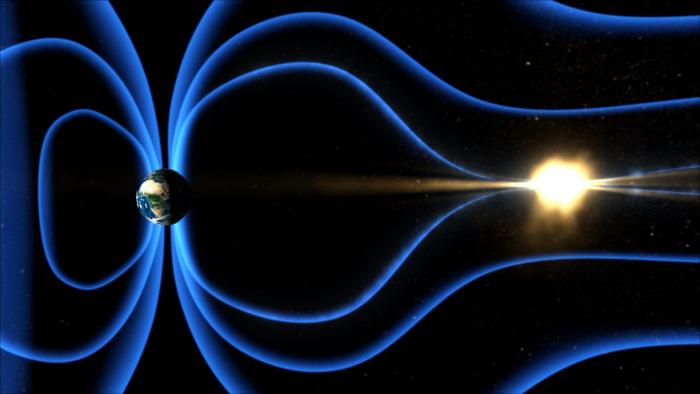
Credit: NASA/Goddard Space Flight Center-Conceptual Image Lab
SAN ANTONIO — May 14, 2024 —Southwest Research Institute is investigating an unusual event in the Earth’s magnetotail, the elongated portion of the planet’s magnetosphere trailing away from the Sun. Using data from NASA’s Magnetospheric Multiscale (MMS) mission, SwRI scientists are examining the nature of substorms, fleeting disturbances in the magnetotail that release energy and often cause aurorae.
Since their launch in 2015, the MMS spacecraft have been surveying the magnetopause, the boundary between the magnetosphere and surrounding plasma, for signs of magnetic reconnection, which occurs when magnetic field lines converge, break apart and reconnect, explosively converting magnetic energy into heat and kinetic energy. In 2017, MMS observed signs of magnetic reconnection in the magnetotail but not the normal signs of a substorm that accompany reconnection, such as strong electrical currents and perturbations in the magnetic field.
“We want to see how the local physics observed by MMS affects the entire global magnetosphere,” said SwRI’s Dr. Andy Marshall, a postdoctoral researcher. “By comparing that event to more typical substorms, we are striving to improve our understanding of what causes a substorm and the relationship between substorms and reconnection.”
During the one-year project, SwRI will compare in situ MMS measurements of reconnection affecting local fields and particles to global magnetosphere reconstructions created by the Community Coordinated Modeling Center at NASA’s Goddard Space Flight Center using the University of Michigan’s Space Weather Modeling Framework.
“It’s possible that significant differences exist between the global magnetotail convection patterns for substorms and non-substorm tail reconnection,” Marshall said. “We have not looked at the movement of the magnetic field lines on a global scale, so it could be that this unusual substorm was a very localized occurrence that MMS happened to observe. If not, it could reshape our understanding of the relationship between tail-side reconnection and substorms.”
MMS is the fourth NASA Solar Terrestrial Probes Program mission. Goddard Space Flight Center built, integrated and tested the four MMS spacecraft and is responsible for overall mission management and mission operations. The principal investigator for the MMS instrument suite science team is based at SwRI in San Antonio. Science operations planning and instrument commanding are performed at the MMS Science Operations Center at the University of Colorado’s Laboratory for Atmospheric and Space Physics in Boulder.
For more information, visit https://www.swri.org/planetary-science.