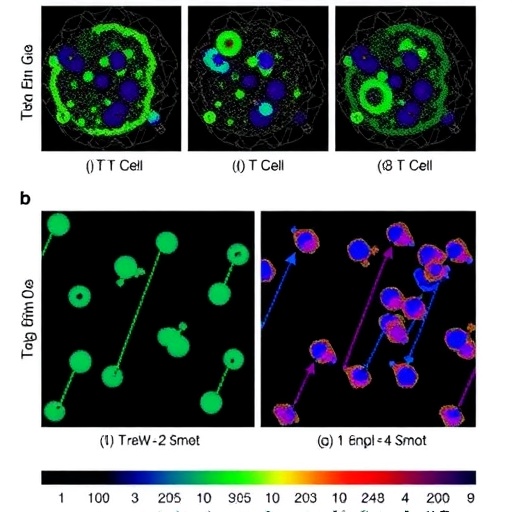
Researchers from Karolinska Institutet, together with Pixelgen Technologies, have developed and applied a technique that makes it possible to map proteins in individual cells in a completely new way, according to a new study in Nature Methods. Not only is it now possible to measure the amount of proteins, but also how they are distributed in the cell’s membrane and how they interact with each other.

Credit: Andreas Lundberg
Researchers from Karolinska Institutet, together with Pixelgen Technologies, have developed and applied a technique that makes it possible to map proteins in individual cells in a completely new way, according to a new study in Nature Methods. Not only is it now possible to measure the amount of proteins, but also how they are distributed in the cell’s membrane and how they interact with each other.
Previously, researchers could only study a limited number of proteins in individual cells using so-called flow cytometry. But the new technique, called molecular pixelation, goes one step further. It is now possible to analyze hundreds of proteins simultaneously and get a more detailed picture of their distribution and interactions in individual cells. This is important because proteins play a crucial role in cellular function and signaling.
“By understanding how proteins behave in individual cells, we can better study diseases such as cancer and inflammatory disorders. In addition, we can use the technique to evaluate new drugs and their impact on the distribution of proteins in cells,” says one of the authors of the study, Petter Brodin, Professor at the Department of Women’s and Children’s Health, Karolinska Institutet, and continues:
“No one else has previously reported a similar technology, which is why this is so unique.
The next step is to use molecular pixelation in research on cancer, the immune system and other processes where protein distribution changes over time, according to Petter Brodin.
“This is exciting because it will open up completely new possibilities in single-cell analysis and contribute to our understanding of biological processes,” says Petter Brodin.
The main funders are the Knut and Alice Wallenberg Foundation, the Swedish Society for Medical Research and the Swedish Research Council. The company Pixelgen is commercializing the technology, and the founders and employees of the company are involved in the study.
Publication: “Molecular Pixelation: Spatial proteomics of single-cells by sequencing”, Filip Karlsson1, Tomasz Kallas, Divya Thiagarajan, Max Karlsson, Maud Schweitzer, Jose Fernandez Navarro, Louise Leijonancker, Sylvain Geny, Erik Pettersson, Jan Rhomberg-Kauert, Ludvig Larsson, Hanna van Ooijen, Stefan Petkov, Marcela Gonzalez Granillo, Jessica Bunz, Johan Dahlberg, Michele Simonetti, Prajakta Sathe, Petter Brodin, Alvaro Martinez Barrio, Simon Fredriksson, Nature Methods, online May 8, 2024.
Journal
Nature Methods
DOI
10.1038/s41592-024-02268-9
Article Title
Molecular pixelation: spatial proteomics of single cells by sequencing
Article Publication Date
8-May-2024