Early embryonic development is tumultuous. It involves a rapid sequence of events, including cell division, differentiation, and lots of compartments moving around within each cell. Like an orchestra performance where each member of the band must start playing at the exact right moment and in perfect harmony, these processes need to be precisely timed and coordinated to ensure the embryo develops normally.
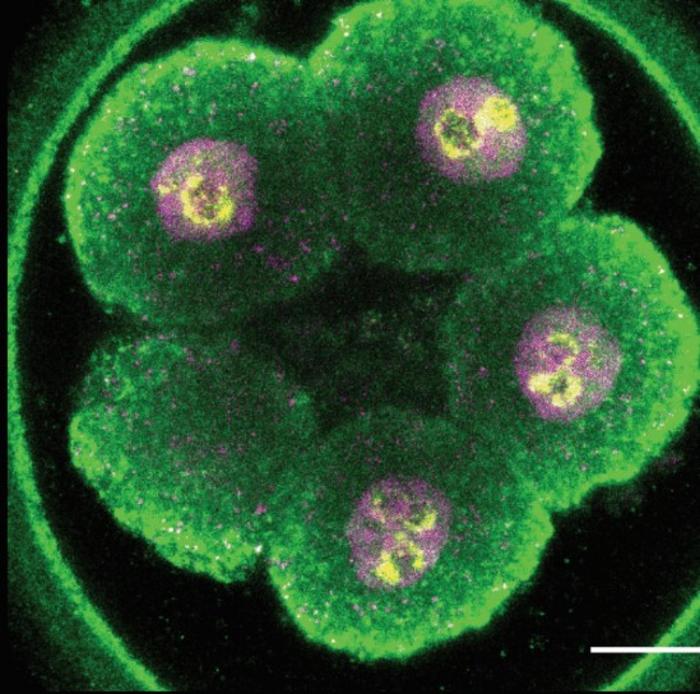
Credit: Shoma Nakagawa/Centro de Regulación Genómica
Early embryonic development is tumultuous. It involves a rapid sequence of events, including cell division, differentiation, and lots of compartments moving around within each cell. Like an orchestra performance where each member of the band must start playing at the exact right moment and in perfect harmony, these processes need to be precisely timed and coordinated to ensure the embryo develops normally.
How cells make sense of this chaos at the very beginning of an embryo’s development is an open question. The protein NKX1-2 a crucial role, according to a new study published today in the journal Stem Cell Reports by ICREA Research Professor Pia Cosma at the Centre for Genomic Regulation (CRG) in Barcelona and Professor Andrea Califano President of the Chan Zuckerberg Biohub New York and Professor at Columbia University.
NKX1-2 behaves like an orchestra’s conductor, skilfully ensuring that the genetic instructions for developing the embryo are executed correctly and at the right times. The protein helps manage the production and organisation of the cell’s machinery for making proteins (like ribosomes) and is also crucial for keeping chromosomes organized and properly distributed when cells divide.
When the researchers experimentally inhibited the function of NKX1-2 in mice, they found the nucleolus (a part of the nucleus that assembles ribosomes) was severely altered, disrupting the embryo’s ability to produce ribosomes correctly. They also found the 2- to 4-cell embryos could not distribute chromosomes correctly during cell division, and would stop growing at these very early stages of development.
“NKX1-2 belongs to a protein family which is known to play crucial roles in early development and organ formation. While we knew that members of this family were important in general development, NKX1-2’s specific role, especially in early embryonic stages, wasn’t well understood,” explains ICREA Research Professor Pia Cosma, corresponding author of the study.
“It is intriguing that such mechanistic determinants of embryogenesis could be identified by assembling and interrogating a mouse embryonic stem cell regulatory network, using methodologies originally developed for cancer research,” adds Dr. Califano, co-corresponding author on the study.
Given the similarities in early developmental processes between mice and humans, the findings offer new clues into unexplained causes of developmental problems, including miscarriages. Miscarriages often result from chromosomal abnormalities, which can arise from issues like those observed in the study — improper chromosome segregation and cell division errors. Further research could explore if there is a human counterpart that influences these fundamental processes as it does in mice, and what happens when it fails.
Despite the importance of NKX1-2 in early embryo development, the researchers suspect more ‘conductors’ remain to be discovered. “NKX1-2 is expressed at very low levels, which makes it extremely difficult to detect. It’s like trying to find a needle in a haystack using traditional methods in biology. Repeating our methods could help find other rare and critical elements that have been historically overlooked,” adds Dr. Cosma.
Journal
Stem Cell Reports
DOI
10.1016/j.stemcr.2024.04.004
Method of Research
Experimental study
Subject of Research
Cells
Article Title
The Wnt-dependent master regulator NKX1-2 controls mouse pre-implantation development
Article Publication Date
2-May-2024