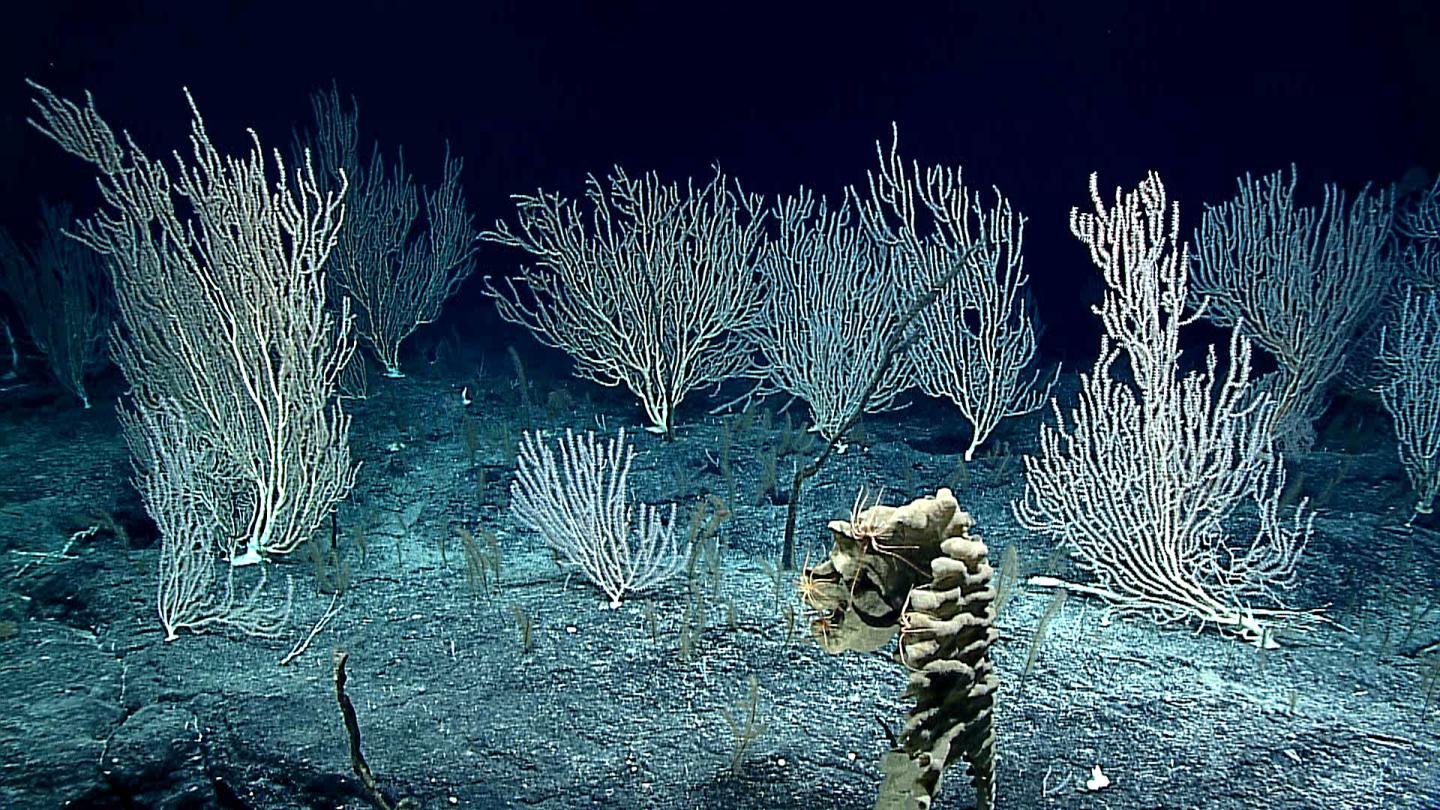
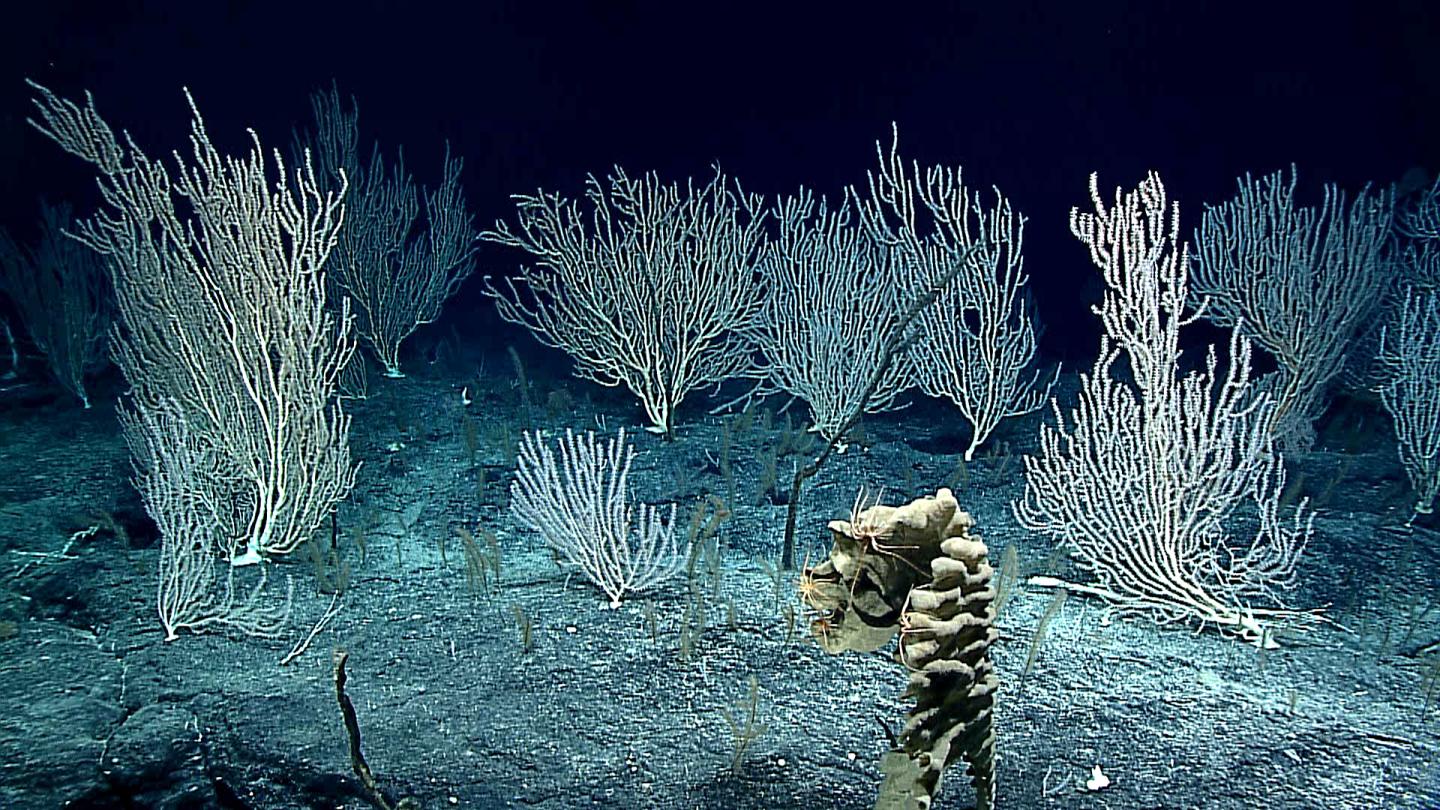
Credit: (NOAA Office of Ocean Exploration and Research, Deepwater Wonders of Wake)
Home to an immense diversity of marine life, the deep ocean also contains valuable minerals with metals such as nickel, copper, cobalt, manganese, zinc, and gold, and rare-earth elements used in electronic technology like smart phones and medical imaging machines. As demand for these resources increases and supplies on land decrease, commercial mining operators are looking to the deep ocean as the next frontier for mining.
What are the risks and environmental impacts of deep-sea mining on fragile marine ecosystems? Would seafloor mineral resources be enough to keep up with the evolving demands of modern society?
A panel of scholars including Stace Beaulieu, a deep-sea biologist at Woods Hole Oceanographic Institution (WHOI), will discuss these and other questions during the symposium, "Should We Mine the Seafloor?" scheduled on Saturday, February 18, at the AAAS meeting in Boston, MA. A news briefing for science journalists will be held at 4 p.m. on Friday, February 17, in room 103 of the Hynes Convention Center.
The speakers will examine the pros and cons of seafloor mining, its engineering feasibility, and its legal and societal implications with the goal of providing the best available, objective, scientific evidence to inform ongoing policy efforts on this important and timely topic.
"Our panel is unique in that we bring together knowledge of the demand for critical metals and the potential supply from known and yet-to-be-discovered seafloor mineral resources, and an understanding of deep-sea ecosystems, including a new perspective on ecosystem services that contribute to human well-being," Beaulieu says.
Currently, there's no mining occurring in the ocean deeper than the continental shelves, but the industry is moving forward quickly. Many of the engineering challenges associated with working in the deep sea have already been addressed by the offshore oil and gas industry. Different types of machines for mining have been built and the components for mining systems are currently being tested in deep-sea deployments.
About 27 countries have already signed contracts to explore for deep-sea resources with the International Seabed Authority (ISA), the organization that controls mineral exploration and exploitation in the area beyond national jurisdiction. And the first deep-sea mining project –Solwara 1 within the jurisdiction of Papua New Guinea–is scheduled to begin in 2019 by Nautilus Minerals.
Beaulieu's talk will address potential environmental impacts from deep-sea mining and highlight new research on the vulnerability and resilience of deep-sea ecosystems. She's also been working with social scientists to address the question of economic impacts from lost and degraded ecosystem services, such as the potential for new medicines from deep-sea, biological resources.
The symposium will also feature talks by experts Thomas Graedel, an industrial ecologist at Yale University, and Mark Hannington, a geologist at GEOMAR-Helmholtz Center for Ocean Research.
Graedel will examine how the demand for metals might evolve in the next few decades. Hannington's talk will focus on estimates of the abundance of seafloor deposits targeted for mining.
The symposium will be moderated by Mindy Todd, a radio producer and journalist at WCAI – The Cape & Islands NPR Station.
###
Should We Mine the Seafloor?
Saturday, Feb. 18, 2017, 8 a.m. -9:30 a.m.
Room 313- Hynes Convention Center
https://aaas.confex.com/aaas/2017/webprogram/Session15154.html
The Woods Hole Oceanographic Institution is a private, non-profit organization on Cape Cod, Mass., dedicated to marine research, engineering, and higher education. Established in 1930 on a recommendation from the National Academy of Sciences, its primary mission is to understand the ocean and its interaction with the Earth as a whole, and to communicate a basic understanding of the ocean's role in the changing global environment. For more information, please visit http://www.whoi.edu.
Media Contact
WHOI Media Relations
[email protected]
508-289-3340
@WHOImedia
############
Story Source: Materials provided by Scienmag