Some of the final work of a late University of Virginia School of Medicine scientist has opened the door for life-saving new treatments for solid cancer tumors, including breast cancer, lung cancer and melanoma.
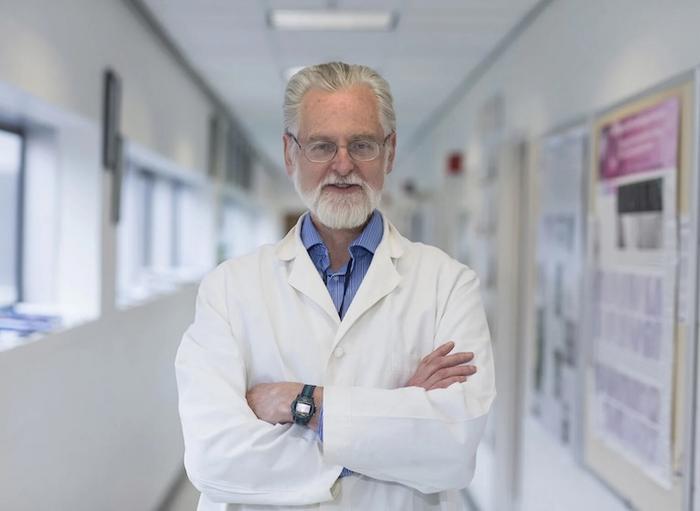
Credit: Dan Addison | UVA Communications
Some of the final work of a late University of Virginia School of Medicine scientist has opened the door for life-saving new treatments for solid cancer tumors, including breast cancer, lung cancer and melanoma.
Prior to his sudden death in 2016, John Herr, PhD, had been collaborating with UVA Cancer Center’s Craig L. Slingluff Jr., MD, to investigate the possibility that a discovery from Herr’s lab could help treat cancer.
Eight years of research has borne that idea out: Herr’s research into the SAS1B protein could lead to “broad and profound” new treatments for multiple cancers, many of which are very difficult to treat, Slingluff reports in a new scientific paper in the Journal for ImmunoTherapy of Cancer. Herr is listed as a senior author on the paper.
“John was very excited about this protein SAS1B to be a valuable new target on human cancers, and I am delighted that our findings together further support his hope to make such a difference,” said Slingluff, a surgical oncologist and translational immunologist at UVA Health and the UVA School of Medicine. “The work we published included work done by Dr. Herr and his team over a period of years, as well as our subsequent work together; so, I am glad that the journal agreed with our request to include John as a senior author.”
Promising New Cancer Target
Herr’s lab was not originally focused on cancer — he was the head of UVA’s Center for Research in Contraceptive and Reproductive Health. In that role, he developed the first home fertility test for men, SpermCheck, which is available in pharmacies across the country. But his discoveries about the SAS1B protein found in developing eggs in women could pave the way for new cancer immunotherapies.
While SAS1B is found inside female reproductive cells called oocytes, it is also found on the surface of many different solid cancer cells, Slingluff’s new research verifies. Importantly, it did not appear on the surface of any of the other normal cells Slingluff’s laboratory tested. That suggests that doctors may be able to develop use antibody-based immunotherapy – such as antibody-drug conjugates or CAR T-cell therapy, a strength of UVA Health – to attack the cancer cells while sparing healthy tissue.
“Selectively targeting SAS1B has the potential to have broad and profound impact on the treatment, and therefore reduction in mortality, of multiple malignancies,” Slingluff and his colleagues write in their new paper.
While much more work needs to be done, the new findings are promising. If the approach is successful, it could be a big step forward in cancer care. Many solid-organ cancers are extremely difficult to treat, and patients often have few good treatment options, Slingluff notes.
“Immune therapy is revolutionizing treatment of human cancers,” Slingluff said. “But some cancers have been particularly resistant to immune therapy because of the lack of good targets on those cancers. We hope that this work that John Herr started will bring new hope to patients with those cancers.”
Finding new ways to improve cancer care is a foundational mission of UVA Cancer Center, one of only 56 cancer centers to receive “comprehensive” designation from the National Cancer Institute. The designation honors elite cancer centers with the most outstanding cancer care and research programs in the country.
Advancing the field of immunotherapy is also a key mission of UVA’s forthcoming Paul and Diane Manning Institute of Biotechnology. Now under construction at Fontaine Research Park, the institute is poised to accelerate the development of new treatments and cures for a wide variety of diseases, ultimately transforming how healthcare is delivered across Virginia and beyond.
About the Research
Slingluff’s collaborators on the new paper consisted of Arabinda Mandal, Jagathpala Shetty, Christine A. Tran, Walter C. Olson, Mriganka Mandal, Bhupal Ban, Eusebio S. Pires, Sara J. Adair and Todd W. Bauer. Herr is also credited on the paper – he and Slingluff are listed as joint senior authors.
The research was supported by the Cancer Research Institute; the Grand Challenges Exploration Program from the Bill and Melinda Gates Foundation; the Wallace H. Coulter Translation Research Partnership Endowment; the Virginia Center for Innovative Technology; the National Cancer Institute, grants P30 CA044579 and T32 CA163177; and by the National Institutes of Health’s National Heart, Lung and Blood Institute, grant T32 HL007849.
UVA has filed patent applications on the use of SAS1B as a cancer drug and diagnostic target. Slingluff has received research support from Celldex, Glaxo-Smith Kline, Merck, 3M and Theraclion, and he receives licensing fees through the UVA Licensing and Ventures Group for patents for peptides used in cancer vaccines. A full list of the authors’ disclosures is included in the paper.
To keep up with the latest medical research news from UVA, subscribe to the Making of Medicine blog at http://makingofmedicine.virginia.edu.
Journal
Journal for ImmunoTherapy of Cancer
DOI
10.1136/jitc-2023-008430