New research on desert isopods’ dietary preferences is the revelation of the complex factors influencing their food choices. By understanding how these animals meticulously regulate their nutrient intake and prefer biological soil crusts over plant litter, the study highlights the intricate dynamics of trophic interactions. Understanding the dietary preferences of desert isopods sheds light on the intricate interplay between organisms and their environment, informing ecosystem management and conservation strategies.
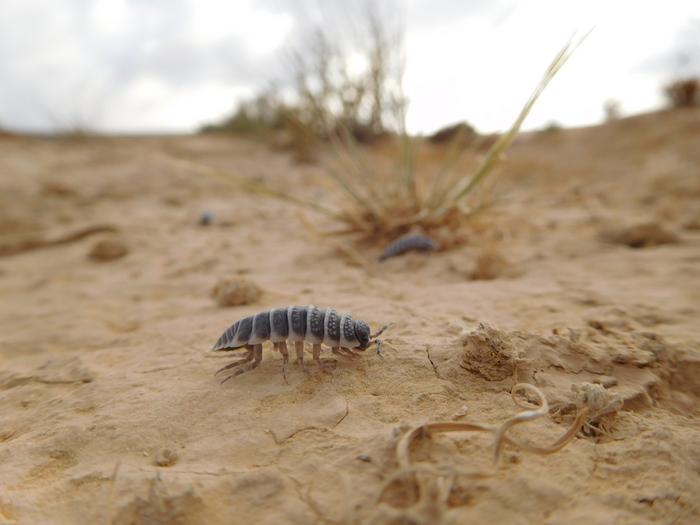
Credit: Moshe Zaguri
New research on desert isopods’ dietary preferences is the revelation of the complex factors influencing their food choices. By understanding how these animals meticulously regulate their nutrient intake and prefer biological soil crusts over plant litter, the study highlights the intricate dynamics of trophic interactions. Understanding the dietary preferences of desert isopods sheds light on the intricate interplay between organisms and their environment, informing ecosystem management and conservation strategies.
New study sheds light on the intricate nutritional and functional dynamics shaping the dietary choices of desert isopods (Hemilepistus reaumuri). The study, published in Ecology Letters unveils the multifaceted considerations that influence food selection among these fascinating creatures. The research was conducted under the guidance of Prof. Dror Hawlena from the Hebrew University by (then PhD. student) Dr. Moshe Zaguri at the Institute of Life Sciences at the Hebrew University and now from the Volcani Institute in collaboration with Prof. David Raubenheimer from the University of Sidney.
Foods are complex mixtures of chemical compounds provided in various levels of digestibility that humans and animals ingest for nutritional support. Often, animals need to ingest several food types in order to fulfill their multidimensional nutritional needs and may suffer health consequences by not eating the needed nutrients in specific quantities and ratio. Understanding what considerations influence dietary choices is, thus, a very important but extremely challenging question to study. The authors’ addressed this challenge by focusing on the simple but mysterious diet of the desert isopods- an interesting species of pill-bug that eats dry leaves and large quantity of nutritionally poor biological soil crust (the upper lair of desert soils that harbor many microorganisms).
The researcher fed isopods with natural and artificial foods and found that when allowing a choice, isopods can tightly regulate their food consumption to meet a very specific ratio of proteins, sugars and calcium. Isopods received most of their proteins and sugars from dry leaves and eat soil crust to meet their very high calcium needs. The exoskeleton of isopods is made of calcium carbonates that they must consume in large quantities to grow. However, when isopods could supplement leaf litter with artificial sources of calcium, they successfully met their exact calcium needs, but suffered reduced growth. The authors used gamma-radiation to kill the microorganisms of the soil crust while maintaining its nutritional value and measured the isopods’ food assimilation efficiency and growth rate in comparison to isopods that ate untreated crust. The authors found that isopods eat the crust to incorporate live microorganisms to their digestive system. Those microbes assisted to improve digestion of the fibrous plant litter. The authors concluded that isopods eat foods that allow them to meet their nutritional needs by providing the nutrients but also by helping them to digest. These revolutionary findings may shed new light on how different animals and humans choose their diet by considering both the foods nutrients and the existence of digestive assisting agents. Humans do not eat soil crust but may think about the general insights of this interesting study during their next visit to the local grocery shop.
Animals optimize their fitness by assimilating specific quantities and ratios of macronutrients and mineral nutrients. To understand this phenomenon, the team conducted extensive field and laboratory experiments focusing on the dietary preferences of desert isopods. Contrary to expectations, wild isopods exhibited a preference for macronutrient-poor biological soil crust (BSC) over plant litter, consuming three times more of the former.
The research revealed that desert isopods rigorously regulate their intake of macronutrients and calcium, with phosphorus intake remaining unaffected. Moreover, the team observed that despite equivalent calcium ingestion, isopods thrived better when consuming BSC compared to artificial foods. Notably, isopods consuming gamma-radiation-sterilized BSC exhibited increased consumption but slower growth rates compared to those consuming live BSC, suggesting the crucial role of ingested microorganisms in facilitating litter digestion.
Dr. Moshe Zaguri, lead researcher of the study, commented, “Our findings underscore the complexity of dietary decision-making among desert isopods and highlight the importance of considering multifaceted factors in understanding trophic interactions.”
Understanding the complex nutritional and functional considerations driving the dietary choices of desert isopods is crucial for advancing our knowledge of ecological dynamics. This research sheds light on how these animals optimize their fitness by regulating nutrient intake and preferring specific food sources. By uncovering the role of ingested microorganisms in facilitating digestion and growth, the study emphasizes the interconnectedness of organisms and their environment. Moreover, it highlights the broader implications for ecosystem management and conservation efforts, underscoring the need for interdisciplinary approaches in ecological research to address the multifaceted factors influencing trophic interactions and ecosystem functioning.
Journal
Ecology Letters
DOI
10.5061/dryad.tdz08kq57
Method of Research
Experimental study
Subject of Research
Animals
Article Title
“Dust you shall eat”: the complex nutritional and functional considerations underlying a simple diet
Article Publication Date
7-Mar-2024