• HOME
  • NEWS
  • EXPLORE
    • CAREER
      • Companies
      • Jobs
    • EVENTS
    • iGEM
      • News
      • Team
    • PHOTOS
    • VIDEO
    • WIKI
  • BLOG
  • COMMUNITY
    • FACEBOOK
    • INSTAGRAM
    • TWITTER
Sunday, May 31, 2026
BIOENGINEER.ORG
No Result
View All Result
  • Login
  • HOME
  • NEWS
  • EXPLORE
    • CAREER
      • Companies
      • Jobs
        • Lecturer
        • PhD Studentship
        • Postdoc
        • Research Assistant
    • EVENTS
    • iGEM
      • News
      • Team
    • PHOTOS
    • VIDEO
    • WIKI
  • BLOG
  • COMMUNITY
    • FACEBOOK
    • INSTAGRAM
    • TWITTER
  • HOME
  • NEWS
  • EXPLORE
    • CAREER
      • Companies
      • Jobs
        • Lecturer
        • PhD Studentship
        • Postdoc
        • Research Assistant
    • EVENTS
    • iGEM
      • News
      • Team
    • PHOTOS
    • VIDEO
    • WIKI
  • BLOG
  • COMMUNITY
    • FACEBOOK
    • INSTAGRAM
    • TWITTER
No Result
View All Result
Bioengineer.org
No Result
View All Result
Home NEWS Science News Chemistry

Photocrosslinking, not Ojak bridge, facilitates transistor functionality

Bioengineer by Bioengineer
May 2, 2024
in Chemistry
Reading Time: 3 mins read
0
A schematic depiction showcasing the Photophore-Anchored Molecular Switch for High-Performance Nonvolatile Organic Memory Transistor
Share on FacebookShare on TwitterShare on LinkedinShare on RedditShare on Telegram

In the tale of the herdsman and the weaver, “Ojak Bridge” stood as a testament to the enduring love between them, crafted by the crow and the magpie. Similarly, in the realm of chemical engineering, functional molecules forge bonds much like the avian duo once did.
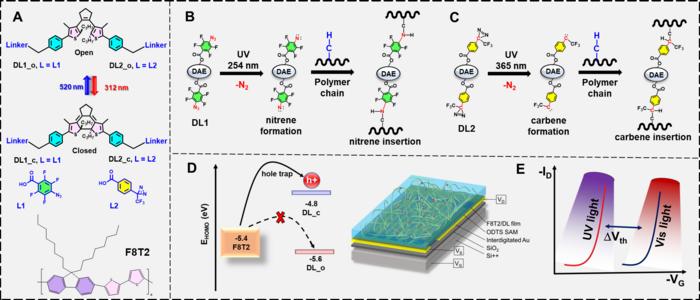
A schematic depiction showcasing the Photophore-Anchored Molecular Switch for High-Performance Nonvolatile Organic Memory Transistor

Credit: POSTECH

In the tale of the herdsman and the weaver, “Ojak Bridge” stood as a testament to the enduring love between them, crafted by the crow and the magpie. Similarly, in the realm of chemical engineering, functional molecules forge bonds much like the avian duo once did.


A research team led by Professor Dae Sung Chung and Dr. Syed Zahid Hassan from the Department of Chemical Engineering at Pohang University of Science and Technology (POSTECH) has developed a memory transistor capable of adjusting its threshold voltage. This innovation combines two molecules that form a stable bond with a polymeric semiconductor, situated at the end of a molecular switch. The research recently featured in the online edition of “Advanced Science,” an international materials science journal.


These molecular switches control electrical signals by leveraging the conversion properties of diverse organic molecular isomers. When integrated into field-effect transistors (FETs), they govern electron flow at the molecular scale. While molecular switch-based FETs have been a key technology for implementing organic FETs (OFETs) in recent years, their longevity has been hampered by the limited ability of the molecules that act as switch molecules to serve as efficient deep traps for capturing and storing electrons within the semiconductor layer.


In this research, the team tackled this challenge by constructing a bridge illuminated by “light.” They pioneered a novel method to establish a “photonic bridge,” a light-triggered chemical linkage between a molecular switch molecule and a polymeric organic semiconductor. At the terminus of the molecular switch, consisting of diarylethene (DAE), the team combined an azide and a diazirine. Under light exposure, these two functional groups forge a chemical connection with the organic polymer semiconductor, stabilizing the typically precarious closed isomer of DAE in a deep-trapped state.


In experimental trials, the OFETs incorporating the team’s DAE compounds demonstrated remarkable endurance, maintaining stable deep-trap states for durations exceeding a million seconds. Furthermore, they showcased exceptional photoprogrammable on-off switching ratios surpassing 1,000 at a voltage of 22 V, alongside outstanding storage performance, enduring stability through more than 100 cycles.


Specifically, the team’s OFETs boast precise patterning through photocrosslinking, enabling meticulous control of the semiconductor layer’s structure. The researchers identified diverse applications for their findings, spanning microelectronics and optoelectronics.


Professor Dae Sung Chung of POSTECH expressed his expectation by saying, “This research unveils fresh prospects in memory transistor realms, impacting data storage and processing technologies profoundly. It holds promise for innovation across a spectrum of disciplines, extending beyond the domain of transistors.”


The research was conducted with support from the BK21 Innovative Chemical Engineering Leadership Program of the National Research Foundation of Korea and a program of Toray Advanced Materials Korea.


Journal

Advanced Science

DOI

10.1002/advs.202401482

Article Title

Photophore-Anchored Molecular Switch for High-Performance Nonvolatile Organic Memory Transistor

Article Publication Date

30-Mar-2024

Share12Tweet8Share2ShareShareShare2

Related Posts

Transforming Microalgae Waste into High-Performance Membranes for Enhanced Municipal Wastewater Treatment — Chemistry

Transforming Microalgae Waste into High-Performance Membranes for Enhanced Municipal Wastewater Treatment

May 29, 2026
Hydrochar Transforms Agricultural Waste into a Potent Solution for Healthier, Carbon-Rich Soils — Chemistry

Hydrochar Transforms Agricultural Waste into a Potent Solution for Healthier, Carbon-Rich Soils

May 29, 2026

FAPESP Aims to Strengthen Scientific Collaboration Between São Paulo and the United Kingdom

May 29, 2026

Mild Ketone-to-Ketyl Conversion Enables Redox-Neutral Coupling

May 29, 2026

POPULAR NEWS

  • ESMO 2025: mRNA COVID Vaccines Enhance Efficacy of Cancer Immunotherapy

    319 shares
    Share 128 Tweet 80
  • Multi-Hospital Study Reveals Long Covid Burden Is Twice as High as Current Estimates

    81 shares
    Share 32 Tweet 20
  • Common Food Preservatives Associated with Elevated Blood Pressure and Increased Heart Disease Risk

    56 shares
    Share 22 Tweet 14
  • AI-Powered Atlas Uncovers Extensive Whole-Body Damage Linked to Obesity

    53 shares
    Share 21 Tweet 13

About

We bring you the latest biotechnology news from best research centers and universities around the world. Check our website.

Follow us

Recent News

Impact of Immigration Restrictions on the US Healthcare Workforce

Study Reveals Cancer Diagnostic Delays Linked to Population-Based Screening Using Cell-Free DNA Multicancer Early Detection Test

Innovative AI Technique Predicts Radiation Dosage Prior to Treatment in Advanced Prostate Cancer

Subscribe to Blog via Email

Success! An email was just sent to confirm your subscription. Please find the email now and click 'Confirm' to start subscribing.

Join 82 other subscribers
  • Contact Us

Bioengineer.org © Copyright 2023 All Rights Reserved.

Welcome Back!

Login to your account below

Forgotten Password?

Retrieve your password

Please enter your username or email address to reset your password.

Log In
No Result
View All Result
  • Homepages
    • Home Page 1
    • Home Page 2
  • News
  • National
  • Business
  • Health
  • Lifestyle
  • Science

Bioengineer.org © Copyright 2023 All Rights Reserved.