Combining time-restricted eating with high-intensity functional training may improve body composition and cardiometabolic parameters more than either alone, according to a study published May 1, 2024 in the open-access journal PLOS ONE by Ranya Ameur and Rami Maaloul from the University of Sfax, Tunisia, and colleagues.
Credit: Ameur et al., 2024, PLOS ONE, CC-BY 4.0 (https://creativecommons.org/licenses/by/4.0/)
Combining time-restricted eating with high-intensity functional training may improve body composition and cardiometabolic parameters more than either alone, according to a study published May 1, 2024 in the open-access journal PLOS ONE by Ranya Ameur and Rami Maaloul from the University of Sfax, Tunisia, and colleagues.
Changes in diet and exercise are well-known ways to lose weight and improve cardiometabolic health. However, finding the right combination of lifestyle changes to produce sustainable results can be challenging. Prior studies indicate that time-restricted eating (which limits when, but not what, individuals eat) and high-intensity functional training (which combines intense aerobic and resistance exercise) may be beneficial and easier for individuals to commit to long term.
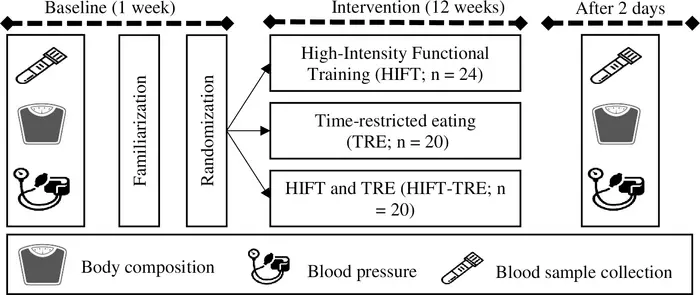
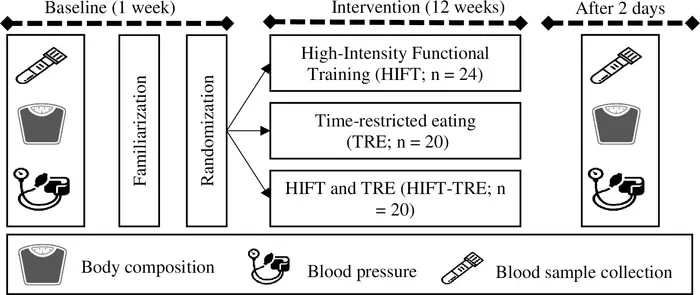
In a new study, researchers investigated the impact of time-restricted eating and high-intensity functional training on body composition and markers of cardiometabolic health such as cholesterol, blood glucose, and lipid levels. 64 women with obesity were assigned to one of three groups: time-restricted eating (diet only), high-intensity functional training (exercise only), or time-restricted eating plus high-intensity functional training (diet + exercise). Participants following the time-restricted eating regimen ate only between 8:00 am and 4:00 pm. Those in the functional training groups worked out three days per week with an instructor.
After 12 weeks, all three groups had significant weight loss and decreases in waist and hip circumference. Likewise, all groups showed favorable changes in lipid and glucose levels.
Some differences were seen between groups. For example, fat-free mass (a combination of lean mass and skeletal muscle mass) and blood pressure improved in the diet + exercise and exercise groups but did not change in the diet-only group.
Participants in the diet + exercise group generally experienced more profound changes in body composition and cardiometabolic parameters than either diet or exercise alone.
The researchers noted that this is a relatively small study, and it is difficult to tease out the contributions of specific exercise routines or of time-restricted eating and calorie reduction since both groups reduced their calorie intake. However, they note that combining time-restricted eating with high-intensity functional training might show promise in improving body composition and cardiometabolic health.
The authors add: “Combining time-restricted eating with High Intensity Functional Training is a promising strategy to improve body composition and cardiometabolic health.”
#####
Author interview: https://plos.io/3xOdYyx
In your coverage please use this URL to provide access to the freely available article in PLOS ONE: https://journals.plos.org/plosone/article?id=10.1371/journal.pone.0301369
Citation: Ameur R, Maaloul R, Tagougui S, Neffati F, Hadj Kacem F, Najjar MF, et al. (2024) Unlocking the power of synergy: High-intensity functional training and early time-restricted eating for transformative changes in body composition and cardiometabolic health in inactive women with obesity. PLoS ONE 19(5): e0301369. https://doi.org/10.1371/journal.pone.0301369
Author Countries: Tunisia, France, Germany
Funding: The authors received no specific funding for this work.
Journal
PLoS ONE
DOI
10.1371/journal.pone.0301369
Method of Research
Experimental study
Subject of Research
People
Article Title
Unlocking the power of synergy: High-intensity functional training and early time-restricted eating for transformative changes in body composition and cardiometabolic health in inactive women with obesity
Article Publication Date
1-May-2024
COI Statement
The authors have declared that no competing interests exist.