• HOME
  • NEWS
  • EXPLORE
    • CAREER
      • Companies
      • Jobs
    • EVENTS
    • iGEM
      • News
      • Team
    • PHOTOS
    • VIDEO
    • WIKI
  • BLOG
  • COMMUNITY
    • FACEBOOK
    • INSTAGRAM
    • TWITTER
Sunday, May 31, 2026
BIOENGINEER.ORG
No Result
View All Result
  • Login
  • HOME
  • NEWS
  • EXPLORE
    • CAREER
      • Companies
      • Jobs
        • Lecturer
        • PhD Studentship
        • Postdoc
        • Research Assistant
    • EVENTS
    • iGEM
      • News
      • Team
    • PHOTOS
    • VIDEO
    • WIKI
  • BLOG
  • COMMUNITY
    • FACEBOOK
    • INSTAGRAM
    • TWITTER
  • HOME
  • NEWS
  • EXPLORE
    • CAREER
      • Companies
      • Jobs
        • Lecturer
        • PhD Studentship
        • Postdoc
        • Research Assistant
    • EVENTS
    • iGEM
      • News
      • Team
    • PHOTOS
    • VIDEO
    • WIKI
  • BLOG
  • COMMUNITY
    • FACEBOOK
    • INSTAGRAM
    • TWITTER
No Result
View All Result
Bioengineer.org
No Result
View All Result
Home NEWS Science News Biology

“Incredible Hulk” lizard provides clues to understanding evolution

Bioengineer by Bioengineer
April 29, 2024
in Biology
Reading Time: 3 mins read
0
“Incredible Hulk” lizard provides clues to understanding evolution
Share on FacebookShare on TwitterShare on LinkedinShare on RedditShare on Telegram

Body shape, colour and behaviour often evolve together as species adapt to their environment. Researchers from Lund University in Sweden have studied this phenomenon in a specific type of large, bright green and aggressive common wall lizard found near the Mediterranean. They discovered that a unique cell type might have played a key role in this joint evolution.
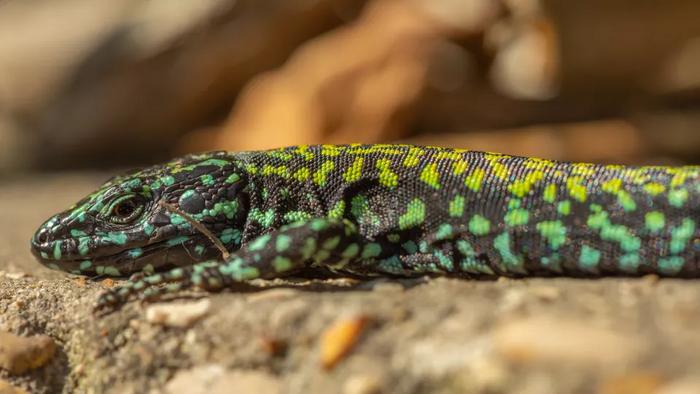
"Hulk" Lizard

Credit: Javier Abalos

Body shape, colour and behaviour often evolve together as species adapt to their environment. Researchers from Lund University in Sweden have studied this phenomenon in a specific type of large, bright green and aggressive common wall lizard found near the Mediterranean. They discovered that a unique cell type might have played a key role in this joint evolution.

Adaptation is a genetic change that results in increased viability in the surrounding environment. It may affect colour, shape and behaviour. However, the basis for how this works genetically has remained shrouded in mystery.

In a new study, evolutionary biologists have combined field work and DNA analysis to study large, green, aggressive and sexually prominent wall lizards in the Mediterranean region. They discovered a number of genes responsible for the lizard’s Hulk-like appearance.

“All tissues and organs that are behind the Hulk-like appearance develop from cells called neural crest cells that form in the early embryo. We believe that the cells that underlie changes in shape, colour and behaviour are regulated together, and that the traits therefore evolve together,” says Nathalie Feiner, evolutionary biologist at Lund University.

The research group investigated a common wall lizard with green and black colouring, impressive body size and aggressive behaviour. Males with this appearance emerged many thousands of years ago, close to present-day Rome, and have shown themselves to be dominant over males with other colour combinations. This has resulted in the Hulk lizards spreading throughout Italy.

“Our knowledge of neural crest cells comes almost entirely from a few model organisms, such as mice. We are now charting this type of cell in lizard embryos in order to understand how phenomena such as the Hulk lizard can evolve,” says Nathalie Feiner.

Over the next few years, Feiner and her team will conduct more field studies, set up breeding groups and undertake advanced genetic analyses, including using the CrispR-Cas9 gene-editing technique. All with the aim of establishing what role neural crest cells play in the intertwined evolution of colour, shape and behaviour.

“Our focus is on lizards, but our discoveries can probably be applied to all animals with neural crest cells, which would cover around 70,000 species of vertebrate. Although our work provides a possible explanation to how evolution works, it is also the beginning of many new areas of research,” she says.

In addition to Lund University, the following higher education institutions and organisations participated in the study: Chengdu Institute of Biology, University of Tasmania, Uppsala Genome Centre.


Journal

Science Advances

DOI

10.1126/sciadv.adk9315

Article Title

Adaptive introgression reveals the genetic basis of a sexually selected syndrome in wall lizards

Article Publication Date

3-Apr-2024

Share12Tweet8Share2ShareShareShare2

Related Posts

Ohio Wall Lizards Overcame Genetic Bottleneck Through Reproduction, Study Finds — Biology

Ohio Wall Lizards Overcame Genetic Bottleneck Through Reproduction, Study Finds

May 29, 2026
Double Agent Unveils Unexpected Revelations — Biology

Double Agent Unveils Unexpected Revelations

May 29, 2026

University of Toronto Scientists Work to Enhance Access to Advanced Research and Biomanufacturing Tools in Resource-Limited Areas

May 29, 2026

CLPTM1L Alters Lipid Rafts to Drive Glioblastoma Progression

May 29, 2026

POPULAR NEWS

  • ESMO 2025: mRNA COVID Vaccines Enhance Efficacy of Cancer Immunotherapy

    319 shares
    Share 128 Tweet 80
  • Multi-Hospital Study Reveals Long Covid Burden Is Twice as High as Current Estimates

    81 shares
    Share 32 Tweet 20
  • Common Food Preservatives Associated with Elevated Blood Pressure and Increased Heart Disease Risk

    56 shares
    Share 22 Tweet 14
  • AI-Powered Atlas Uncovers Extensive Whole-Body Damage Linked to Obesity

    53 shares
    Share 21 Tweet 13

About

We bring you the latest biotechnology news from best research centers and universities around the world. Check our website.

Follow us

Recent News

Impact of Immigration Restrictions on the US Healthcare Workforce

Study Reveals Cancer Diagnostic Delays Linked to Population-Based Screening Using Cell-Free DNA Multicancer Early Detection Test

Innovative AI Technique Predicts Radiation Dosage Prior to Treatment in Advanced Prostate Cancer

Subscribe to Blog via Email

Success! An email was just sent to confirm your subscription. Please find the email now and click 'Confirm' to start subscribing.

Join 82 other subscribers
  • Contact Us

Bioengineer.org © Copyright 2023 All Rights Reserved.

Welcome Back!

Login to your account below

Forgotten Password?

Retrieve your password

Please enter your username or email address to reset your password.

Log In
No Result
View All Result
  • Homepages
    • Home Page 1
    • Home Page 2
  • News
  • National
  • Business
  • Health
  • Lifestyle
  • Science

Bioengineer.org © Copyright 2023 All Rights Reserved.