Due to the changing climate, young herring arrive in the Wadden Sea earlier and earlier in spring. That is shown in a new publication by NIOZ ecologists Mark Rademaker, Myron Peck and Anieke van Leeuwen, in this month’s journal Global Change Biology. “The fact that we were able to demonstrate this, was only due to very consistently, for more than 60 years, and continuously sampling the fish every spring and every fall with exactly the same fyke every time”, Rademaker says. “Recognizing this kind of change requires extreme precision and endurance!”
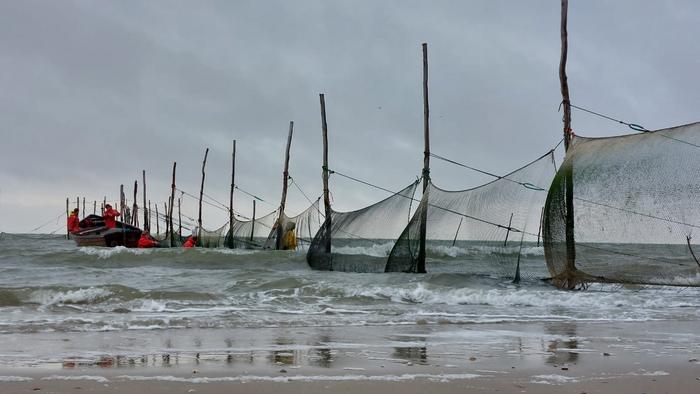
Credit: Robert Twijnstra NIOZ
Due to the changing climate, young herring arrive in the Wadden Sea earlier and earlier in spring. That is shown in a new publication by NIOZ ecologists Mark Rademaker, Myron Peck and Anieke van Leeuwen, in this month’s journal Global Change Biology. “The fact that we were able to demonstrate this, was only due to very consistently, for more than 60 years, and continuously sampling the fish every spring and every fall with exactly the same fyke every time”, Rademaker says. “Recognizing this kind of change requires extreme precision and endurance!”
NIOZ fyke
Since 1960, NIOZ, Royal Netherlands Institute for Sea Research, has been measuring the number and species of fish that swim in the Marsdiep, between Den Helder and Texel, day in and day out using a standard fyke, in spring and fall. These measurements show that the peak of the number of young herring swimming into the Wadden Sea since 1982 comes at least two weeks earlier now. “Such a calculation is difficult with a species of fish that swims in large schools”, Rademaker says. “One day there may be only ten herring, while the next there are suddenly ten thousand fish swimming by. So, if you were to accidentally take a measurement just one day or the other, you would get a completely different picture.”
Extremely consistent measurement
According to Rademaker, the solution to that problem lies in extremely consistent measurement, almost to the square meter. “Only by carrying out measurements in the same place over and over again, and almost continuously, year after year, can you reliably reveal changes in the long term.”
Unique set of data
The research with the ‘NIOZ fyke’ is unique in the world. Most other monitoring programs measure only once or a few times per month or even per quarter, and then often not even at exactly the same spot. Rademaker: “When I projected that frequency from other research programs onto the data from the NIOZ fyke, picking out a few random measurement days, the changes in the timing of the herring did not show up.”
Don’t stare blindly at statistics
The study of the rhythm of young herring in the Wadden Sea, will also be one of the chapters in the dissertation that Rademaker will defend next month at Wageningen University. Just as he was able to fish out the influence of climate on herring from huge data sets, he also did calculations on the long-term sampling of benthic life from the SIBES-program in the Wadden Sea and on measurements of deep-sea squid around the Azores.
Besides making a case for solid long-term research, Rademaker’s dissertation also comes with an important warning for colleagues. “Don’t stare blindly at statistics”, he stresses. “With the help of artificial intelligence, you can sometimes filter out the most amazing trends from huge data sets. But that research is worth nothing if you don’t combine it with experiments and measurements in the field. After all, you also need to have a good theory that can explain what you think you see in the data.”
Journal
Global Change Biology
DOI
10.1111/gcb.17285
Method of Research
Observational study
Subject of Research
Animals
Article Title
Local reflects global: Life-stage dependent changes in the phenology of coastal habitat use by North Sea herring