Chemokines are signalling proteins that orchestrate the interaction of immune cells against pathogens and tumours. To understand this complex network, various techniques have been developed to identify chemokine-producing cells. However, it has not yet been possible to determine which cells react to these chemokines. Researchers at the University Hospital Bonn (UKB) and the University of Bonn have developed a new class of genetically modified mice that enables the simultaneous identification of chemokine producers and sensors. Using the chemokine Ccl3 as a “proof of principle”, they discovered that its function in the immune defence against viruses is different than had been previously assumed. Their results have now been published in the Journal of Experimental Medicine.
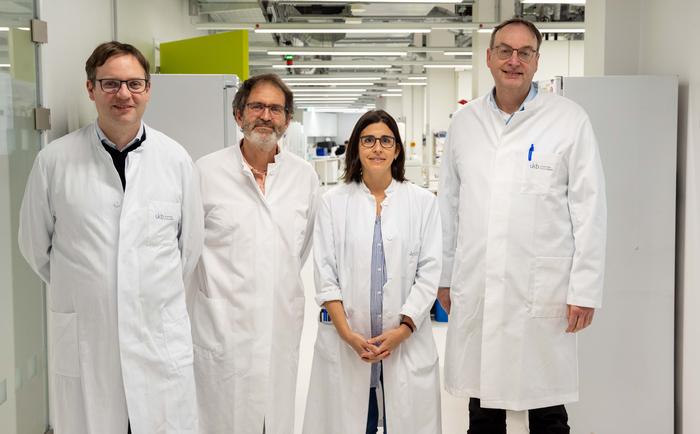
Credit: University Hospital Bonn / Alessandro Winkler
Chemokines are signalling proteins that orchestrate the interaction of immune cells against pathogens and tumours. To understand this complex network, various techniques have been developed to identify chemokine-producing cells. However, it has not yet been possible to determine which cells react to these chemokines. Researchers at the University Hospital Bonn (UKB) and the University of Bonn have developed a new class of genetically modified mice that enables the simultaneous identification of chemokine producers and sensors. Using the chemokine Ccl3 as a “proof of principle”, they discovered that its function in the immune defence against viruses is different than had been previously assumed. Their results have now been published in the Journal of Experimental Medicine.
Our immune response to infections is critically controlled by chemokines. In order to understand how these signalling proteins coordinate immune cells, researchers from Bonn took a closer look at the chemokine Ccl3. Using a novel technology known as Ccl3-EASER mice, they investigated its role in coordinating the immune response to cytomegalovirus (CMV) infection, which can lead to severe diseases in immunocompromised individuals. “Until now, it was thought that certain macrophages, cells which colonize all organs as immune guardians, produce Ccl3 to attract antiviral immune cells,” says co-senior author Prof. Dr. Christian Kurts, Director of the Institute of Molecular Medicine and Experimental Immunology (IMMEI) at the UKB. He is also a member of the Transdisciplinary Research Area 3 (TRA 3) “Life & Health” and the Cluster of Excellence Immunosensation2 at the University of Bonn.
NK cells are both chemokine producers and sensors
“However, we actually found that the natural killer cells – NK cells for short – are the most important Ccl3 producers during CMV infection,” says co-senior author Prof. Dr. Natalio Garbi, research group leader from IMMEI at the UKB. He is also a member of the Cluster of Excellence Immunosensation2 at the University of Bonn. NK cells are white blood cells that can directly destroy virus-infected body cells. The scientists found that NK cells are in a permanent alarm mode to be ready for rapid Ccl3 production. As soon as a viral infection occurs, the body releases type I interferon as an alarm signal. This triggers the NK cells to rapidly produce the chemokine Ccl3. “However, NK cells are not only the cellular source, i.e. the producers of Ccl3, but also the main sensors for the chemokine in this context,” says co-senior author Prof. Dr. Niels A. Lemmermann, research group leader from the Institute of Virology at the UKB and member of the Cluster of Excellence Immunosensation2 at the University of Bonn. This means that Ccl3 acts as an auto/paracrine signal through which NK cells communicate directly with each other and coordinate their antiviral response.
“The experimental strategy used here is completely new. It can also be used for messenger substances other than Ccl3, which are released during various infections, diverse forms of inflammation or cancers,” explains Dr. Maria Belen Rodrigo, first author and scientist at the IMMEI of the UKB. With this work, the Bonn researchers have succeeded in gaining a better understanding of the complex choreography of immune cells in the defence against viruses.
Promotion: The study was funded by the German Research Foundation (DFG) [SFB TRR 237, SFB 1454, SFB 1292/2] and the Cluster of Excellence ImmunoSensation2 of the University of Bonn.
Journal
Journal of Experimental Medicine
DOI
10.1084/jem.20231814
Article Title
Dual fluorescence reporter mice for Ccl3 transcription, translation and intercellular communication
Article Publication Date
25-Apr-2024