• HOME
  • NEWS
  • EXPLORE
    • CAREER
      • Companies
      • Jobs
    • EVENTS
    • iGEM
      • News
      • Team
    • PHOTOS
    • VIDEO
    • WIKI
  • BLOG
  • COMMUNITY
    • FACEBOOK
    • INSTAGRAM
    • TWITTER
Monday, June 1, 2026
BIOENGINEER.ORG
No Result
View All Result
  • Login
  • HOME
  • NEWS
  • EXPLORE
    • CAREER
      • Companies
      • Jobs
        • Lecturer
        • PhD Studentship
        • Postdoc
        • Research Assistant
    • EVENTS
    • iGEM
      • News
      • Team
    • PHOTOS
    • VIDEO
    • WIKI
  • BLOG
  • COMMUNITY
    • FACEBOOK
    • INSTAGRAM
    • TWITTER
  • HOME
  • NEWS
  • EXPLORE
    • CAREER
      • Companies
      • Jobs
        • Lecturer
        • PhD Studentship
        • Postdoc
        • Research Assistant
    • EVENTS
    • iGEM
      • News
      • Team
    • PHOTOS
    • VIDEO
    • WIKI
  • BLOG
  • COMMUNITY
    • FACEBOOK
    • INSTAGRAM
    • TWITTER
No Result
View All Result
Bioengineer.org
No Result
View All Result
Home NEWS Science News Health

Unveiling immune features of heart failure paves the way for targeted therapies

Bioengineer by Bioengineer
April 24, 2024
in Health
Reading Time: 2 mins read
0
Graphical abstract summarizes the workflow and major findings of the study
Share on FacebookShare on TwitterShare on LinkedinShare on RedditShare on Telegram

This study was led by Prof. Xiang Cheng (Department of Cardiology, Union Hospital, Tongji Medical College, Huazhong University of Science and Technology). In this study, researchers employed single-cell RNA sequencing on cardiac immune cells from heart failure patients (ischemic cardiomyopathy and dilated cardiomyopathy) undergoing heart transplantation and from healthy donors. Transcriptomic characteristics associated with heart failure were identified. In addition to the bioinformatics analysis, experimental validations were conducted to further substantiate the reliability of the findings.
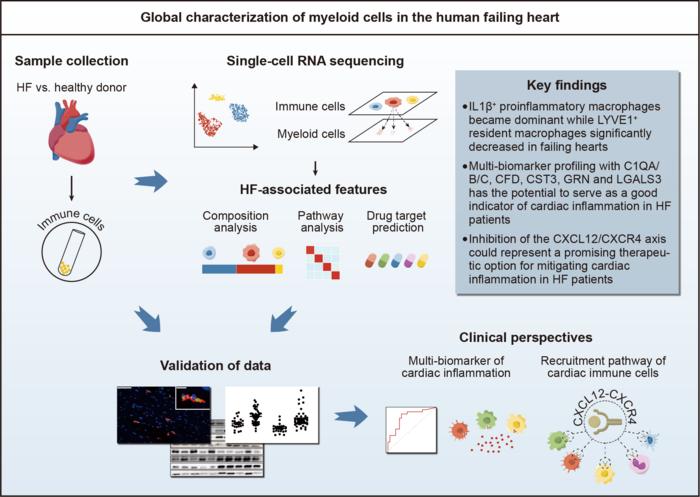
Graphical abstract summarizes the workflow and major findings of the study

Credit: ©Science China Press

This study was led by Prof. Xiang Cheng (Department of Cardiology, Union Hospital, Tongji Medical College, Huazhong University of Science and Technology). In this study, researchers employed single-cell RNA sequencing on cardiac immune cells from heart failure patients (ischemic cardiomyopathy and dilated cardiomyopathy) undergoing heart transplantation and from healthy donors. Transcriptomic characteristics associated with heart failure were identified. In addition to the bioinformatics analysis, experimental validations were conducted to further substantiate the reliability of the findings.

Macrophages emerged as the most abundant immune cells in normal and failing hearts, with differential expression of genes related to tissue residency, inflammation and fibrosis. In normal human hearts, Mac-LYVE1 expressing resident macrophage-associated genes dominated the macrophage population, but their proportion decreased in failing hearts. In contrast, Mac-IL1β, which surged significantly in failing hearts, exhibited high expression of genes linked to proinflammatory and antigen-presenting function.

Heart samples from patients with heart failure are typically unavailable for clinical assessment, posing a challenge to directly evaluating cardiac inflammation. Inflammatory biomarkers signaling cardiac inflammation have emerged as a viable alternative approach. In this study, a multi-biomarker profiling utilizing complement C1q, complement factor D, cystatin C, progranulin, and galectin-3 demonstrated promising potential as reliable indicators of cardiac inflammation in heart failure.

Chemokine receptor analysis plays a crucial role in unraveling the mechanisms of immune cell migration, which is of great significance for immunotherapies. A key finding of this research is the upregulation of CXCR4 in myeloid cell clusters within failing hearts compared to those in normal hearts. The CXCL12/CXCR4 axis potentially orchestrates the recruitment of myeloid cells to failing hearts, highlighting it as a promising therapeutic target for addressing heart failure.

Additionally, drug prediction analysis revealed drugs that potentially target myeloid cell subpopulations associated with heart failure, some of which have demonstrated potential efficacy in impeding the progression of heart failure.

###

See the article:

Global characterization of myeloid cells in the human failing heart

https://doi.org/10.1016/j.scib.2024.03.042


Journal

Science Bulletin

DOI

10.1016/j.scib.2024.03.042
Share12Tweet8Share2ShareShareShare2

Related Posts

Study Reveals Minimal Change in Americans’ Attitudes Toward Political Violence

June 1, 2026

New Study Reveals Body Mass Index Significantly Underestimates Obesity Rates in the U.S.

June 1, 2026

PET Imaging Reveals Whole-Body Metabolic Shifts Following Bariatric Surgery

June 1, 2026

Even Adults with a Normal BMI Can Face Obesity-Related Health Risks

June 1, 2026

POPULAR NEWS

  • ESMO 2025: mRNA COVID Vaccines Enhance Efficacy of Cancer Immunotherapy

    320 shares
    Share 128 Tweet 80
  • Multi-Hospital Study Reveals Long Covid Burden Is Twice as High as Current Estimates

    85 shares
    Share 34 Tweet 21
  • Saying Goodbye to PGY-6: Pediatric Fellowship Realities

    60 shares
    Share 24 Tweet 15
  • Common Food Preservatives Associated with Elevated Blood Pressure and Increased Heart Disease Risk

    57 shares
    Share 23 Tweet 14

About

We bring you the latest biotechnology news from best research centers and universities around the world. Check our website.

Follow us

Recent News

Study Reveals Minimal Change in Americans’ Attitudes Toward Political Violence

New Study Reveals Body Mass Index Significantly Underestimates Obesity Rates in the U.S.

PET Imaging Reveals Whole-Body Metabolic Shifts Following Bariatric Surgery

Subscribe to Blog via Email

Enter your email address to subscribe to this blog and receive notifications of new posts by email.

Join 82 other subscribers
  • Contact Us

Bioengineer.org © Copyright 2023 All Rights Reserved.

Welcome Back!

Login to your account below

Forgotten Password?

Retrieve your password

Please enter your username or email address to reset your password.

Log In
No Result
View All Result
  • Homepages
    • Home Page 1
    • Home Page 2
  • News
  • National
  • Business
  • Health
  • Lifestyle
  • Science

Bioengineer.org © Copyright 2023 All Rights Reserved.