Obesity has become a pressing worldwide health issue, with rates steadily rising over recent decades. Beyond its well-documented associations with physical health issues, such as cardiovascular disease and diabetes, obesity has also been linked to cognitive decline, including conditions like Alzheimer’s disease and Parkinson’s disease. Understanding the complex mechanisms underlying this cognitive impairment is crucial for developing effective interventions.
Credit: Yugo Kato from Shibaura Institute of Technology, Japan.
Obesity has become a pressing worldwide health issue, with rates steadily rising over recent decades. Beyond its well-documented associations with physical health issues, such as cardiovascular disease and diabetes, obesity has also been linked to cognitive decline, including conditions like Alzheimer’s disease and Parkinson’s disease. Understanding the complex mechanisms underlying this cognitive impairment is crucial for developing effective interventions.
In a recent study published online on March 21, 2024, in the International Journal of Molecular Sciences, Assistant Professor Yugo Kato from Tottori University and Shibaura Institute of Technology, along with Professor Koji Fukui from Shibaura Institute of Technology along with their team, offer insights into potential solutions. The study investigated the neuroprotective effects of tocotrienols (T3s) in mitigating the adverse impact of diet-induced obesity on brain function. “Our goal is to combat obesity-related diseases using natural compounds and thereby reduce the prevalence of conditions like dementia among individuals affected by obesity,” says Prof. Kato.
T3s are a group of naturally occurring chemical compounds belonging to the vitamin E family. Past studies have revealed that T3s have neuroprotective and anti-obesity properties. Additionally, they have also been shown to pass through the blood-brain barrier and enter cells to produce antioxidant effects. However, little is known about how T3s contribute to the decline in brain function brought on by obesity.
To address this gap, the team conducted a comprehensive investigation using a mouse model system. They employed a meticulous experimental design, with C57BL/6 male mice subjected to either a high-fat, high-sucrose diet (HFSD) or a control diet, supplemented with or without T3s.
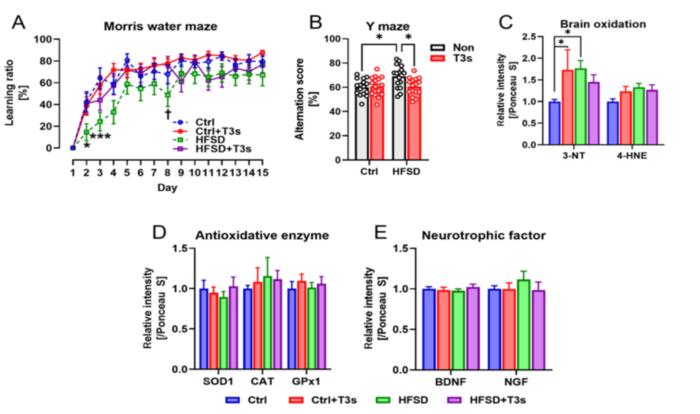
In the initial phase of the study, the team evaluated the anti-obesity effects of T3s. To do so, they incorporated a 50mg T3s mixture into 100g of both experimental diets, namely the control and HFSD. Key parameters, including body weight, fat deposition, serum cholesterol, triglyceride, and glucose concentrations, were assessed alongside cognitive function using the Morris water maze and Y-maze tests. Additionally, markers of oxidative stress and proteomic changes in the cortex were analyzed to gain deeper insights into the underlying mechanisms.
The results of the study were highly promising. While HFSD feeding induced obesity in the mice, supplementation with T3s did not mitigate weight gain. However, T3s treatment demonstrated a significant improvement in cognitive function, as evidenced by enhanced learning ability in HFSD-fed mice. Furthermore, the study revealed the role of oxidative stress in obesity-induced cognitive decline, with HFSD-fed mice exhibiting increased brain oxidation levels. Remarkably, T3s treatment appeared to mitigate this oxidative stress, suggesting a potential mechanism for their neuroprotective effects. Additionally, contrary to expectations, the team found that respiratory metabolism decreased and the temperature around brown adipose tissue increased in mice fed with HFSD. This unexpected finding suggests that HFSD may have a complex impact on metabolic processes and temperature regulation in the body.
“Lastly, we wanted to examine the protein change associated with the consumption of the HFSD. So, we performed a quantitative proteomic analysis of the mouse cortex. Our focus was on the proteins that were expressed differently between the HFSD and control groups,” explains Prof. Kato. They discovered that, in comparison to the control group, obesity brought on by HFSD feeding changed 12 proteins, and mice treated with T3s showed considerable prevention of these changes.
In conclusion, this groundbreaking study represents a significant step forward in our understanding of the intricate relationship between obesity and cognitive decline. By uncovering the potential benefits of T3s in preserving cognitive function, the research opens up new avenues for therapeutic interventions targeting neurodegenerative diseases associated with obesity.
***
Reference
Title of original paper: Tocotrienols Prevent the Decline of Learning Ability in High-Fat, High-Sucrose Diet-Fed C57BL/6 Mice
Journal: International Journal of Molecular Sciences
DOI: https://doi.org/10.3390/ijms25063561
About Shibaura Institute of Technology (SIT), Japan
Shibaura Institute of Technology (SIT) is a private university with campuses in Tokyo and Saitama. Since the establishment of its predecessor, Tokyo Higher School of Industry and Commerce, in 1927, it has maintained “learning through practice” as its philosophy in the education of engineers. SIT was the only private science and engineering university selected for the Top Global University Project sponsored by the Ministry of Education, Culture, Sports, Science and Technology and will receive support from the ministry for 10 years starting from the 2014 academic year. Its motto, “Nurturing engineers who learn from society and contribute to society,” reflects its mission of fostering scientists and engineers who can contribute to the sustainable growth of the world by exposing their over 8,000 students to culturally diverse environments, where they learn to cope, collaborate, and relate with fellow students from around the world.
Website: https://www.shibaura-it.ac.jp/en/
About Professor Koji Fukui from SIT, Japan
Dr. Koji Fukui is currently a Professor at Shibaura Institute of Technology, Japan. He has 24 years of research experience and has published over 87 scientific articles. Professor Fukui’s research mainly explores the relationship between oxidative damage and brain aging, as well as, the protective effects of antioxidants in the brain and body. He obtained his Ph.D. from Shibaura Institute of Technology in 2003 and has since worked at various research institutes such as Wakayama Medical University, Hokkaido University and National Institute on Aging.
About Assistant Professor Yugo Kato from Tottori University, Japan
Prof. Yugo Kato is currently an Assistant Professor at Department of Pathophysiological and Therapeutic Science ,Tottori University, Japan and obtained his Ph.D. in Biochemistry from Shibaura Institute of Technology, following his undergraduate studies in Bioscience and Engineering at the same institution. With a diverse career spanning academia and research, Prof. Kato has made significant contributions to the field. He has been recognized with prestigious awards, including the Young Investigator Excellent Abstract Award at the 22nd International Congress of Nutrition and the SFRR JAPAN Young Investigator Award. Prof. Kato has authored 22 papers in reputed journals, showcasing his expertise in biochemistry and related disciplines.
Funding Information
This research received no external funding.
Journal
International Journal of Molecular Sciences
DOI
10.3390/ijms25063561
Method of Research
Experimental study
Subject of Research
Animals
Article Title
Tocotrienols Prevent the Decline of Learning Ability in High-Fat, High-Sucrose Diet-Fed C57BL/6 Mice
Article Publication Date
21-Mar-2024
COI Statement
The authors have no conflicts of interest.