A new study shows that ocean acidification is changing the mix of microbes in coral reef systems, which can be used to assess ecosystem health.
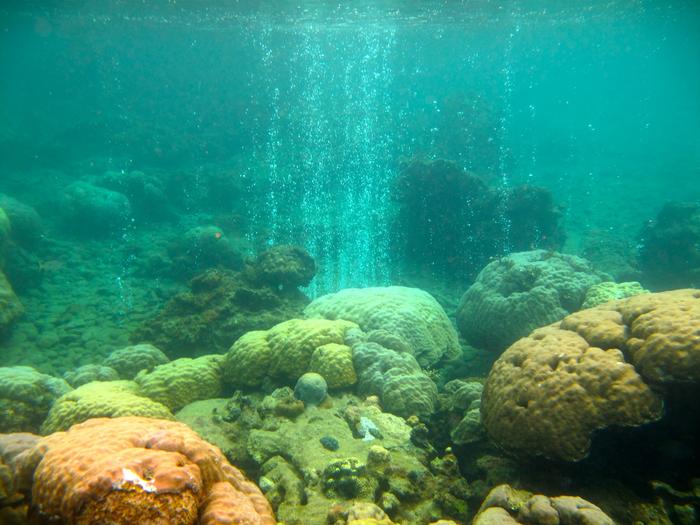
Credit: Emma Ransome / Imperial College London
A new study shows that ocean acidification is changing the mix of microbes in coral reef systems, which can be used to assess ecosystem health.
The study, published today in Microbiome, looked at coral reefs specifically, but the researchers say it could be widely applicable as a method for measuring how ecosystems are responding to human activities.
Understanding how ecosystems are changing in response to human activity allows predictions of their future, and how to conserve them. Although microbes are crucial for ecosystems – supporting critical functions such as nutrition and immune system modulation – changes in microbial communities are rarely measured when assessing ecosystem health.
The team, led by Imperial College London researchers, tested whether measuring changes across the whole community of larger (macro) organisms and microbes together could provide a novel measurement of stress on coral reefs. In these ecosystems, microbes are particularly important and live not only on the macro-organisms, but also in the surrounding sediment and water.
Coral and carbon dioxide
Some reefs grow near natural carbon dioxide (CO2) vents on the ocean floor, which can be used to understand the response of reefs to future oceanic CO2 conditions, and resultant acidification, caused by human activities. The researchers visited such CO2 vents in Papua New Guinea and used Autonomous Reef Monitoring Structures (ARMS) to collect samples of organisms and sediments from areas of varying CO2.
They used genetic sequencing and mass spectrometry to determine the microbes and metabolites (small molecules produced by organisms that have various ecological functions) present in each sample.
They found that as the amount of CO2 in the ocean increased, the microbes and metabolites found in the community of reef macro-organisms became more similar to those in the sediment, referred to as a decline in ‘holobiont community distinctness’.
The findings suggest that the way microbial communities hosted by macro-organisms change could be used as early indicator of ecosystem stress. They also highlight the importance of taking an ‘ecosystem approach’ to understanding the impact of human stressors.
Ecosystem stress
The new result is only for one ecosystem under one source of stress (acidification), so the team are now testing this approach across more than 80 reef sites around the world that are subject to varying human pressures.
First author Jake Williams, from the Department of Life Sciences at Imperial and ZSL’s Institute of Zoology, said: “Intensifying human activity and the climate crisis are increasing stress on ecosystems across the globe. But we lack general and robust ways of monitoring this stress and how ecosystems are responding.
“Our findings suggest the possibility of developing such general and robust metrics based on the relationships between microbes and chemicals inside and outside organisms. Ideally, these metrics shouldn’t depend on what type of ecosystem you are looking at, but be applicable in every system from coral reefs to rainforests.”
Lead researcher Dr Emma Ransome, from the Department of Life Sciences at Imperial, added: “A holistic approach is needed to accurately evaluate and predict impacts on coral reefs. Microbes are a vastly important and overlooked component of all of our ecosystems and a crucial tool for understanding environmental outcomes and achieving an environmentally sustainable future.”
Journal
Microbiome
DOI
10.1186/s40168-023-01683-y
Article Title
Decline of a distinct coral reef holobiont community under ocean acidification
Article Publication Date
17-Apr-2024