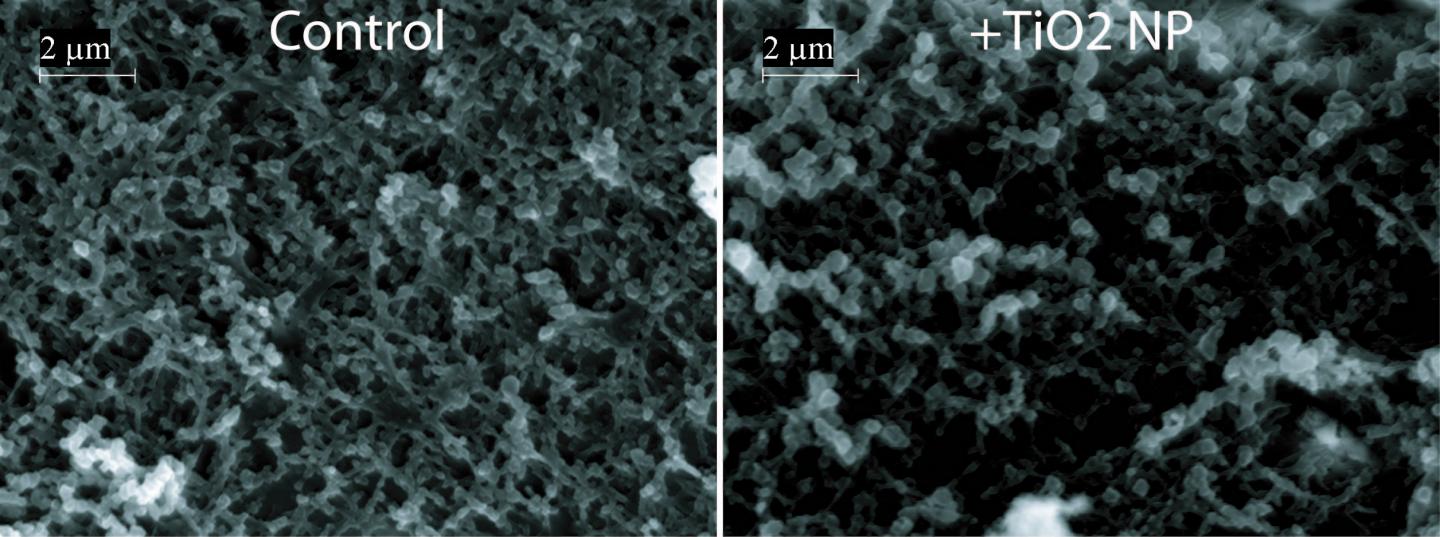
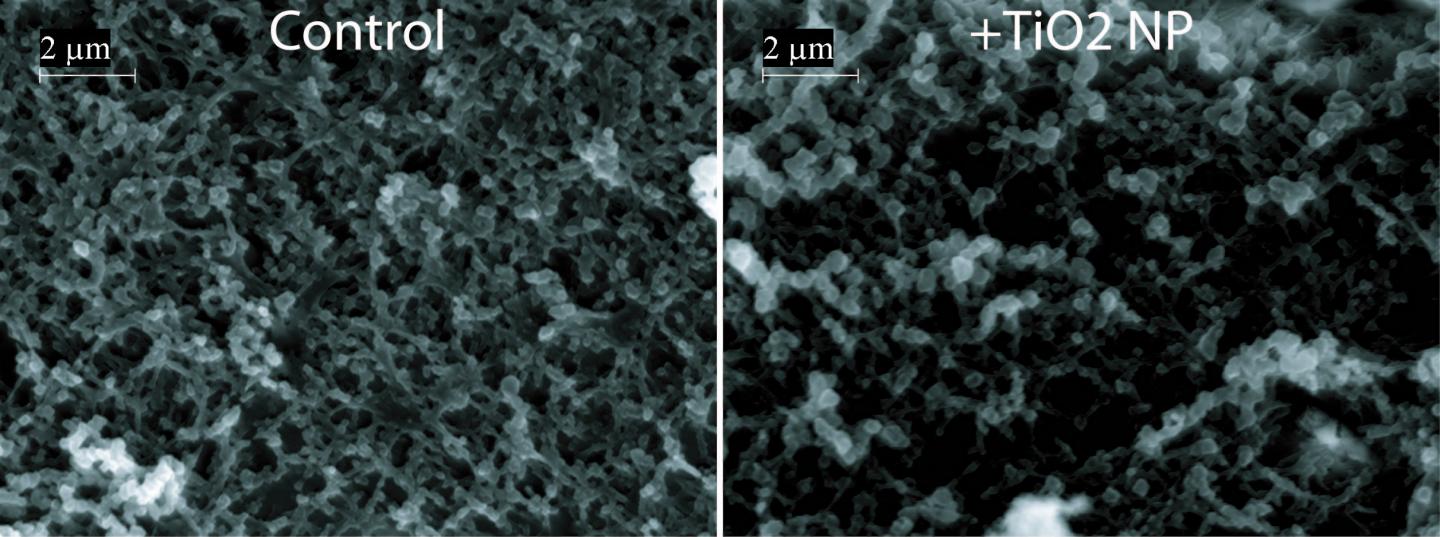
Credit: Gretchen Mahler
BINGHAMTON, NY – The ability of small intestine cells to absorb nutrients and act as a barrier to pathogens is "significantly decreased" after chronic exposure to nanoparticles of titanium dioxide, a common food additive found in everything from chewing gum to bread, according to research from Binghamton University, State University of New York.
Researchers exposed a small intestinal cell culture model to the physiological equivalent of a meal's worth of titanium oxide nanoparticles–30 nanometers across–over four hours (acute exposure), or three meal's worth over five days (chronic exposure).
Acute exposures did not have much effect, but chronic exposure diminished the absorptive projections on the surface of intestinal cells called microvilli. With fewer microvilli, the intestinal barrier was weakened, metabolism slowed and some nutrients–iron, zinc, and fatty acids, specifically–were more difficult to absorb. Enzyme functions were negatively affected, while inflammation signals increased.
"Titanium oxide is a common food additive and people have been eating a lot of it for a long time–don't worry, it won't kill you!–but we were interested in some of the subtle effects, and we think people should know about them," said Biomedical Engineering Assistant Professor Gretchen Mahler, one of the authors of the paper.
"There has been previous work on how titanium oxide nanoparticles affects microvilli, but we are looking at much lower concentrations," Mahler said. "We also extended previous work to show that these nanoparticles alter intestinal function."
Titanium dioxide is generally recognized as safe by the U.S. Food and Drug Administration, and ingestion is nearly unavoidable. The compound is an inert and insoluble material that is commonly used for white pigmentation in paints, paper and plastics. It is also an active ingredient in mineral-based sunscreens for pigmentation to block ultraviolet light.
However, it can enter the digestive system through toothpastes, as titanium dioxide is used to create abrasion needed for cleaning. The oxide is also used in some chocolate to give it a smooth texture; in donuts to provide color; and in skimmed milks for a brighter, more opaque appearance which makes the milk more palatable.
A 2012 Arizona State University study tested 89 common food products including gum, Twinkies, and mayonnaise and found that they all contained titanium dioxide. About five percent of products in that study contained titanium dioxide as nanoparticles. Dunkin Donuts stopped using powdered sugar with titanium dioxide nanoparticles in 2015 in response to pressure from the advocacy group As You Sow.
"To avoid foods rich in titanium oxide nanoparticles you should avoid processed foods, and especially candy. That is where you see a lot of nanoparticles," Mahler said.
###
The paper, "Titanium dioxide nanoparticle ingestion alters nutrient absorption in an in vitro model of the small intestine," was published in NanoImpact. Biomedical Engineering Teaching Assistant and current graduate student Zhongyuan Guo was the lead author of the study, while Nicole J. Martucci '16, current Binghamton graduate student Fabiola Moreno-Olivas, and Elad Tako from the Plant, Soil and Nutrition Laboratory for Agricultural Research Services within the U.S. Department of Agriculture in Ithaca, N.Y. were all co-authors.
The research was supported by grants from the Binghamton University Research Foundation, the National Institutes of Health and the CONACYT Fellowship.
Media Contact
Gretchen Mahler
[email protected]
607-777-5238
@binghamtonu
http://www.binghamton.edu
############
Story Source: Materials provided by Scienmag