


Embargo: This journal article is under embargo until April 15 at 10 a.m. BST/London (5 a.m. EDT/3 a.m. MDT). Media may conduct interviews around the findings in advance of that date, but the information may not be published, broadcast, or posted online until after the release window. Journalists are permitted to show papers to independent specialists under embargo conditions, solely for the purpose of commenting on the work described
University researchers have shown that a transition to green wastewater-treatment approaches in the U.S. that leverages the potential of carbon-financing could save a staggering $15.6 billion and just under 30 million tonnes of CO2-equivalent emissions over 40 years.
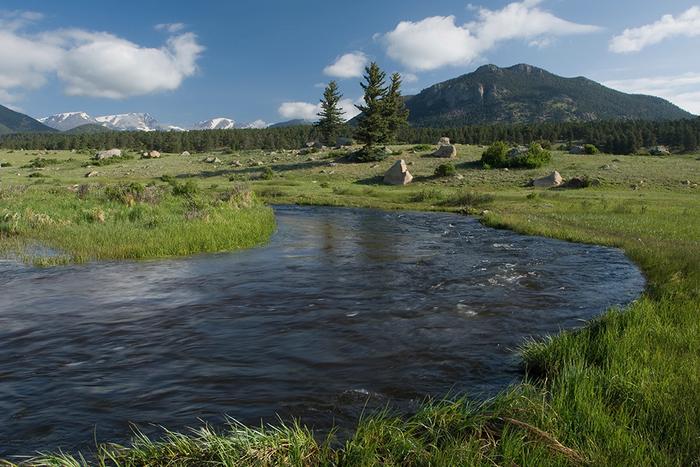
Credit: The Big Thompson River in Rocky Mountain National Park. Please credit Colorado State University.
Embargo: This journal article is under embargo until April 15 at 10 a.m. BST/London (5 a.m. EDT/3 a.m. MDT). Media may conduct interviews around the findings in advance of that date, but the information may not be published, broadcast, or posted online until after the release window. Journalists are permitted to show papers to independent specialists under embargo conditions, solely for the purpose of commenting on the work described
University researchers have shown that a transition to green wastewater-treatment approaches in the U.S. that leverages the potential of carbon-financing could save a staggering $15.6 billion and just under 30 million tonnes of CO2-equivalent emissions over 40 years.
The comprehensive findings from Colorado State University were highlighted in Nature Communications Earth and Environment in a first-of-its-kind study. The work from the Walter Scott, Jr. College of Engineering explores the potential economic tradeoffs of switching to green infrastructure and technology solutions that go beyond existing grey-water treatment practices. Built off data collected at over 22,000 facilities, the report provides comprehensive baseline metrics and explores the relationship among emissions, costs and treatment capabilities for utility operators and decision makers.
Braden Limb is the first author on the paper and a Ph.D. student in the Department of Systems Engineering. He also serves as a research associate in the Department of Mechanical Engineering. He said the findings are a key initial step to categorize and understand potential green solutions for wastewater.
“These findings draw a line in the sand that shows what the potential for adopting green approaches in this space is – both in terms of money saved and total emissions reduced,” he said. “It is a starting point to understand what routes are available to us now and how financing strategies can elevate water treatment from a somewhat local issue into something that is addressed globally through market incentives.”
The research was completed in partnership with the University of Colorado Boulder and Brigham Young University. Findings center around both point-source water treatment and non-point sources of water pollution.
Traditional point-source water treatment facilities such as sewage plants remove problem nutrients like nitrogen and phosphorus before releasing water back into circulation. This grey-infrastructure system – as it is known – is monitored by the Environmental Protection Agency. However, regulation standards may tighten in the future, and facilities would need more power, and in turn more emissions, to reach newly allowable thresholds. Existing facilities already account for 2% of all energy use in the U.S. and 45 million tonnes of CO2 emissions, said Limb.
Another significant source of freshwater contamination in the U.S. comes from non-point source activity such as fertilizer runoff from agriculture entering rivers. Other non-point sources of pollution can come from wildfires – aided by climate change – or urban development, for example.
Limb said that rather than building more grey-infrastructure treatment facilities to address those increasing sources, the paper explores green approaches financed through carbon markets that can tackle both types simultaneously.
“There could be a switch to nature-based solutions such as constructing wetlands or reforestation instead of building yet another treatment facility,” he said. “Those options could sequester over 4.2 million carbon dioxide emissions per year over a 40-year time horizon and have other complementary benefits we should be aiming for, such as cheaper overall costs.”
Carbon financing is a mechanism aimed at mitigating climate change by incentivizing activities that reduce emissions or sequester them from the atmosphere. Companies voluntarily buy “credits” on an open market that represent a reduction or removal of carbon from the atmosphere that can be accomplished in a variety of ways. That credit offsets the institution’s emissions from operations as it aims to reach sustainability goals.
These trades incentivize development of sustainable activities and can also provide a source of fresh money to further develop or scale up new approaches.
While there are similar financing markets for water, the problem is initially more localized than it is for air quality and carbon. That dynamic has limited the value of water market trades in the past. The paper suggests that these existing markets could be improved, and that the carbon markets could also be leveraged to change some of the financial incentives farmers have around water treatment and impacts from their activity.
The researchers found that using the markets could generate $679 million annually in revenue, representing an opportunity to further motivate green infrastructure solutions within water quality trading programs to meet regulated standards.
Mechanical Engineering Professor Jason Quinn is a co-author on the study. He said the findings have some limitations, but that this was an important first step to model both the problem and opportunity available now. He said the results in the paper have supported new research at CSU with the National Science Foundation to further develop the needed carbon credit methodology with stakeholders.
“This is the first time we are considering air and water quality simultaneously – water is local and carbon is global,” he said. “But by bringing these market mechanisms together we can capitalize on a window of opportunity to accelerate the improvement of America’s rivers as we transition to a renewable energy and restored watershed future.”
Journal
Communications Earth & Environment
DOI
10.1038/s43247-024-01359-x
Article Title
The potential of carbon markets to accelerate green infrastructure based water quality trading
Article Publication Date
15-Apr-2024

![Tuning Endergonic Triplet Photosensitization Enables Bicyclo[1.1.0]butane–Alkene Cycloadditions](https://bioengineer.org/wp-content/uploads/2026/08/Tuning-Endergonic-Triplet-Photosensitization-Enables-Bicyclo110butane–Alkene-Cycloadditions-120x86.jpg)
