


RIVERSIDE, Calif. — Last September, the James Webb Space Telescope, or JWST, discovered JWST-ER1g, a massive ancient galaxy that formed when the universe was just a quarter of its current age. Surprisingly, an Einstein ring is associated with this galaxy. That’s because JWST-ER1g acts as a lens and bends light from a distant source, which then appears as a ring — a phenomenon called strong gravitational lensing, predicted in Einstein’s theory of general relativity.
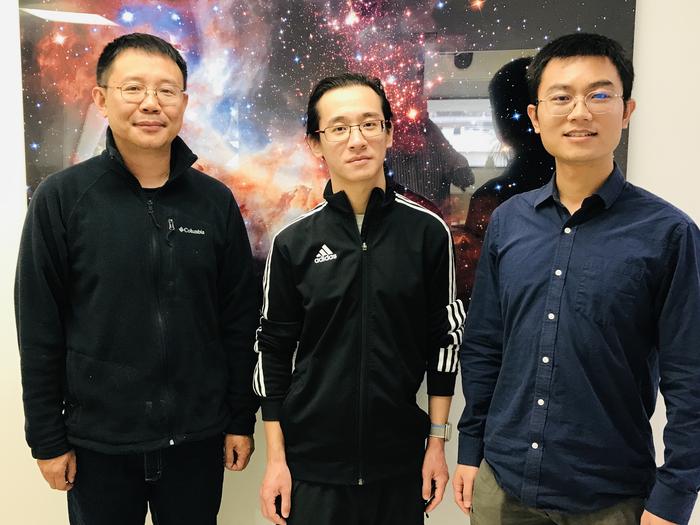
Credit: Hai-Bo Yu, UC Riverside.
RIVERSIDE, Calif. — Last September, the James Webb Space Telescope, or JWST, discovered JWST-ER1g, a massive ancient galaxy that formed when the universe was just a quarter of its current age. Surprisingly, an Einstein ring is associated with this galaxy. That’s because JWST-ER1g acts as a lens and bends light from a distant source, which then appears as a ring — a phenomenon called strong gravitational lensing, predicted in Einstein’s theory of general relativity.
The total mass enclosed within the ring has two components: stellar and dark matter components.
“If we subtract the stellar mass from the total mass, we get the dark matter mass within the ring,” said Hai-Bo Yu, a professor of physics and astronomy at the University of California, Riverside, whose team has published new work about JWST-ER1g in the journal The Astrophysical Journal Letters. “But the value for the dark matter mass seems higher than expected. This is puzzling. In our paper, we offer an explanation.”
A dark matter halo is the halo of invisible matter that permeates and surrounds a galaxy like JWST-ER1g. Although dark matter has never been detected in laboratories, physicists are confident dark matter, which makes up 85% of the universe’s matter, exists.
“When ordinary matter — pristine gas and stars — collapses and condenses into the dark matter halo of JWST-ER1g, it may be compressing the halo, leading to a high density,” said Demao Kong, a second-year graduate student at UCR, who led the analysis. “Our numerical studies show that this mechanism can explain the high dark matter density of JWST-ER1g — more dark matter mass in the same volume, resulting in higher density.”
According to Daneng Yang, a postdoctoral researcher at UCR and co-author on the paper, JWST-ER1g, formed 3.4 billion years after the Big Bang, provides “a great chance to learn about dark matter.”
“This strong lensing object is unique because it has a perfect Einstein ring, from which we can obtain valuable information about the total mass within the ring, a critical step for testing dark matter properties,” he said.
Launched on Christmas Day in 2021, NASA’s JWST is an orbiting infrared observatory. Also called Webb, it is designed to answer questions about the universe. It is the largest, most complex, and powerful space telescope ever built.
“JWST provides an unprecedented opportunity for us to observe ancient galaxies formed when the universe was young,” Yu said. “We expect to see more surprises from JWST and learn more about dark matter soon.”
The study was supported by the John Templeton Foundation and the U.S. Department of Energy.
The title of the open access research paper is “Cold Dark Matter and Self-interacting Dark Matter Interpretations of the Strong Gravitational Lensing Object JWST-ER1.”
The University of California, Riverside is a doctoral research university, a living laboratory for groundbreaking exploration of issues critical to Inland Southern California, the state and communities around the world. Reflecting California’s diverse culture, UCR’s enrollment is more than 26,000 students. The campus opened a medical school in 2013 and has reached the heart of the Coachella Valley by way of the UCR Palm Desert Center. The campus has an annual impact of more than $2.7 billion on the U.S. economy. To learn more, visit www.ucr.edu.
Journal
The Astrophysical Journal Letters
DOI
10.3847/2041-8213/ad394b
Method of Research
Observational study
Subject of Research
Not applicable
Article Title
Cold Dark Matter and Self-interacting Dark Matter Interpretations of the Strong Gravitational Lensing Object JWST-ER1
Article Publication Date
11-Apr-2024
COI Statement
No conflict.

![Tuning Endergonic Triplet Photosensitization Enables Bicyclo[1.1.0]butane–Alkene Cycloadditions](https://bioengineer.org/wp-content/uploads/2026/08/Tuning-Endergonic-Triplet-Photosensitization-Enables-Bicyclo110butane–Alkene-Cycloadditions-120x86.jpg)
