The ERC awards the work of Professor Grohmann and his team in its Universe Sciences panel. “I congratulate Professor Steffen Grohmann on this grant. The selection of a technology development project in the area of astronomy and astrophysics is remarkable. It reflects the importance of this research and development at KIT for the Einstein Telescope and its significance for gravitational-wave physics and the Universe sciences in general,” says KIT Vice President Research Professor Oliver Kraft.
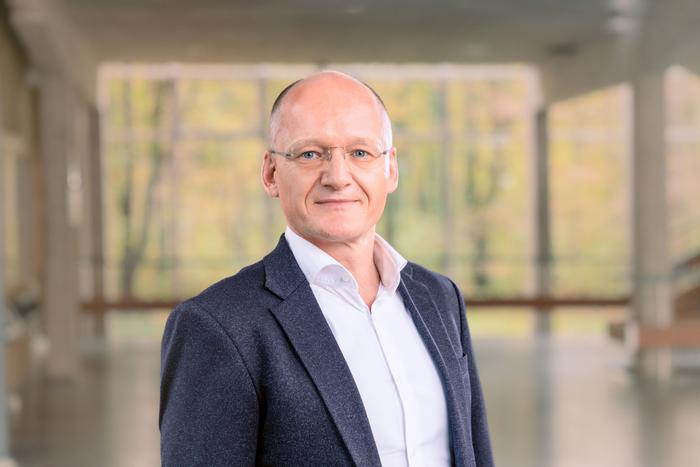
Credit: Amadeus Bramsiepe, KIT
The ERC awards the work of Professor Grohmann and his team in its Universe Sciences panel. “I congratulate Professor Steffen Grohmann on this grant. The selection of a technology development project in the area of astronomy and astrophysics is remarkable. It reflects the importance of this research and development at KIT for the Einstein Telescope and its significance for gravitational-wave physics and the Universe sciences in general,” says KIT Vice President Research Professor Oliver Kraft.
Concept Shall Enable Measurements of Highest Precision
The Einstein Telescope is a proposed European project to construct an underground laser interferometer with several kilometer long dimensions. In this measurement principle, gravitational waves from the depth of the Universe will cause by the curvature in spacetime tiny changes of the distances between measurement mirrors of about 200 kg, which reflect the laser beams.
Extreme Cold Prevents Disturbing Noise
For this purpose, the mirrors must be isolated from any vibration and external impact. They are installed in several meters high vacuum towers, suspended from fine crystal fiber at the lower ends of multi-stage pendula. “When taking measurements at such limits, the noise of Brownian molecular motion in the crystal fibers at room-temperature is already sufficient to disturb the detection,” Grohmann explains. “This thermal noise can be prevented by extremely low temperatures only. The difficulty is to cool the mirrors without any mechanical impact and technical noise input.” The researchers from KIT plan to achieve this with superfluid helium at temperatures of about -271 °C, i.e. just above absolute zero. In this state, helium as a Bose-Einstein condensate has outstanding properties: Quantum effects yield the formation of an extremely quiet superfluid without viscosity, in which heat flows with almost no resistance similar to electricity in a superconductor.
Test Center Will Be Set Up
The principle has already been proven theoretically by Grohmann’s team. A new question in science is, however, whether and how energy from mechanical vibrations dissipates in the quantum fluid, i.e. being converted into heat. GRAVITHELIUM is expected to provide such experimental data. With the help of the ERC Advanced Grant, a new test center will be set up at KIT, where the researchers will collect fundamental physical data and resolve technical challenges for the practical application.
“The project will not only contribute to realizing the Einstein Telescope. The technology may also be applied in quantum computing, where smallest vibrations influence quantum states,” Grohmann says.
At KIT, the project is embedded in the Helmholtz Research Programs “Matter and the Universe“ and “Matter and Technology“ as well as in the KIT Elementary Particle and Astroparticle Physics Center (KCETA).
ERC Advanced Grants 2023
ERC Advanced Grants support established researchers in various areas of research, who have a track record of significant research achievements in the past ten years. Funding will help leading researchers open up new areas of research. In the competition of 2023, 1829 researchers applied for funding, of these about 14 percent were successful. The ERC decided to award advanced grants in a total volume of EUR 652 million to 255 research projects.
Further information on the ERC Advanced Grants
More Information